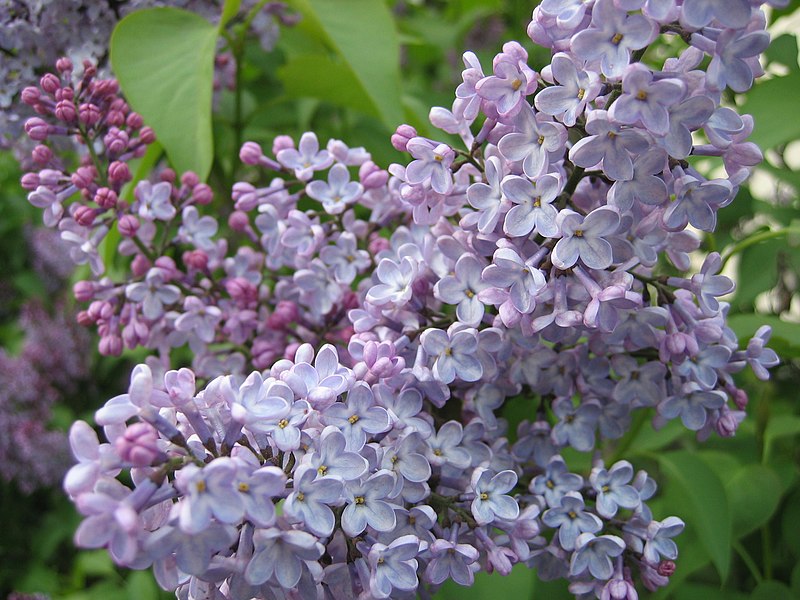
File:Stockholm-lilac.jpg · Wikimedia Commons · See Wikimedia Commons
Syringa
Sign in to saveAlso known as Lilac
Syringa is a genus of 12 currently recognized species of flowering woody plants in the olive family called lilacs. They are native to woodland and scrub from southeastern Europe to eastern Asia, and widely and commonly cultivated in temperate areas elsewhere.
Syringa is a group of 12 flowering shrubs and small trees in the olive family, commonly known as lilacs, that produce fragrant blooms and are native to woodlands across Europe and Asia. These plants are popular ornamentals grown in temperate gardens worldwide because of their attractive flowers and hardiness.
AI-generated from the Wikipedia summary — may contain errors.
Species
common lilac
Syringa
GENUS
- KingdomPlantae
- PhylumTracheophyta
- ClassMagnoliopsida
- OrderLamiales
- FamilyOleaceae
Dieser Artikel behandelt die Pflanzengattung Syringa (Flieder); zu weiteren Bedeutungen siehe Flieder (Begriffsklärung). Flieder (Syringa) ist eine Pflanzengattung aus der Familie der Ölbaumgewächse (Oleaceae). Sie umfasst etwa 20 bis 25 Arten. Sie sind hauptsächlich in Asien sowie in Südosteuropa verbreitet. Der Gemeine Flieder (Syringa vulgaris) wird häufig als Zierstrauch gepflanzt. Mit den ebenfalls als Ziersträucher verwendeten kleineren Sommerfliedern aus der Familie der Braunwurzgewächse ist der Flieder nicht verwandt. Inhaltsverzeichnis 1 Beschreibung 2 Verbreitung 3 Systematik 4 Verwendung 5 Quellen 6 Einzelnachweise 7 Weblinks Beschreibung Fruchtstände eines Flieders Pollenkorn des Flieders (400×) Die Vertreter dieser Gattung wachsen als sommergrüne Sträucher oder kleine Bäume. Die Zweige sind manchmal vierflügelig. Die gegenständigen, meist gestielten Laubblätter der meisten Flieder-Arten sind einfach, selten fiederteilig; fiederförmige Blätter haben zum Beispiel Syringa laciniata und Syringa pinnatifolia. In oft auffälligen, unterschiedlich aufgebauten Blütenständen sind viele Blüten zusammengefasst. Die Blütezeit der meisten Arten und Sorten erstreckt sich von Mai bis
via GBIF · Kew POWO
Museum specimens
- Specimen records
- 532
- With media
- 393
- Family
- Oleaceae
- Collections
- MEMORIAL UNIVERSITY OF NEWFOUNDLAND, MICH, CHSC, DEK, EIU, DBG
- Recorded in
- Canada, United States, China
Research
311 papers- Syringa microphylla Diels: A comprehensive review of its phytochemical, pharmacological, pharmacokinetic, and toxicological characteristics and an investigation into its potential health benefits.ReviewPhytomedicine : international journal of phytotherapy and phytopharmacology · 2021Yang D, Li J, Liang C et al.DOI: 10.1016/j.phymed.2021.153770
- [Advances on terpenoids from genus Syringa].ReviewZhongguo Zhong yao za zhi = Zhongguo zhongyao zazhi = China journal of Chinese materia medica · 2020Gao JQ, Jiao SG, Ma JY et al.DOI: 10.19540/j.cnki.cjcmm.20200220.203
- Phytochemical and pharmacological progress on Syringa oblata, a traditional Mongolian medicine.ReviewChinese herbal medicines · 2022Tai B, Bai L, Ji R et al.DOI: 10.1016/j.chmed.2022.04.002
- Traditional uses, phytochemistry and pharmacology of genus Syringa: A comprehensive review.ReviewJournal of ethnopharmacology · 2021Zhu W, Wang Z, Sun Y et al.DOI: 10.1016/j.jep.2020.113465
- Syringa oblata Lindl extract alleviated corticosterone-induced depression via the cAMP/PKA-CREB-BDNF pathway.Journal of ethnopharmacology · 2025A RH, Gong Q, Tuo YJ et al.DOI: 10.1016/j.jep.2024.119274
- [A new sesquiterpene from Syringa oblata].Zhongguo Zhong yao za zhi = Zhongguo zhongyao zazhi = China journal of Chinese materia medica · 2024Tai BL, Sun TX, Dai NT et al.DOI: 10.19540/j.cnki.cjcmm.20240124.201
- Syringa reticulata potently inhibits the activity of SARS-CoV-2 3CL protease.Biochemistry and biophysics reports · 2024Hao Z, Liu Y, Guan W et al.DOI: 10.1016/j.bbrep.2023.101626
- Three Pairs of Enantiomeric Sesquiterpenoids from Syringa pinnatifolia.The Journal of organic chemistry · 2021Jiao S, Su G, Zhou X et al.DOI: 10.1021/acs.joc.1c00267
via PubMed
Wikidata facts
- Instance of
- taxon
- Subclass of
- tree
- Parent taxon
- Ligustrinae
- Named after
- Syrinx
- Image
- Stockholm-lilac.jpg
Show 9 more facts
- taxon name
- Syringa
- taxon rank
- genus
- Commons category
- Syringa
- taxonomic type
- Syringa vulgaris
- topic's main category
- Category:Syringa
- Commons gallery
- Syringa
- taxon common name
- španski bezeg
- has fruit type
- capsule
via Wikidata · CC0
~9 min read
Encyclopedic overview
13 sectionsContents
- Description
- Flowers
- Fruit
- Taxonomy
- Species
- Hybrids
- Etymology
- Cultivation and uses
- Symbolism
- Festivals
- Gallery
- References
- External links
Syringa is a genus of 12 currently recognized species of flowering woody plants in the olive family called lilacs. They are native to woodland and scrub from southeastern Europe to eastern Asia, and widely and commonly cultivated in temperate areas elsewhere.
The genus is most closely related to Ligustrum (privet), classified with it in Oleaceae tribus Oleeae subtribus Ligustrinae.
Excerpted from Wikipedia’s “Syringa” article, available under the CC BY-SA 4.0 licence.
Gallery (26)
Available in 71 languages
- Español
- Français
- Deutsch
- 中文
- Русский
- Português
- Italiano
- العربية
- हिन्दी
- Armenian
- azb
- Azerbaijani
- Bahasa Indonesia
- Basque
- bat_smg
- be_x_old
- Belarusian
- Bosnian
Show 52 more
- Bulgarian
- Catalan
- Cebuano
- Chuvash
- Croatian
- Czech
- Danish
- Egyptian Arabic
- Esperanto
- Estonian
- Finnish
- Galician
- Georgian
- Hebrew
- Hungarian
- Icelandic
- Ido
- Kazakh
- Kyrgyz
- Latin
- Latvian
- Lithuanian
- Macedonian
- Malayalam
- Mongolian
- Nederlands
- Northern Frisian
- Norwegian
- Norwegian Nynorsk
- Ossetic
- Polski
- Romanian
- rsk
- Serbian
- Serbian (Latin)
- simple
- Slovak
- Svenska
- Tibetan
- Tiếng Việt
- Türkçe
- Ukrainian
- Upper Sorbian
- Uyghur
- Uzbek
- Walloon
- Waray
- Wu Chinese
- zh_yue
- فارسی
- ไทย
- 한국어
via Wikidata sitelinks · CC0