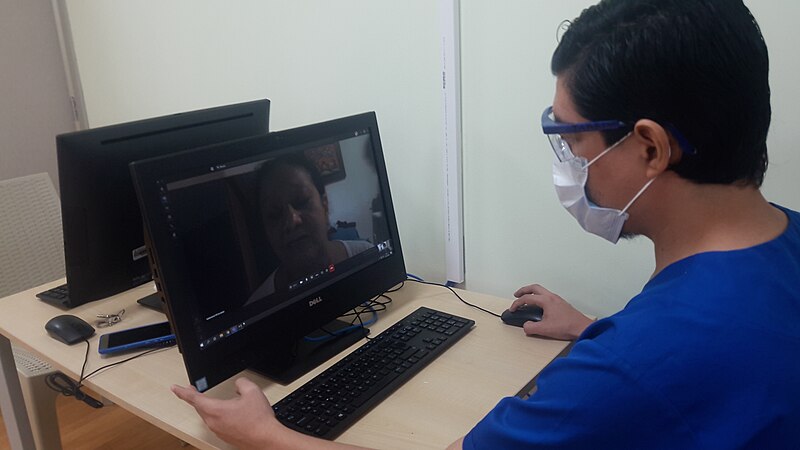
File:Doctor_attending_by_teleconsultation.jpg · Wikimedia Commons · See Wikimedia Commons
telemedicine
Sign in to saveAlso known as telehealth, e-health
thumb|Telehealth Telehealth is the use of electronic information and telecommunication technologies to support long-distance clinical health care, patient and professional health-related education, health administration, and public health.This includes data sharing by way of patient portals and electronic medical records. Telehealth encompasses a broad range of technologies and services used to provide patient care, health education, public health services, and health administration remotely using telecommunications technologies.
Research
75,948 papers- Telemedicine Abortion.Clinical obstetrics and gynecology · 2023
- Telemedicine and the assessment of clinician time: a scoping review.International journal of technology assessment in health care · 2023
- Telemedicine in High-Risk Obstetrics.Obstetrics and gynecology clinics of North America · 2020
- Telemedicine: a Primer.Current allergy and asthma reports · 2018
- The pandemic, telemedicine, and andrology: what have we learned?Sexual medicine reviews · 2023
via PubMed
Wikidata facts
- Subclass of
- medicine
- Image
- Covid 19 Doctor Phone Consultation.jpg
Show 3 more facts
- topic has template
- Template:Telemedicine navbox
- Commons category
- Telemedicine
- topic's main category
- Category:Telemedicine
via Wikidata · CC0
~94 min read
Encyclopedic overview
68 sectionsContents
- Telehealth versus telemedicine
- Methods and modalities
- Store and forward
- Remote monitoring
- Real-time interactive
- Videotelephony
- Categories
- Emergency care
- Telenursing
- Telepalliative care
- Telepharmacy
- Telepsychiatry
- Teledentistry
- Teleaudiology
- Teleneurotherapy
- Teleneurology
- Teleneurosurgery
- Teleneuropsychology
- Telenutrition
- Telerehabilitation
- Teletrauma care
- Telecardiology
- Transmission of ECGs
- Teleradiology
- Telepathology
- Teledermatology
- Teleophthalmology
- Telesurgery
- Teleabortion
- Other specialist care delivery
- Major developments
- In policy
- Transition to mainstream
- Technology advancement
- Licensing
- U.S. licensing and regulatory issues
- EU licensing and regulatory issues
- Major implications and impacts
- Health promotion
- Health care quality and barriers to adoption
- Geriatric population
- Economic evaluations
- Beneficial enablements
- During war and disasters
- Nonclinical uses
- Limitations and restrictions
- Ethical issues
- State of the market
- United States
- Switzerland
- Developing countries
- Telemedicine in developing countries
- Telemedicine in India
- Telemedicine in Sub-Saharan Africa
- Internet via satellite in rural areas
- History
- Earliest instances
- 1800s to early 1900s
- Mid-1900s to 1980s
- 1980s to 1990s – maturation and renaissance
- At-home virtual care
- 2000s to present
- COVID-19
- Telehealth versus in-person on treatment and follow-up visits study
- See also
- References
- Further reading
- External links
thumb|Telehealth Telehealth is the use of electronic information and telecommunication technologies to support long-distance clinical health care, patient and professional health-related education, health administration, and public health.This includes data sharing by way of patient portals and electronic medical records. Telehealth encompasses a broad range of technologies and services used to provide patient care, health education, public health services, and health administration remotely using telecommunications technologies.
Telemedicine is sometimes used as a synonym but is actually a subset of telehealth. The Federation of State Medical Boards defines telemedicine as "the practice of medicine using electronic communication, information technology, or other means between a physician in one location, and a patient in another location, with or without an intervening health care provider." When rural settings, lack of transport, a lack of mobility, conditions due to outbreaks, epidemics or pandemics, decreased funding, or a lack of staff restrict access to care, telemedicine may bridge the gap and can even improve retention in treatment as well as provide distance-learning; meetings, supervision, and presentations between practitioners; online information and health data management and healthcare system integration. EHealth encompasses a wide range of applications, including but not limited to the following: Two clinicians discussing a case via video conference; Robotic surgery performed through remote access; Physical therapy conducted using digital monitoring instruments, live feed, and application combinations; Diagnostic tests transferred between facilities for interpretation by a higher specialist; Home monitoring through continuous transmission of patient health data; Online consultations between patients and practitioners; Video remote interpretation services for clinical visits.
Excerpted from Wikipedia’s “telemedicine” article, available under the CC BY-SA 4.0 licence.