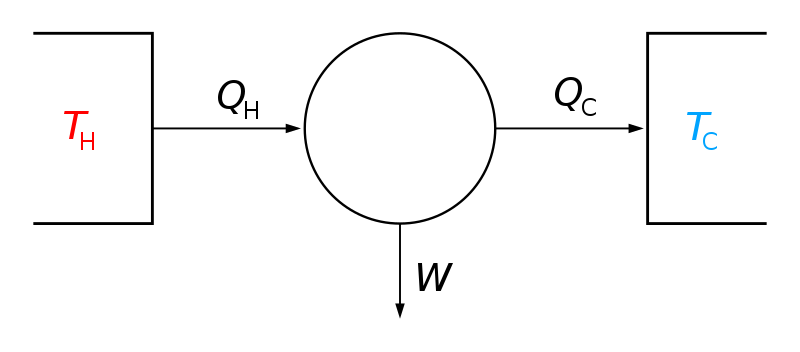
File:Carnot_heat_engine_2.svg · Wikimedia Commons · See Wikimedia Commons
thermodynamic equilibrium
Sign in to saveAlso known as local thermodynamic equilibrium
state of thermodynamic system(s) where no net macroscopic flow of matter or energy occurs
Thermodynamic equilibrium is a state where a system stops changing because matter and energy are no longer flowing in any particular direction—everything is balanced. It matters because understanding when and how systems reach this balanced state helps us predict how things will behave, from chemical reactions to weather patterns to the engines that power machines.
AI-generated from the Wikipedia summary — may contain errors.
Wikidata facts
- Subclass of
- equilibrium point
- Has part
- mechanical equilibrium
Show 3 more facts
- studied by
- thermodynamics
- has characteristic
- energy flux
- Commons category
- Thermodynamic equilibrium
via Wikidata · CC0
~40 min read
Encyclopedic overview
Thermodynamic equilibrium is a notion of thermodynamics with axiomatic status referring to an internal state of a single thermodynamic system, or a relation between several thermodynamic systems connected by more or less permeable or impermeable walls.
In thermodynamic equilibrium, there are no net macroscopic flows of mass nor of energy within a system or between systems. In a system that is in its own state of internal thermodynamic equilibrium, not only is there an absence of macroscopic change, but there is an "absence of any tendency toward change on a macroscopic scale." Systems in mutual thermodynamic equilibrium are simultaneously in mutual thermal, mechanical, chemical, and radiative equilibria. Systems can be in one kind of mutual equilibrium, while not in others. In thermodynamic equilibrium, all kinds of equilibrium hold at once and indefinitely, unless disturbed by a thermodynamic operation. In a macroscopic equilibrium, perfectly or almost perfectly balanced microscopic exchanges occur; this is the physical explanation of the notion of macroscopic equilibrium.
Excerpted from Wikipedia’s “thermodynamic equilibrium” article, available under the CC BY-SA 4.0 licence.