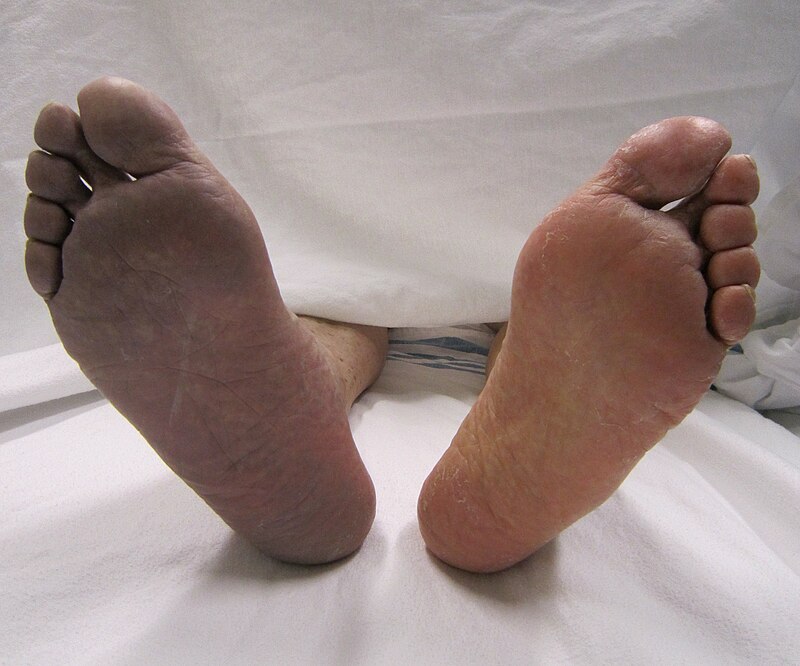
File:Arterial_thrombosis_causing_cyanosis.jpg · Wikimedia Commons · See Wikimedia Commons
thrombosis
Sign in to saveAlso known as Clots, Blood, Blood Clots, Blood Clot, Thrombus, Clot, Blood, thrombotic disorder, Thromboses
Thrombosis () is the formation of a blood clot inside a blood vessel, obstructing the flow of blood through the circulatory system. When a blood vessel (a vein or an artery) is injured, the body uses platelets (thrombocytes) and fibrin to form a blood clot to prevent blood loss. Even when a blood vessel is not injured, blood clots may form in the body under certain conditions. A clot, or a piece of the clot, that breaks free and begins to travel around the body is known as an embolus. Thrombosis can cause serious conditions such as stroke and heart attack.
Thrombosis is when a blood clot forms inside a blood vessel and blocks blood flow through your body. While clots are normally helpful to stop bleeding when vessels are injured, clots can sometimes form even without an injury and may travel through the body, potentially causing serious conditions like stroke or heart attack.
AI-generated from the Wikipedia summary — may contain errors.
Key facts
- Medical condition (new).name
- Thrombosis
- Medical condition (new).image
- Arterial thrombosis causing cyanosis.jpg
- Medical condition (new).caption
- Cyanosis of the lower right extremity, resulting from acute arterial thrombosis of the right leg (on the left side of the image)
- Medical condition (new).field
- Vascular surgery, internal medicine, pulmonology
- Medical condition (new).symptoms
- Dependent on location
via Wikipedia infobox
Research
298,269 papers- [Splanchnic vein thrombosis].La Revue de medecine interne · 2024
- Management of occlusion and thrombosis associated with long-term indwelling central venous catheters.Lancet (London, England) · 2009
- [Thrombosis and platelet dysfunction in myeloproliferative neoplasms].La Revue de medecine interne · 2020
- [Hemolytic disorders and venous thrombosis: An update].La Revue de medecine interne · 2019
- Perianal thrombosis: no need for surgery.Langenbeck's archives of surgery · 2022
via PubMed
Wikidata facts
- Subclass of
- disease
- Image
- Blausen 0089 BloodClot Motion.png
Show 7 more facts
- Commons category
- Thrombosis
- health specialty
- hematology
- exact match
- identifiers.org/doid/DOID:0060903
- NCI Thesaurus ID
- C26891
- ICD-9-CM
- 453.9
- drug or therapy used for treatment
- rac-warfarin
- on focus list of Wikimedia project
- WikiProject Medicine
via Wikidata · CC0
~22 min read
Encyclopedic overview
37 sectionsContents
- Signs and symptoms
- Arterial thrombosis
- Stroke
- Myocardial infarction
- Limb ischemia
- Other sites
- Venous thrombosis
- Deep vein thrombosis
- Paget-Schroetter disease
- Budd-Chiari syndrome
- Portal vein thrombosis
- Renal vein thrombosis
- Cerebral venous sinus thrombosis
- Jugular vein thrombosis
- Cavernous sinus thrombosis
- Causes
- Mechanism
- Pathogenesis
- Hypercoagulability
- Endothelial cell injury
- Disturbed blood flow
- Pathophysiology
- Natural history
- Embolization
- Prevention
- Treatment
- Anticoagulation
- Thrombolysis
- Surgery
- Endovascular treatment
- Antiplatelet agents
- Targeting ischemia/reperfusion injury
- Neonatal thrombosis
- See also
- References
- Bibliography
- External links
Thrombosis () is the formation of a blood clot inside a blood vessel, obstructing the flow of blood through the circulatory system. When a blood vessel (a vein or an artery) is injured, the body uses platelets (thrombocytes) and fibrin to form a blood clot to prevent blood loss. Even when a blood vessel is not injured, blood clots may form in the body under certain conditions. A clot, or a piece of the clot, that breaks free and begins to travel around the body is known as an embolus. Thrombosis can cause serious conditions such as stroke and heart attack.
Thrombosis may occur in veins (venous thrombosis) or in arteries (arterial thrombosis). Venous thrombosis (sometimes called DVT, deep vein thrombosis) leads to a blood clot in the affected part of the body, while arterial thrombosis (and, rarely, severe venous thrombosis) affects the blood supply and leads to damage of the tissue supplied by that artery (ischemia and necrosis). A piece of either an arterial or a venous thrombus can break off as an embolus, which could then travel through the circulation and lodge somewhere else as an embolism. This type of embolism is known as a thromboembolism. Complications can arise when a venous thromboembolism (commonly called a VTE) lodges in the lung as a pulmonary embolism. An arterial embolus may travel further down the affected blood vessel, where it can lodge as an embolism.
Excerpted from Wikipedia’s “thrombosis” article, available under the CC BY-SA 4.0 licence.