File:Blitze_IMGP6376_wp.jpg · Wikimedia Commons · See Wikimedia Commons
thunderstorm
Sign in to saveAlso known as electrical storm, lightning storm, 🌩
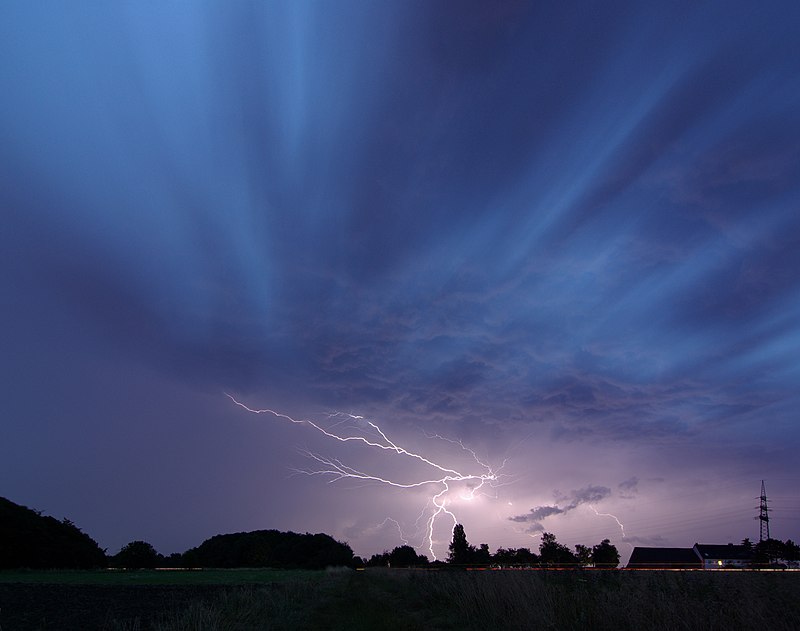
upright=1.35|thumb|Lightning from a thunderstorm near Pritzerbe, Germany
A thunderstorm is a weather event that produces lightning, as shown in this image captured near Pritzerbe, Germany. Thunderstorms matter because they involve electrical discharges and atmospheric activity that can affect weather patterns and pose risks to people and property.
AI-generated from the Wikipedia summary — may contain errors.
Wikidata facts
- Subclass of
- precipitation
- Has part
- lightning
- Image
- Lightning Pritzerbe 01 (MK).jpg
Show 10 more facts
- history of topic
- water cycle
- produced sound
- thunder
- Commons gallery
- Thunderstorm
- Unicode character
- ⛈
- Commons category
- Thunderstorms
- topic's main category
- Category:Thunderstorms
- different from
- Burza
- P8168
- Alcantara
- on focus list of Wikimedia project
- Wikipedia:Vital articles/Level/4
- exact match
- purl.obolibrary.org/obo/ENVO_01000878
Sources (8)
via Wikidata · CC0
~38 min read
Encyclopedic overview
33 sectionsContents
- Life cycle
- Developing stage
- Mature stage
- Dissipating stage
- Classification
- Single-cell
- Multi-cell clusters
- Squall line
- Supercells
- Severe thunderstorms
- Mesoscale convective systems
- Motion
- Back-building thunderstorm
- Hazards
- Cloud-to-ground lightning
- Acid Rain
- Hail
- Tornadoes and waterspouts
- Flash flood
- Downburst
- Thunderstorm asthma
- Safety precautions
- Preparedness
- Safety
- Frequent occurrences
- Energy
- Studies
- Mythology and religion
- Outside of Earth
- See also
- References
- Further reading
- External links
upright=1.35|thumb|Lightning from a thunderstorm near Pritzerbe, Germany
A thunderstorm, also known as an electrical storm or a lightning storm, is a storm characterized by the presence of lightning and thunder. Relatively weak thunderstorms are sometimes called thundershowers. Thunderstorms occur in cumulonimbus clouds. They are usually accompanied by strong winds and often produce heavy rain and sometimes snow, sleet, or hail, but some thunderstorms can produce little or no precipitation at all. Thunderstorms may line up in a series or become a rainband, known as a squall line. Strong or severe thunderstorms include some of the most dangerous weather phenomena, including large hail, strong winds, and tornadoes. Some of the most persistent severe thunderstorms, known as supercells, rotate as do cyclones. While most thunderstorms move with the mean wind flow through the layer of the troposphere that they occupy, vertical wind shear sometimes causes a deviation in their course at a right angle to the wind shear direction.
Excerpted from Wikipedia’s “thunderstorm” article, available under the CC BY-SA 4.0 licence.
Gallery (52)
Available in 85 languages
- Español
- Français
- Deutsch
- 中文
- 日本語
- Русский
- Português
- Italiano
- العربية
- हिन्दी
- Afrikaans
- Aragonese
- Armenian
- Asturian
- Azerbaijani
- Bahasa Indonesia
- Bangla
- Bashkir
Show 66 more
- Basque
- bat_smg
- be_x_old
- Belarusian
- Bhojpuri
- Bulgarian
- Burmese
- Catalan
- Central Kurdish
- Chuvash
- Croatian
- Czech
- Danish
- Esperanto
- Estonian
- Finnish
- Galician
- Georgian
- Greek
- Hebrew
- Hungarian
- Icelandic
- Ido
- Interlingua
- Irish
- Kazakh
- Latin
- Latvian
- Lithuanian
- Lombard
- Luxembourgish
- Macedonian
- Malagasy
- Malay
- Malayalam
- Marathi
- Mingrelian
- Nederlands
- Norwegian
- Norwegian Nynorsk
- Occitan
- Picard
- Polski
- Punjabi
- Quechua
- Romanian
- Scots
- Serbian
- Serbian (Latin)
- simple
- Slovak
- Slovenian
- Somali
- Svenska
- Tamil
- Tiếng Việt
- Türkçe
- Ukrainian
- Walloon
- Western Frisian
- Western Panjabi
- Wu Chinese
- zh_yue
- فارسی
- ไทย
- 한국어
via Wikidata sitelinks · CC0