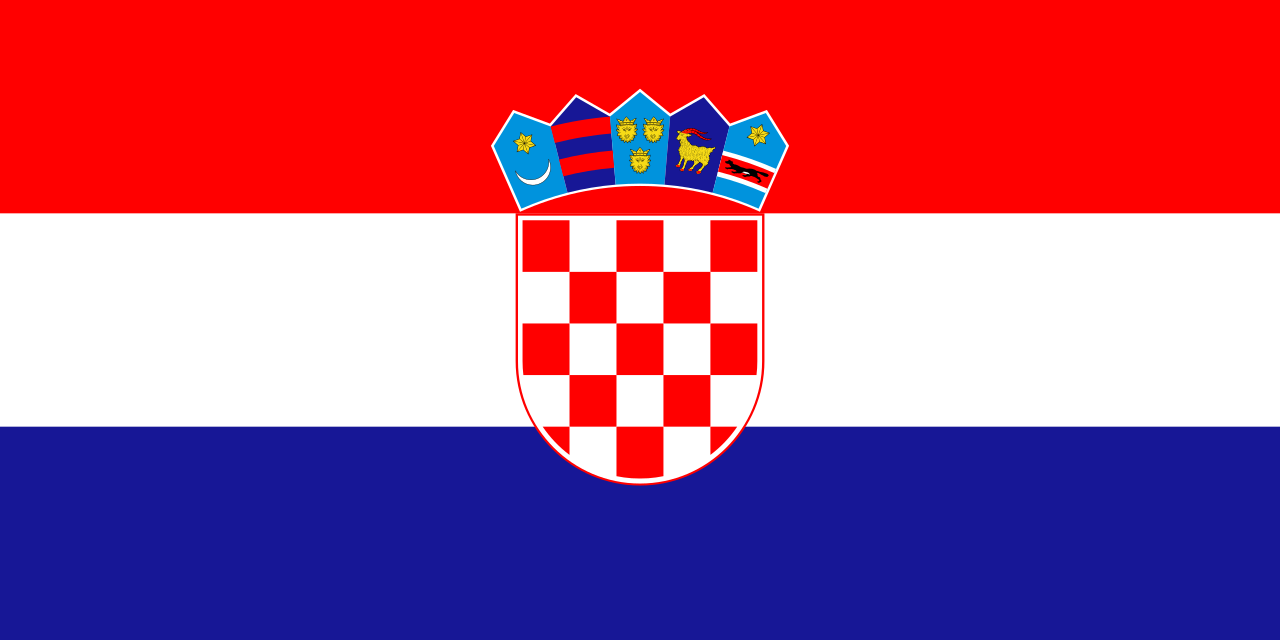
Croatia
Sign in to saveAlso known as Republic of Croatia, HR, HRV, CRO, RH
Croatia, officially the Republic of Croatia, is a country in Central and Southeast Europe, on the coast of the Adriatic Sea. It borders Slovenia to the northwest, Hungary to the northeast, Serbia to the east, Bosnia and Herzegovina and Montenegro to the southeast, and shares a maritime border with Italy to the west. Its capital and largest city, Zagreb, forms one of the country's primary subdivisions, with twenty counties. Other major urban centers include Split, Rijeka and Osijek. The country spans , and has a population of nearly 3.9 million.
OverviewAI-generated
Croatia, officially the Republic of Croatia, is a country in Southeast Europe. Its capital is Zagreb. The nation operates as a republic with the Parliament of Croatia as its legislative body. The Prime Minister of Croatia holds the office of head of government. Croatia shares diplomatic relations with Italy, Germany, Australia, and Slovenia. It became independent in 1991. The country is characterized as a free country.
The population is reported as 4,784,265 in one source and 3,866,233 in another. The area covers 56,594 square kilometers. The official name includes Republika Hrvatska. The native label is Hrvatska. The license plate code is HR. The top-level domain is .hr. The emergency phone number is 112. Electrical plugs are Europlug and Schuko. The time zone is UTC+01:00. The flag is 🇭🇷.
Synthesized by Vinony from 67 facts across 9 sources: Wikidata, REST Countries, Open Meteo, Openweathermap, World Bank, OpenStreetMap, PubMed, Vinony graph, Geo. Generated from structured data (not the Wikipedia text) and checked against those facts — may still contain errors.
Weather now
7-day forecast
via Open-Meteo
Country

- Capital
- Zagreb
- Population
- 3,866,233
- Region
- Europe · Southeast Europe
- Demonym
- Croatian
- Currencies
- EUR (€)
- Languages
- Croatian
- Calling code
- +385
- Drives on
- Right
- Gini
- 29.7 (2018)
- FIFA code
- CRO
- TLD
- .hr
- Timezones
- UTC+01:00
- Borders
- BIH, HUN, MNE, SRB, SVN
via REST Countries
Indicators · World Bank
- GDP
- $93B(2024)
- Population
- 3,866,200(2024)
- Life expectancy
- 78.9 yrs(2024)
- Unemployment
- 5 %(2025)
- Urban population
- 57.5 %(2024)
- Internet users
- 83.6 %(2024)
- Forest area
- 34.8 %(2023)
- Renewable energy
- 34.1 %(2021)
via World Bank Open Data · CC BY 4.0
Place details
- Locality
- Gornje Primišlje
- Country
- Hrvatska
- Population
- 3,871,833
- Timezone
- Europe/Zagreb
via OpenStreetMap · GeoNames
Wikipedia views (30d)
213,929 totalvia Wikimedia Pageviews API
Key facts
- Country.conventional_long_name
- Republic of Croatia
- Country.common_name
- Croatia
- Country.image_flag
- Flag of Croatia.svg
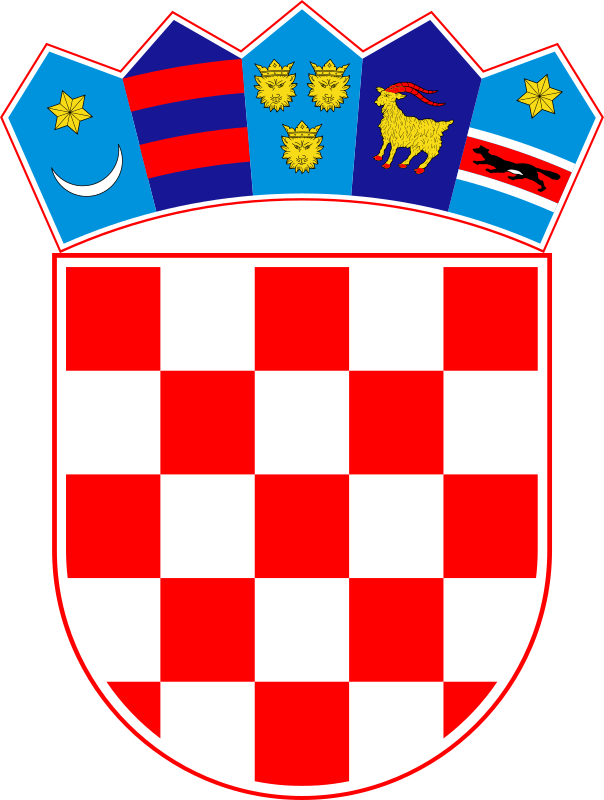
- Country.image_coat
- Coat of arms of Croatia.svg
- Country.coa_size
- 70
- Country.anthem
- "Lijepa naša domovino"("Our Beautiful Homeland")center
- Country.capital
- Zagreb
- Country.largest_city
- capital
- Country.official_languages
- Croatian
- Country.languages_type
- Writing system
- Country.languages
- Latin
- Country.ethnic_groups_year
- 2021
- Country.religion_year
- 2021
- Country.government_type
- Unitary parliamentary republic
- Country.leader_title1
- President
- Country.leader_name1
- Zoran Milanović
- Country.leader_title2
- Prime Minister
- Country.leader_name2
- Andrej Plenković
via Wikipedia infobox
Research
73,458 papers- Historical and contemporary population genetics of the invasive western corn rootworm (Coleoptera: Chrysomelidae) in Croatia.Environmental entomology · 2013Lemic D, Mikac KM, Bažok RDOI: 10.1603/EN12351
- Terrorism in Croatia.ReviewPrehospital and disaster medicine · 2003Bradic N, Cuculic D, Jancic EDOI: 10.1017/s1049023x00000819
- Mental health services in Croatia-current perspectives and future challenges.ReviewInternational review of psychiatry (Abingdon, England) · 2025Rojnic Kuzman M, Medved SDOI: 10.1080/09540261.2024.2434576
- Human Alveolar Echinococcosis, Croatia.Emerging infectious diseases · 2020Dušek D, Vince A, Kurelac I et al.DOI: 10.3201/eid2602.181826
- The development of the nursing profession and nursing education in Croatia.ReviewJournal of professional nursing : official journal of the American Association of Colleges of Nursing · 2021Kurtovic B, Friganovic A, Cukljek S et al.DOI: 10.1016/j.profnurs.2021.03.001
- The cost of ischaemic stroke in Croatia.European stroke journal · 2023Benković V, Parker M, Novaković T et al.DOI: 10.1177/23969873221123840
- Rickettsiae and rickettsial diseases in Croatia: Implications for travel medicine.ReviewTravel medicine and infectious disease · 2016Dzelalija B, Punda-Polic V, Medic A et al.DOI: 10.1016/j.tmaid.2016.06.010
- Earthquake in the time of COVID-19: The story from Croatia (CroVID-20).ReviewJournal of global health · 2020Čivljak R, Markotić A, Capak KDOI: 10.7189/jogh.10.010349
via PubMed
Wikidata facts
- Instance of
- country
- Part of
- eurozone
- Official name
- Republiken Kroatien
- Demonym
- Kroatinnen
- Country
- Croatia
- Contains
- Dubrovnik-Neretva County
- Continent
- Europe
- Capital
- Zagreb
- Official language
- Croatian
- Currency
- euro
- Population
- 4784265
- Area
- 56594
- Body of water
- Adriatic Sea
- Head of government
- Stjepan Mesić
- Head of state
- Franjo Tuđman
- Form of government
- republic
- Legislature
- Parliament of Croatia
- Anthem
- Lijepa naša domovino
- Shares border with
- Liberland
- Highest point
- Dinara
- Official website
- vlada.gov.hr/en
- Image
- Dubrovnik june 2011..JPG
- Life expectancy
- 78
- Nominal GDP
- 70964606465
Show 71 more facts
- Unemployment rate
- 17
- Calling code
- +385
- Licence plate code
- HR
- Electrical plug type
- Schuko
- Mains voltage
- 230
- Motto
- Llawn bywyd
- Flag
- flag of Croatia
- Significant event
- Independence of Croatia
- topic's main Wikimedia portal
- Portal:Croatia
- Unicode character
- 🇭🇷
- category of associated people
- Category:Croatian people
- trunk prefix
- 0
- geography of topic
- Geography of Croatia
- office held by head of government
- Prime Minister of Croatia
- native label
- Hrvatska
- has characteristic
- free country
- diplomatic relation
- Poland
- Commons gallery
- Hrvatska
- inception
- 1991-06-25
- history of topic
- history of Croatia
- mobile country code
- 219
- total fertility rate
- 1.46
- maritime identification digits
- 238
- marriageable age
- 18
- topic's main category
- Category:Croatia
- central bank
- Croatian National Bank
- category for people buried here
- Category:Burials in Croatia
- age of majority
- 18
- member of
- Schengen Area
- railway traffic side
- right
- GS1 country code
- 385
- located in/on physical feature
- Balkans
- category for films shot at this location
- Category:Films shot in Croatia
- executive body
- Government of Croatia
- category for people who died here
- Category:Deaths in Croatia
- office held by head of state
- President of Croatia
- Commons category
- Croatia
- top-level Internet domain
- .hr
- category for people born here
- Category:Births in Croatia
- short name
- Croația
- number of out-of-school children
- 90510
- driving side
- right
- lowest point
- Adriatic Sea
- IPA transcription
- xɔrˈvät͡sjä
- language used
- Istro-Romanian
- suicide rate
- 11.0
- culture
- culture of Croatia
- VAT rate
- 25
- BTI Status Index
- 8.13
- BTI Governance Index
- 5.98
- economy of topic
- economy of Croatia
- demographics of topic
- demographics of Croatia
- P6482
- Croatia
- Democracy Index
- 6.50
- topic has template
- Template:Counties of Croatia
- Human Development Index
- 0.858
- P11012
- United States
- hashtag
- Croatia
- on focus list of Wikimedia project
- Wikipedia:Vital articles/Level/4
- Gini coefficient
- 28.9
- Happy Planet Index score
- 46.2
- Inequality-adjusted Human Development Index
- 0.797
- P12749
- Arachnida
- birth rate
- 8.8
- male population
- 1877942
- death rate
- 14.8
- rural population
- 1610925
- female population
- 1977699
- urban population
- 2244716
- number of seats in assembly
- 11
Sources (15)
via Wikidata · CC0
Travel guide
Understand
300px|thumb|right|Croatia has 1244 islands thumb|right|Ban Jelačić Square in Zagreb
Get in
thumb|450px| Visa policy of Schengen states
See
thumb|300px|right|Croatian National Theatre in [[Zagreb]] Croatia is dense with places that are well worthy of a visit, owing to its diverse regions, each with its own layered past. Towns and cities generally have a historical urban core that exhibits the architectural heritage of a specific era. To a get a sense of Croatia as a whole—how it was shaped by different influences, and the resulting contrasts—it is important to visit both the coastal and the inland part of the country. Dubrovnik being such a world renowned destination, it is often taken as the exemplar of the former style. However it is more of an enclosed world with its admirably individual aesthetic (having been an independent city-state for the most of its history). Other similarly gratifying places, like Šibenik, carry the true spirit of Dalmatia, but going further north along the coast, there is Rijeka, which again has quite a different kind of charm.
Dominating continental Crotia lies its capital of Zagreb, a home to nearly 1 million. It is a modern city with all the modern features, yet it mostly has an easy-going atmosphere. In the east, in the region of Slavonia with its regional capital Osijek and the war torn Vukovar are awe inspiring. Scattered throughout the region are vineyards and wine cellars, most of which give tours and tastings.
Throughout the country there are numerous cultural venues that are worth seeing. Croatia has 10 UNESCO World Heritage Sites, 8 national parks and 10 nature parks. In t…
Do
300px|thumb|right|City of [[Hvar has average of 2726 hours of sunshine per year, as do many other Croatian towns on Adriatic coast. Croatia is a land of urban culture which numbers more cities than any other part of the Mediterranean]]
Eat
thumb|Croatian cheese
Croatian cuisine is quite diverse so it is hard to say what meal is most typically Croatian. In the eastern continental regions (Slavonija and Baranja) spicy sausage such as kulen or kulenova seka is a must try. Čobanac ("shepherd's stew") is a mixture of several kinds of meat with a lot of red spicy paprika. In Hrvatsko Zagorje and Central Croatia pasta filled with cheese called štrukli is a famous delicacy (it is said that the best štrukli in Croatia is served in the Esplanade Hotel restaurant in Zagreb), as is purica s mlincima, which is baked turkey cooked in a special kind of pastry. Sir i vrhnje (sour cream with cottage cheese) can be bought fresh on the Zagreb main market Dolac. Croats love a bit of oil and you will find plenty of it in piroška. In the mountainous regions of Lika and Gorski Kotar meals containing mushrooms, wild berries and game meat are very popular. One of typical dishes in Lika is police (oven-baked potatoes covered with bacon) and several kinds of cheese (smoked cheese and škripavac).
The coastal region is well known for its truffle delicacies and soup maneštra od bobić (Istria), Dalmatian pršut and paški sir (Pag-island cheese). Dishes made of fresh fish and other products of the sea (calamari, octopus, crabs, scampi) shouldn't be given a miss. Many places serve fish delivered from the local fisherman the night before – find out which ones!
thumb|Ćevapi
Croatian cuisine has yet to come up with a fast food representative. …
Drink
thumb|Bottles of medica
Alcoholic: Rakija, a type of brandy which can be made of plum (šljivovica), grapes (loza), figs (smokovača), honey (medica) and many other types of fruit and aromatic herbs, is the main distilled beverage served in Croatia. Pelinkovac is a bitter herbal liquor popular in Central Croatia, but is said to resemble cough-medicine in flavor. Famous Maraschino, a liquer flavored with Marasca cherries, which are grown around Zadar, Dalmatia.
Croatia also produces a broad palette of high quality wines (up to 700 wines with protected geographic origin), beers and mineral water. On the coast people usually serve bevanda with meals. Bevanda is heavy, richly flavoured red wine mixed with plain water. Its counterpart in northern parts of Croatia is gemišt. This term designates dry, flavoured white wines mixed with mineral water.
Two popular domestic beers are Karlovačko and Ožujsko, but Velebitsko and Tomislav pivo have a semi-cult status. They are served only in some places in Zagreb and Croatia. Many well-known European brands (Stella Artois, Beck's, Carling, Heineken and others) are made under licence in Croatia.
Non-alcoholic: Mineral water, fruit juices, coffee (espresso, Turkish or instant), tea, Cedevita (instant multivitamin drink), and drinkable yogurt. Very rarely you may find sok od bazge (elderflower juice) in the continental region. Worth trying! Also, in Istria there is a drink called pašareta, a sparkling red drink with herbal extracts. Very swee…
Sleep
Accommodation in Croatia is increasingly geared towards well-furnished, self-declared four- and five-star hotels. Prices are at their most expensive during the warmer months from June to September, especially July and August. Many coastal hotels are closed during the winter but there is at least one place to stay which is open in the off-season in all major towns.
Private rooms and apartments are quite common, targeting the mass tourism market as visits to the country surged in the 2010s. Apartments tend to be self-containing, with a kitchen, bathroom, small lounge, and often a terrace outside.
B&Bs haven't really taken off in Croatia because of the bureaucratic rules in place. In the countryside, rural homestays have become more visible, particularly in the inland regions. These homestays are slightly pricier than the private rooms and apartments, but include breakfast and home-cooked meals.
Stay safe
Croatia is extremely safe by international standards in most crime categories.
In case of an emergency, dial 112 for fire brigade, police, ambulance or mountain rescue.
Police can search anyone at any time in public spaces and while they should have a reason there is in reality no recourse against it. Everyone is required to carry an ID or passport.
Corruption exists but is exceedingly rare compared to other countries in the region. Attempts to bribe police will get you arrested.
It is not uncommon that older Police officers outside Zagreb, even in Rijeka, Pula & Split, do not speak any English.
Generally it is not advisable to carry knives even though it is not illegal. With an explanation (fishing, food, camping....) and not intoxicated this is usually not a problem.
During summer make sure you use adequate SPF to protect yourself from sunburn. There are no ozone holes over Croatia but it's fairly easy to burn in the sun. If this happens make sure you get out of the sun, drink plenty of fluids and rehydrate your skin. The locals will often advise covering the burnt spot with cold yogurt bought from the supermarket.
thumb|A mine warning sign Since the wars ended in 1995, landmines remain buried in Croatian soil. If you plan to hike consult locals before you go. The suspected areas are marked with mine warning signs. Although mines are still a problem for Croatia, it is highly unlikely you will spot any minefields in Croatia today. However, it is still better not to le…
Stay healthy
No vaccinations are required when going to Croatia.
If you're going camping or hiking in continental Croatia during summer, you should be aware of ticks and tick-carrying diseases such as encephalitis and lyme disease. Approximately 3 ticks in 1000 carry the virus.
In Eastern Slavonia (particularly around the Kopački Rit near Osijek) wear long sleeves and take insect repellent.
Tap water in Croatia is perfectly safe, and in some areas considered the best in the world. However, you can still choose from several brands of excellent bottled water (Jamnica being the most popular, and Jana, several times awarded as the world's best bottled water.)
Though the water may be some of the best in the world, avoid drinking the home-made wine sold in refilled plastic jugs in many local farmer's markets as it may cause intestinal distress.
Respect
Croatia gained independence from Yugoslavia in 1991, and the 1990s were marked by ethnic conflict and the bloody and brutal war in Croatia is still a painful subject, but generally there should be no problem if you approach that topic with respect. Croatia has seen a heap of invaders through history; Greek, Roman, Ottoman, Austro-Hungarian, Yugoslav, etc. Proudly independent today, calling Croatia Yugoslavia or calling Croats Yugoslav, would almost be considered an insult. Also don’t call the Croatian language Serbo-Croatian, as you could easily come across a person sensitive about the issue. Locals tend to be way more forgiving overall with Western than with ex-USSR and especially ex-Yugoslav tourists.
Due to its history as part of Yugoslavia, there is still some mistrust towards Serbia and also Russia. While individual Serbian and Russian visitors are unlikely to encounter any problems, try to avoid being overly enthusiastic about either country, as it can quickly arouse negative sentiments among locals. Extremely rarely cars with Serbian registration are vandalized (in Zagreb, the border regions and on the coast mostly), this incidents are primarily caused by drunk youth and are more "in the moment" than planned.
Visitors should avoid describing Croatia as a Balkan country, as Croats prefer to think of their country as Mediterranean and Central European, and some will take offence at the word "Balkan". Geographically, southern and coastal Croatia is part of the Balkans, …
Travel guide from Wikivoyage (CC BY-SA 4.0)
~40 min read
Encyclopedic overview
40 sectionsContents
- Etymology
- History
- Prehistory and antiquity
- Middle Ages
- Union with Hungary and Austria
- The World Wars and Yugoslavia
- Independence
- Geography
- Climate
- Biodiversity
- Governance
- Law and judicial system
- Foreign relations
- Croatian diaspora
- Military
- Administrative divisions
- Economy
- Tourism
- Infrastructure
- Motorways
- Railways
- Aviation
- Ports
- Energy
- Demographics
- Religion
- Languages
- Education
- Healthcare
- Culture
- Arts, literature, and music
- Media
- Film industry
- Cuisine
- Sports
- See also
- Explanatory notes
- Citations
- General and cited references
- External links
Croatia, officially the Republic of Croatia, is a country in Central and Southeast Europe, on the coast of the Adriatic Sea. It borders Slovenia to the northwest, Hungary to the northeast, Serbia to the east, Bosnia and Herzegovina and Montenegro to the southeast, and shares a maritime border with Italy to the west. The Croatian archipelago contains over 1,000 islands and islets, the largest overseas territory on the Adriatic Sea. Its capital, largest city and main cultural and economic centre is Zagreb. Major urban centers include Split, Rijeka, and Osijek. The country is composed of twenty counties spanning 56,594 square kilometres (21,851 square miles) within four administrative regions. Croatia has a population of nearly 3.9 million as of 2026.
Croatian history began with the 6th century arrival of the Croats to Roman Illyria. Settled as two duchies a century later, Croatia was granted independence in 878 under Duke Branimir and elevated into a kingdom under King Tomislav in 925. The Trpimirović dynastic succession crisis placed Croatia into a personal union with Hungary in 1102. In 1527, amid Ottoman conflict, Croatia aligned with the Habsburg monarchy. It reorganized into the State of Slovenes, Croats, and Serbs before merging into the Kingdom of Yugoslavia in 1918. During World War II, most of Croatia was invaded by the Axis powers who installed a puppet state known as the Independent State of Croatia. A resistance movement restored sovereignty, emerging as the Socialist Republic of Croatia within the Socialist Federal Republic of Yugoslavia in 1943. Croatia declared independence from Yugoslavia in 1991, successfully fighting the War of Independence until 1995.
Excerpted from Wikipedia’s “Croatia” article, available under the CC BY-SA 4.0 licence.
Gallery (59)
On the map
60 mapped locations
Available in 291 languages
- Español
- Français
- Deutsch
- 中文
- 日本語
- Русский
- Português
- Italiano
- العربية
- हिन्दी
- Abkhazian
- abstract
- Achinese
- Adyghe
- Afrikaans
- Akan
- Albanian
- Albanian
Show 272 more
- Amharic
- ami
- Angika
- Aragonese
- Aramaic
- Armenian
- Arpitan
- Asturian
- Avaric
- Awadhi
- Aymara
- azb
- Azerbaijani
- Bahasa Indonesia
- Balinese
- Bangla
- Bashkir
- Basque
- bat_smg
- Bavarian
- be_x_old
- Belarusian
- Betawi
- Bhojpuri
- Bikol
- Bishnupriya
- Bislama
- blk
- Bosnian
- Breton
- Bulgarian
- Buriat
- Burmese
- Catalan
- cbk_zam
- cdo
- Cebuano
- Central Kurdish
- Chamorro
- Chechen
- Cherokee
- Cheyenne
- Church Slavic
- Chuvash
- Cornish
- Corsican
- Crimean Tatar
- Croatian
- Czech
- dag
- Danish
- Divehi
- dty
- Dzongkha
- Egyptian Arabic
- eml
- Erzya
- Esperanto
- Estonian
- Ewe
- Extremaduran
- Faroese
- Fiji Hindi
- Fijian
- Filipino
- Finnish
- fiu_vro
- Friulian
- Fula
- Gagauz
- Galician
- Gan Chinese
- Ganda
- gcr
- Georgian
- Gilaki
- Goan Konkani
- Gothic
- Greek
- Guarani
- Gujarati
- Haitian Creole
- Hakka Chinese
- Hausa
- Hawaiian
- Hebrew
- Hungarian
- hyw
- Icelandic
- Ido
- Igbo
- Iloko
- Inari Sami
- Interlingua
- Interlingue
- Inupiaq
- Irish
- Jamaican Creole English
- Javanese
- Jju
- Kabardian
- Kabyle
- kai
- Kannada
- Kanuri
- Kara-Kalpak
- Karachay-Balkar
- Kashubian
- Kazakh
- kbp
- kge
- Khmer
- Kinyarwanda
- Komi
- Komi-Permyak
- Kongo
- Kotava
- Kurdish
- Kyrgyz
- Ladino
- Lao
- Latgalian
- Latin
- Latvian
- Lezghian
- Ligurian
- Limburgish
- Lingala
- Lingua Franca Nova
- Lithuanian
- lld
- Lojban
- Lombard
- Low German
- Lower Sorbian
- Luxembourgish
- Macedonian
- Madurese
- Maithili
- Malagasy
- Malay
- Malayalam
- Maltese
- Manipuri
- Manx
- Māori
- map_bms
- Marathi
- Mari
- Mazanderani
- Minangkabau
- Mingrelian
- Mirandese
- Moksha
- Mongolian
- Moroccan Arabic
- Navajo
- nds_nl
- Neapolitan
- Nederlands
- Nepali
- Newari
- Northern Frisian
- Northern Sami
- Norwegian
- Norwegian Nynorsk
- Novial
- nrm
- Obolo
- Occitan
- Odia
- Old English
- olo
- Oromo
- Ossetic
- Pampanga
- Pangasinan
- Papiamento
- Pashto
- Pennsylvania German
- Picard
- Piedmontese
- Polski
- Pontic
- Punjabi
- Quechua
- roa_rup
- roa_tara
- Romanian
- Romansh
- Romany
- rsk
- Rundi
- Rusyn
- Samoan
- Sango
- Sanskrit
- Santali
- Sardinian
- Saterland Frisian
- Scots
- Scottish Gaelic
- Serbian
- Serbian (Latin)
- Shan
- Shona
- Sicilian
- Silesian
- simple
- Sindhi
- Sinhala
- Slovak
- Slovenian
- Somali
- Southern Sotho
- Sranan Tongo
- Standard Moroccan Tamazight
- Sundanese
- Svenska
- Swahili
- Swati
- syl
- szy
- Tahitian
- Tajik
- Talysh
- Tamil
- Taroko
- Tatar
- tay
- Telugu
- Tetum
- Tibetan
- Tiếng Việt
- Tok Pisin
- Toki Pona
- Tongan
- Tsonga
- Tumbuka
- Türkçe
- Turkmen
- Tyap
- Udmurt
- Ukrainian
- Upper Sorbian
- Urdu
- Uyghur
- Uzbek
- Venetian
- Veps
- Volapük
- Walloon
- Waray
- Welsh
- West Flemish
- Western Frisian
- Western Panjabi
- Wolof
- Wu Chinese
- Yakut
- Yiddish
- Yoruba
- Zaza
- Zeelandic
- zh_classical
- zh_min_nan
- zh_yue
- Zhuang
- Zulu
- فارسی
- ไทย
- 한국어
via Wikidata sitelinks · CC0