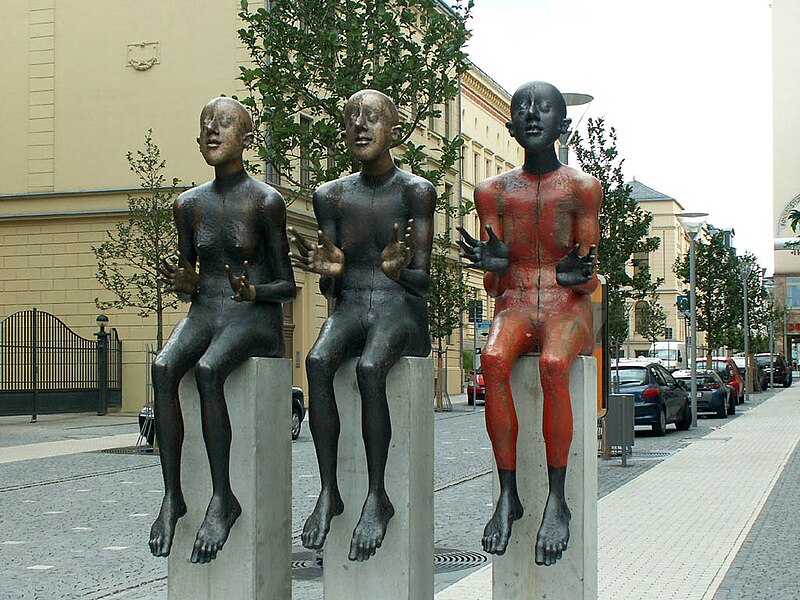
File:Für_Toleranz.jpg · Wikimedia Commons · See Wikimedia Commons
toleration
Sign in to saveAlso known as tolerance
thumb|Sculpture Für Toleranz ("for tolerance") by Volkmar Kühn, [[Gera, Germany ]] Toleration is the act of permitting an action, idea, object, or person that one dislikes or disagrees with. Political scientist Andrew R. Murphy explains that "We can improve our understanding by defining 'toleration' as a set of social or political practices and 'tolerance' as a set of attitudes." Random House Dictionary defines tolerance as "a fair, objective, and permissive attitude toward those whose opinions, beliefs, practices, racial or ethnic origins, etc., differ from one's own". The Merriam-Webster Dic
Toleration is the act of permitting actions, ideas, or people that you disagree with or dislike, and it can refer both to the practices societies establish to accommodate different beliefs and to the attitudes individuals hold toward those who differ from them. It matters because it enables people with different opinions, beliefs, and backgrounds to coexist, which is essential for functioning societies and communities.
AI-generated from the Wikipedia summary — may contain errors.
Wikidata facts
- Instance of
- social behavior
- Subclass of
- intentional human activity
Show 4 more facts
- Commons category
- Tolerance
- on focus list of Wikimedia project
- WikiProject Human rights
- described by source
- Wikitólica
- P8168
- Liu Pi
via Wikidata · CC0
~11 min read
Encyclopedic overview
15 sectionsContents
- Etymology
- France
- In the 19th century
- John Stuart Mill
- Ernest Renan
- In the 20th century
- Modern analyses and critiques
- Modern definition
- Tolerating the intolerant
- Other criticisms and issues
- See also
- Sources
- References
- Further reading
- External links
thumb|Sculpture Für Toleranz ("for tolerance") by Volkmar Kühn, [[Gera, Germany ]] Toleration is the act of permitting an action, idea, object, or person that one dislikes or disagrees with. Political scientist Andrew R. Murphy explains that "We can improve our understanding by defining 'toleration' as a set of social or political practices and 'tolerance' as a set of attitudes." Random House Dictionary defines tolerance as "a fair, objective, and permissive attitude toward those whose opinions, beliefs, practices, racial or ethnic origins, etc., differ from one's own". The Merriam-Webster Dictionary associates toleration both with "putting up with" something undesirable, and with neglect or failure to prevent or alleviate it.
Both these concepts contain the idea of alterity: the state of otherness. Additional choices of how to respond to the "other", beyond toleration, exist. Therefore, in some instances, toleration has been seen as "a flawed virtue" because it concerns acceptance of things that were better overcome. Toleration cannot, therefore, be defined as a universal good, and many of its applications and uses remain contested.
Excerpted from Wikipedia’s “toleration” article, available under the CC BY-SA 4.0 licence.
Gallery (12)
Available in 62 languages
- Español
- Français
- Deutsch
- 中文
- 日本語
- Русский
- Português
- Italiano
- العربية
- Albanian
- Albanian
- Armenian
- Azerbaijani
- Bahasa Indonesia
- Bangla
- Basque
- Belarusian
- Bosnian
Show 43 more
- Bulgarian
- Catalan
- Croatian
- Czech
- Danish
- Egyptian Arabic
- Esperanto
- Estonian
- Filipino
- Finnish
- Galician
- Georgian
- Hausa
- Hebrew
- Hungarian
- Kazakh
- Latin
- Lithuanian
- Mirandese
- Nederlands
- Norwegian
- Norwegian Nynorsk
- Occitan
- Pashto
- Polski
- Romanian
- Serbian
- Serbian (Latin)
- simple
- Slovak
- Slovenian
- Svenska
- Tajik
- Tamil
- Tiếng Việt
- Türkçe
- Ukrainian
- Uzbek
- West Flemish
- Wu Chinese
- zh_min_nan
- فارسی
- 한국어
via Wikidata sitelinks · CC0