File:TriangleInequality.svg · Wikimedia Commons · See Wikimedia Commons
triangle inequality theorem
Sign in to saveinequality of the form |x + y| ≤ |x| + |y|
Wikidata facts
- Instance of
- theorem
- Subclass of
- inequality
Show 4 more facts
- statement describes
- triangle
- maintained by WikiProject
- WikiProject Mathematics
- Commons category
- Triangle inequality
- studied by
- Euclidean geometry
Sources (3)
via Wikidata · CC0
~29 min read
Encyclopedic overview
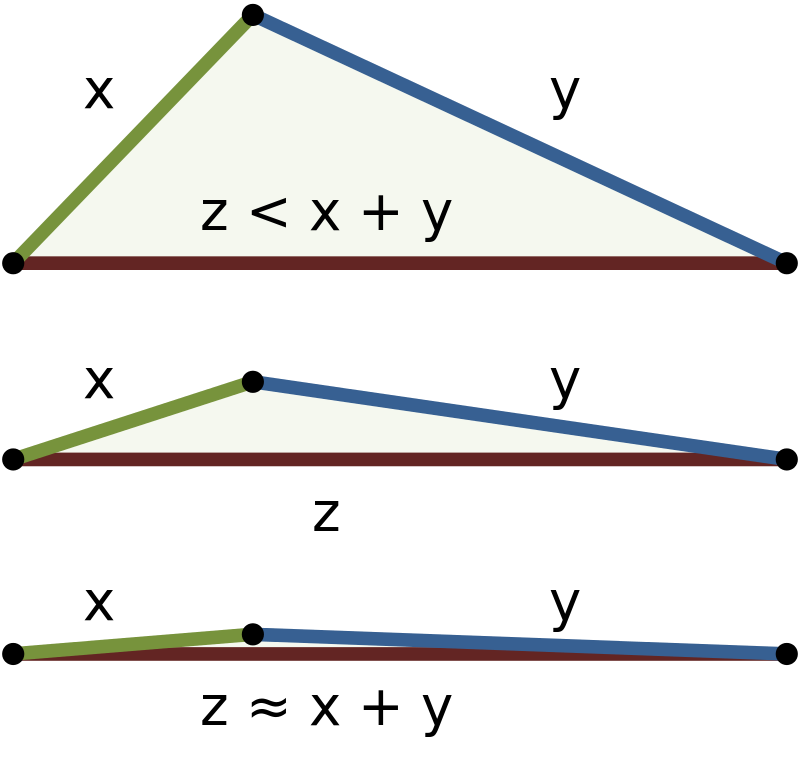
Three examples of the triangle inequality for triangles with sides of lengths x, y, z. The top example shows a case where z is much less than the sum x + y of the other two sides, and the bottom example shows a case where the side z is only slightly less than x + y.
In mathematics, the triangle inequality states that for any triangle, the sum of the lengths of any two sides must be greater than or equal to the length of the remaining side. This statement permits the inclusion of degenerate triangles, but some authors, especially those writing about elementary geometry, will exclude this possibility, thus leaving out the possibility of equality. If a, b, and c are the lengths of the sides of a triangle then the triangle inequality states that
Excerpted from Wikipedia’s “triangle inequality theorem” article, available under the CC BY-SA 4.0 licence.