Encyclopedia of Life · EOL (see source)
Trichophyton
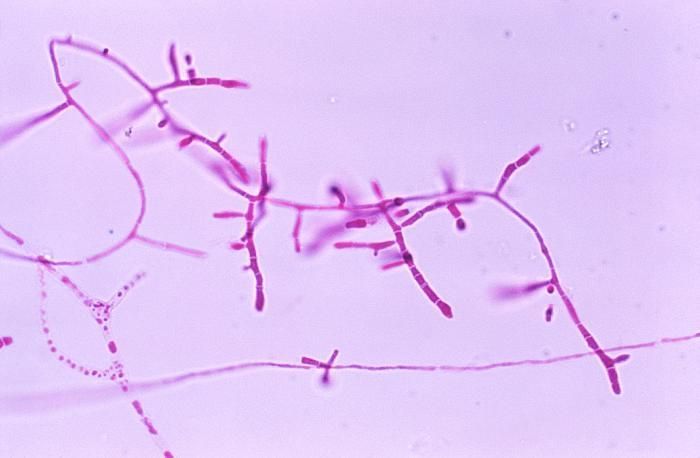
Sign in to saveTrichophyton is a genus of fungus, which includes the parasitic varieties that cause tinea, including athlete's foot, ringworm, jock itch, and similar infections of the nail, beard, skin and scalp. Trichophyton fungi are molds characterized by the development of both smooth-walled macro- and microconidia. Macroconidia are mostly borne laterally directly on the hyphae or on short pedicels, and are thin- or thick-walled, clavate to fusiform, and range from 4 to 8 by 8 to 50 μm in size. Macroconidia are few or absent in many species. Microconidia are spherical, pyriform to clavate or of irregular
Species
毛癬菌屬(學名:Trichophyton)是子囊菌門下的一種真菌。其菌絲可以產生光滑直筒狀的大分生孢子(macroconidia)與許多小分生孢子(microconidia)。其中大分生孢子直接在菌絲側向生長,呈棒狀或紡綻狀,大小約為4-8乘8-50微米。在大部分该属物种中,大分生孢子少见或不存在。小分生孢子呈圓形、梨形、棒狀或不規則狀,大小約為2-3乘2-4微米。毛癬菌屬侵害人類的皮膚、毛囊及指甲造成皮膚感染[1]。 目录 1 感染 2 診斷與治療 3 種與原始生存環境 4 參考資料 感染 毛癬菌造成皮膚感染為最常見,可感染皮膚、毛囊與指甲等組織,其症狀與小孢癬菌和表皮癬菌相似。毛癬菌會造成頭癬、鬍癬、體癬、股癬、甲癬、灰指甲、富貴手及足癬等[1]。 一種稱為疊瓦毛癬菌(英语:Trichophyton concentricum)的毛癬菌屬真菌會引起稱為“Malabar itch”的感染,症狀為全身產生同心圓狀重疊的丘疹鳞屑狀侵害。通常發生在熱帶地區[2]。 診斷與治療 毛癬菌屬感染的診斷通常使用熱氫氧化鉀處理毛屑,可將人體組織的蛋白質水解,留下耐鹼的菌絲及孢子進行形態判斷。也可經培養後以顯微鏡判斷大小分生孢子的特徵,與其他屬進行區別。治療可外用髮癬退(英语:tolnaftate)或咪唑,若為指甲感染則需口服灰黃黴素[1]。 種與原始生存環境 以下列出毛癬菌屬的各物種,以及其天然宿主[3]。 埃澤樓毛癬菌Trichophyton ajelloi 土壤 疊瓦毛癬菌Trichophyton concentricum 人類 馬毛癬菌Trichophyton equinum 動物(馬) Trichophyton flavescens 土壤、鳥類 Trichophyton gloriae 土壤 麥格尼毛癬菌Trichophyton megnini 人類 須癬毛癬菌Trichophyton mentagrophytes var. erinacei 動物(刺蝟) 鬚毛癬菌Trichophyton mentagrophytes var. interdigitale 人類 Trichophyton phaseoliforme 土壤 紅色毛癬菌Trichophyton rubrum 人類 許蘭黃癬菌Trichophyton schoenleinii 人類 猴毛癬菌Trichophyton simii 動物(猴、家禽) 蘇丹毛癬菌Trichophyton soudanense 人類 Trichophyton terrestre 土壤 斷髮毛癬菌Trichophyton tonsurans 人類 Trichophyton vanbreuseghemii 土壤 疣狀毛癬菌Trichophyton verrucosum 動物(牛、馬) 紫色毛癬菌Trichophyton violace
via
Museum specimens
- Specimen records
- 13
- With media
- 6
- Family
- Arthrodermataceae
- Collections
- UFPE, NHMUK, CUP, MNHN
- Recorded in
- FrançA, Brasil, Uruguai
Research
9,481 papers- Trichophyton indotineae Infection, São Paulo, Brazil, 2024.Emerging infectious diseases · 2025
- A Mouse Model of Trichophyton Inflammation Based on Trichophytin-induced Contact Hypersensitivity.Medical mycology journal · 2019
- The world crisis of terbinafine-resistant Trichophyton indotineae until 2024: do we have enough knowledge?Critical reviews in microbiology · 2025
- Expanding the prevalence of Trichophyton indotineae-associated skin infection by transmission from humans to animals.Journal of medical microbiology · 2025
- [Trichophyton mentagrophytes complex].Revista chilena de infectologia : organo oficial de la Sociedad Chilena de Infectologia · 2015
via PubMed
Wikidata facts
- Instance of
- taxon
- Parent taxon
- Arthrodermataceae
- Image
- Trichophyton rubrum var rodhaini.jpg
Show 6 more facts
- Commons category
- Trichophyton
- taxon rank
- genus
- taxon name
- Trichophyton
- topic's main category
- Category:Trichophyton
- taxonomic type
- Trichophyton tonsurans
- taxon author citation
- Malmsten
via Wikidata · CC0
~6 min read
Encyclopedic overview
7 sectionsContents
- Species and their habitat preference
- Mating and meiosis
- Effect on humans
- Treatments
- See also
- References
- External links
Trichophyton is a genus of fungus, which includes the parasitic varieties that cause tinea, including athlete's foot, ringworm, jock itch, and similar infections of the nail, beard, skin and scalp. Trichophyton fungi are molds characterized by the development of both smooth-walled macro- and microconidia. Macroconidia are mostly borne laterally directly on the hyphae or on short pedicels, and are thin- or thick-walled, clavate to fusiform, and range from 4 to 8 by 8 to 50 μm in size. Macroconidia are few or absent in many species. Microconidia are spherical, pyriform to clavate or of irregular shape, and range from 2 to 3 by 2 to 4 μm in size.
==Species and their habitat preference== According to current classification, the genus includes anthropophilic and zoophilic species. Anthropophilic fungi prefer to infect humans. Zoophilic fungi prefer to infect animals other than humans. Humans and other animals are natural reservoirs for parasitic or dermatophytic fungi.
Excerpted from Wikipedia’s “Trichophyton” article, available under the CC BY-SA 4.0 licence.