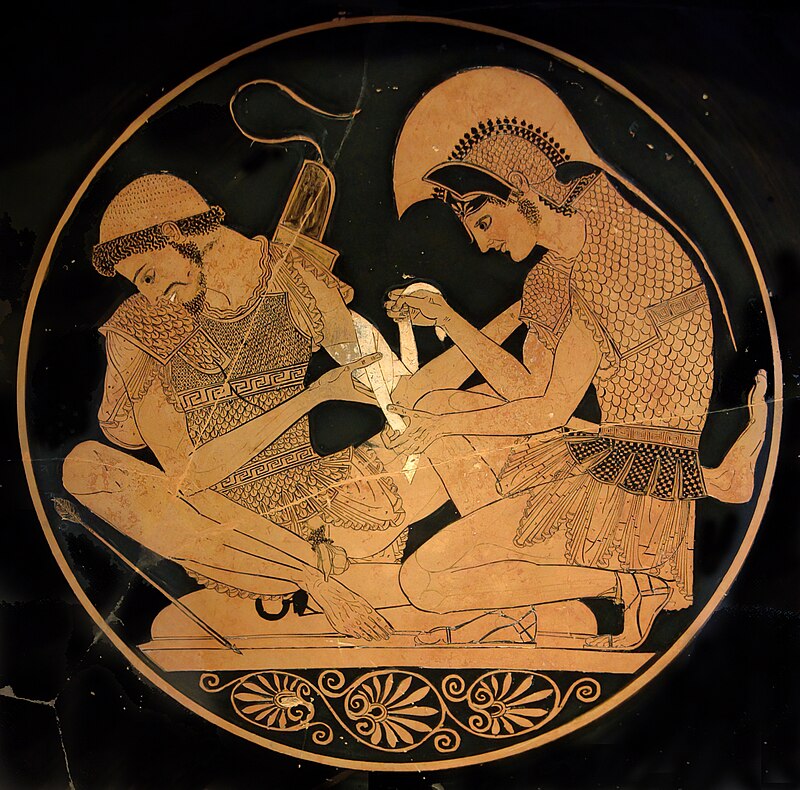
File:Akhilleus_Patroklos_Antikensammlung_Berlin_F2278.jpg · Wikimedia Commons · See Wikimedia Commons
Trojan War
Sign in to savelegendary war in Greek mythology
The Trojan War is a legendary conflict described in Greek mythology, traditionally said to have been fought between Greek forces and the city of Troy over the abduction of Helen. It remains culturally significant because it inspired some of the most influential works of Western literature, including Homer's *Iliad* and *Odyssey*, and continues to shape how people understand ancient heroism, fate, and human conflict.
AI-generated from the Wikipedia summary — may contain errors.
Wikidata facts
- Instance of
- military operation
- Part of
- Greek mythology
- Named after
- Troy
- Location
- Troy
- Image
- Giovanni Domenico Tiepolo - The Procession of the Trojan Horse in Troy - WGA22382.jpg
- Participant
- Troy
Show 5 more facts
- start time
- 1258-00-00
- end time
- 1180-00-00
- on focus list of Wikimedia project
- Wikipedia:Vital articles/Level/4
- Commons category
- Trojan War
- topic's main category
- Category:Trojan War
Sources (3)
via Wikidata · CC0
~40 min read
Encyclopedic overview
The Trojan War was a legendary conflict in Greek mythology that took place around the twelfth or thirteenth century BC. The war was waged by the Achaeans (Greeks) against the city of Troy after Paris of Troy took Helen from her husband Menelaus, king of Sparta. The war is one of the most important events in Greek mythology, and it has been narrated through many works of Greek literature, most notably Homer's Iliad. The core of the Iliad (Books II – XXIII) describes a period of four days and two nights in the tenth year of the decade-long siege of Troy; the Odyssey describes the journey home of Odysseus, one of the war's heroes. Other parts of the war are described in a cycle of epic poems, which have survived through fragments. Episodes from the war provided material for Greek tragedy and other works of Greek literature, and for Roman poets including Virgil and Ovid.
The ancient Greeks believed that Troy was located near the Dardanelles and that the Trojan War was a historical event of the twelfth or thirteenth century BC. By the mid-nineteenth century AD, both the war and the city were widely seen as non-historical, but in 1868, the German archaeologist Heinrich Schliemann met Frank Calvert, who convinced Schliemann that Troy was at what is now Hisarlık in modern-day Turkey. On the basis of excavations conducted by Schliemann and others, this claim is now accepted by most scholars.
Excerpted from Wikipedia’s “Trojan War” article, available under the CC BY-SA 4.0 licence.
Gallery (12)
Available in 102 languages
- Español
- Français
- Deutsch
- 中文
- 日本語
- Русский
- Português
- Italiano
- العربية
- हिन्दी
- Afrikaans
- Albanian
- Albanian
- Aragonese
- Armenian
- Assamese
- Asturian
- azb
Show 83 more
- Azerbaijani
- Bahasa Indonesia
- Bangla
- Bashkir
- Basque
- be_x_old
- Belarusian
- Bosnian
- Breton
- Bulgarian
- Burmese
- Catalan
- Croatian
- Czech
- Danish
- Egyptian Arabic
- Esperanto
- Estonian
- Filipino
- Finnish
- Friulian
- Galician
- Georgian
- Greek
- Hebrew
- Hungarian
- Icelandic
- Ido
- Interlingua
- Irish
- Jamaican Creole English
- Kashmiri
- Kazakh
- Kurdish
- Kyrgyz
- Latin
- Latvian
- Lingua Franca Nova
- Lithuanian
- Macedonian
- Malay
- Malayalam
- Mazanderani
- Mongolian
- Nederlands
- Norwegian
- nrm
- Occitan
- Pashto
- Picard
- Polski
- Punjabi
- Quechua
- Romanian
- Rusyn
- Scots
- Serbian
- Serbian (Latin)
- Sicilian
- simple
- Sinhala
- Slovak
- Slovenian
- Svenska
- Tamil
- Telugu
- Tiếng Việt
- Türkçe
- Ukrainian
- Urdu
- Uzbek
- Venetian
- Waray
- Welsh
- West Flemish
- Western Frisian
- Wu Chinese
- Yiddish
- Zaza
- zh_yue
- فارسی
- ไทย
- 한국어
via Wikidata sitelinks · CC0