
Tunisia
Sign in to saveAlso known as Republic of Tunisia, Tunisian Republic, tn, TUN
Tunisia, officially the Republic of Tunisia, is a country in the Maghreb region of North Africa. It is bordered by Algeria to the west and southwest, Libya to the southeast, and the Mediterranean Sea to the north and east. Tunisia also shares maritime borders with Italy through the islands of Sicily and Sardinia to the north and Malta to the east. It features the archaeological sites of Carthage dating back to the 9th century BC, as well as the Great Mosque of Kairouan. Known for its ancient architecture, souks, and blue coasts, it covers , and has a population of 12.1 million. It contains the
OverviewAI-generated
Tunisia, officially the Tunisian Republic, is a country in Northern Africa. Its capital is Tunis. The nation has a population of 11,972,169 and covers an area of 163,610. It operates as a parliamentary republic and semi-presidential system. The head of state holds the office of President of Tunisia, while the head of government is the Prime Minister of Tunisia. The country is characterized as a free country.
The ethnic groups include European people, Jewish people, and Arabs. Public holidays include International Workers' Day, New Year's Day, Eid al-Fitr, and Eid al-Adha. Diplomatic relations exist with Italy, Germany, France, and the United States. The native labels are تونس, Tunisia, الجمهورية التونسية, and Republic of Tunisia. The license plate code is TN, and the top-level domain is .tn. The time zone is UTC+01:00, also known as Central European Time.
The Gini coefficient is 36.1. Life expectancy is 76.711 years. The unemployment rate is 15.108 percent, and 70.3585355691955 percent of the population lives in urban areas. Internet users account for 76.5 percent of the population. Renewable energy makes up 11.6 percent of the mix. The forest area is 4.55278063851699 percent. The GDP is 51,332,285,656.5422 USD. The electrical plug type is the Europlug.
Synthesized by Vinony from 67 facts across 9 sources: Wikidata, REST Countries, Openweathermap, Open Meteo, World Bank, OpenStreetMap, PubMed, Vinony graph, Geo. Generated from structured data (not the Wikipedia text) and checked against those facts — may still contain errors.
Weather now
7-day forecast
via Open-Meteo
Country
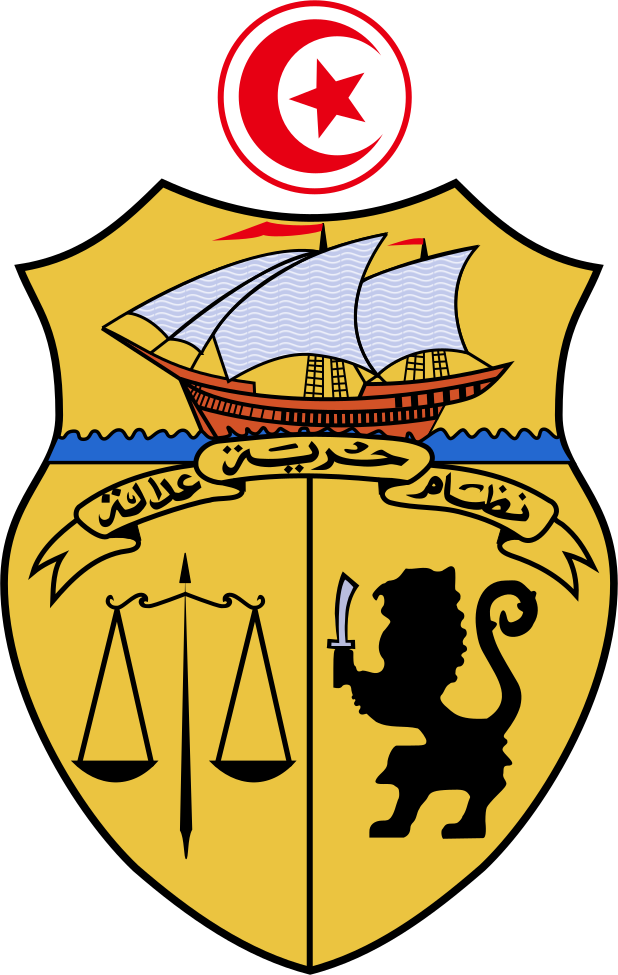
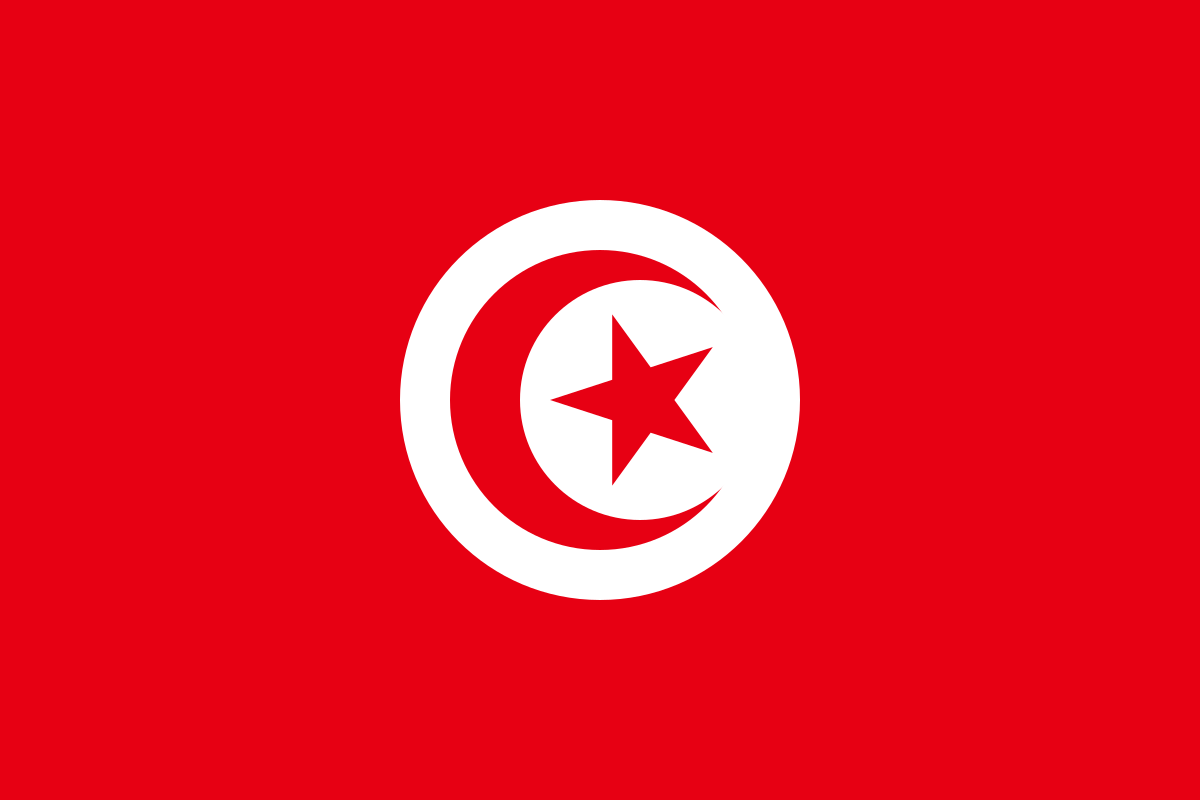
- Capital
- Tunis
- Population
- 11,972,169
- Region
- Africa · Northern Africa
- Demonym
- Tunisian
- Currencies
- TND (د.ت)
- Languages
- Arabic
- Calling code
- +216
- Drives on
- Right
- Gini
- 32.8 (2015)
- FIFA code
- TUN
- TLD
- .tn
- Timezones
- UTC+01:00
- Borders
- DZA, LBY
via REST Countries
Indicators · World Bank
- GDP
- $51.3B(2024)
- Population
- 12,277,109(2024)
- Life expectancy
- 76.7 yrs(2024)
- Unemployment
- 15.1 %(2025)
- Urban population
- 70.4 %(2024)
- Internet users
- 76.5 %(2024)
- Forest area
- 4.6 %(2023)
- Renewable energy
- 11.6 %(2021)
via World Bank Open Data · CC BY 4.0
Wikipedia views (30d)
129,203 totalvia Wikimedia Pageviews API
Key facts
- Country.conventional_long_name
- Republic of Tunisia
- Country.common_name
- Tunisia
- Country.image_flag
- Flag of Tunisia.svg
- Country.image_coat
- Coat of arms of Tunisia.svg
- Country.coa_size
- 70
- Country.national_motto
- """Freedom, Order, Justice"
- Country.national_anthem
- "Humat al-Hima"()
- Country.capital
- Tunis
- Country.largest_city
- capital
- Country.official_languages
- Arabic
- Country.languages_type
- Local vernacular
- Country.languages
- Tunisian Arabic
- Country.languages2_type
- Foreign languages
- Country.languages2
- French and English
- Country.ethnic_groups
- 98% Arabs 1% Berbers 1% Jews and others
- Country.ethnic_groups_year
- 2021
- Country.demonym
- Tunisian
- Country.government_type
- Unitary presidential republic
via Wikipedia infobox
Research
46,891 papers- Actinomycetes studies in Tunisia.ReviewResearch in microbiology · 2025Dhahbi S, Lee J, Ryu D et al.DOI: 10.1016/j.resmic.2025.104279
- Tunisia: communities and community genetics.ReviewCommunity genetics · 2008Chaabouni-Bouhamed HDOI: 10.1159/000133303
- Hepatitis C in Tunisia from 1991 to 2019: A systematic review.La Tunisie medicale · 2021Khedhiri M, Triki H, Triki H
- Aging in Tunisia.The Gerontologist · 2018Karlin NJ, Salem MB, Weil JDOI: 10.1093/geront/gny125
- Tunisia.Department of State publication. Background notes series · 1987United States. Department of State. Bureau of Public Affairs
- Climate change-induced ecosystem disturbance: a review on sclerophyllous and semi-deciduous forests in Tunisia.ReviewPlant biology (Stuttgart, Germany) · 2023Touhami I, Rzigui T, Zribi L et al.DOI: 10.1111/plb.13524
- Cardio-metabolic risk factors in Tunisia: state of the art.ReviewInternal and emergency medicine · 2020Kechida M, Tunisian Society of Internal MedicineDOI: 10.1007/s11739-019-02164-7
- Trends in Adult and Elderly Vaccination: Focus on Vaccination Practices in Tunisia and Morocco.ReviewFrontiers in public health · 2022Abouqal R, Beji M, Chakroun M et al.DOI: 10.3389/fpubh.2022.903376
via PubMed
Wikidata facts
- Named after
- Tunis
- Official name
- الجمهورية التونسية
- Demonym
- Túinéiseach
- Country
- Tunisia
- Contains
- Zaghouan Governorate
- Continent
- Africa
- Capital
- Tunis
- Official language
- Arabic
- Currency
- Tunisian dinar
- Population
- 11972169
- Area
- 163610
- Body of water
- Mediterranean Sea
- Head of government
- Ahmed Hachani
- Head of state
- Kais Saied
- Form of government
- semi-presidential system
- Anthem
- Humat Al Hima
- Shares border with
- Algeria
- Highest point
- Jebel ech Chambi
- Follows
- Beylik of Tunis
- Image
- Tunisia - Location Map (2013) - TUN - UNOCHA.svg
- Households
- 3472188
- Life expectancy
- 35.52
Show 80 more facts
- Nominal GDP
- 46664948952
- Unemployment rate
- 13
- Calling code
- +216
- Licence plate code
- TN
- Mains voltage
- 230
- Motto
- Rhyddid, urddas, cyfiawnder, a threfn
- Flag
- flag of Tunisia
- Coat of arms
- coat of arms of Tunisia
- Significant event
- Tunisian revolution
- Gini coefficient
- 36.1
- topic's main Wikimedia portal
- Portal:Tunisia
- ethnic group
- Arabs
- Unicode character
- 🇹🇳
- category of associated people
- Category:Tunisian people
- trunk prefix
- 00
- geography of topic
- Geography of Tunisia
- office held by head of government
- Prime Minister of Tunisia
- public holiday
- Isra and Mi'raj
- has characteristic
- free country
- diplomatic relation
- North Korea
- office held by head of state
- President of Tunisia
- Commons gallery
- تونس / Tunest / Tunisie
- inception
- 1956-03-20
- history of topic
- history of Tunisia
- native label
- Republik Tunisia
- marriageable age
- 18
- mobile country code
- 605
- total fertility rate
- 2.2
- maritime identification digits
- 672
- topic's main category
- Category:Tunisia
- central bank
- Central Bank of Tunisia
- category for people buried here
- Category:Burials in Tunisia
- age of majority
- 18
- member of
- African Continental Free Trade Area
- railway traffic side
- left
- GS1 country code
- 619
- category for films shot at this location
- Category:Films shot in Tunisia
- category for people who died here
- Category:Deaths in Tunisia
- Commons category
- Tunisia
- top-level Internet domain
- .tn
- category for people born here
- Category:Births in Tunisia
- number of out-of-school children
- 100000
- driving side
- right
- lowest point
- Shatt al Gharsah
- language used
- Malay
- described by source
- Granat Encyclopedic Dictionary
- annual number of weddings
- 107948
- replaces
- French protectorate of Tunisia
- culture
- culture of Tunisia
- VAT rate
- 18
- compulsory education (minimum age)
- 6
- compulsory education (maximum age)
- 14
- archives at
- National Archives of Tunisia
- suicide rate
- 3.2
- speed limit
- 90
- P6413
- Tunisia
- twinned administrative body
- Seto
- BTI Status Index
- 6.26
- BTI Governance Index
- 5.43
- economy of topic
- economy of Tunisia
- demographics of topic
- demographics of Tunisia
- OpenStreetMap zoom level
- 6
- madhhab
- Malikism
- Democracy Index
- 6.59
- Human Development Index
- 0.731
- P11012
- North Korea
- hashtag
- Tunisia
- on focus list of Wikimedia project
- Wikipedia:Vital articles/Level/4
- Happy Planet Index score
- 43.9
- Inequality-adjusted Human Development Index
- 0.588
- P12749
- Rimouski
- birth rate
- 15.6
- death rate
- 7.601
- P8168
- Ashlie Brillault
- male population
- 5905871
- rural population
- 3680393
- female population
- 6066298
- urban population
- 8675724
- mean lifetime
- 1847
- located in/on physical feature
- North Africa
Sources (15)
via Wikidata · CC0
Travel guide
Get in
thumb|250px|A map showing the visa requirements of Tunisia, with countries in green having visa-free access Tunisia depends a lot on tourism; therefore, many people can visit the country without a visa.
See
thumb|Byrsa Hills, some of the remains of Carthage
Eat
Tunisian cuisine has similarities with Middle Eastern cuisine, and mainly builds on the Northern African Maghreb tradition, with couscous and marqa stews (similar to the Moroccan tajine) forming the backbone of most meals. Distinguishing characteristics are the fiery harissa chili sauce, the heavy use of tiny olives which are abundant in the country, and the Tunisian tajine which, unlike the Moroccan dish of the same name, refers to a type of omelette-like pie prepared with a ragout of meat and/or vegetables mixed with herbs, legumes and even offal, enriched with eggs and cheese and baked in a deep pie dish until the eggs are just set, somewhat like an Italian frittata. Lamb forms the basis of most meat dishes and local seafood is plentiful. Pork and pork products are not widely available but can be found in some supermarkets and in some hotels in tourist areas.
thumb|A fiery plate of Harissa
Harissa: very hot spicy chili paste (sometimes made more mild with carrots or yogurt), served with bread and olive oil as a starter at almost any meal. Shorba Frik: lamb soup Coucha: shoulder of lamb cooked with turmeric and cayenne pepper Khobz Tabouna (pronounce Khobz Taboona): traditional oven baked bread Brik (pronounce Breek): very crispy thin pastry with a whole egg (Brik à l'œuf), parsley and onions and sometimes meat like minced lamb or tuna (Brik au thon). Very tasty as an inexpensive starter. Eat it very carefully with your fingers. Berber Lamb: Lamb cooked with potatoes, car…
Drink
Being a progressive Muslim-majority country, alcohol availability is restricted (but not greatly) to certain licensed (and invariably more expensive) restaurants, resort areas and Magasin Général shops. Large department stores (Carrefour at Marsa/Carthage and Hammamet) and some supermarkets (e.g. Monoprix) sell beer and wine, and some local and imported hard liquors, except during Muslim holidays. Female travelers should be aware that, outside resort and areas of significant tourist concentration, they may find themselves with a beer in a smoky bar full of men drinking in a rather dedicated fashion. Some bars will refuse to admit women, others may ask for a passport to check nationality. Look around a bar before you decide to imbibe!
Beer: Celtia is the popular local brand, but some places also carry imported pilsner beers. Locally brewed Löwenbräu is decent, and Heineken has entered in the Tunisian market in 2007. Celtia "En Pression" (On Tap) is good. Celestia is a non-alcoholic beer which is also popular. Wine: Most places that serve alcohol will have Tunisian wine, which is quite good. Tunisian wine always was produced by French oenologists. Most of it was exported to France till the 1970s. Wine cooperatives were left and produce 80% of the wine which is served mostly to tourists. Since the privatisation of some parts of these cooperatives the international taste of wine entered the market in Tunisia. The small companies like Domaine Atlas, St. Augustin, Ceptunes etc. ha…
Sleep
There are lots of fine hotels in Tunisia. Many smaller hotels can be found in major cities, tucked into most roads. Hotel star ratings are not at par with European and US standards - a 4-star Tunisian hotel is the equivalent of a 3-star hotel elsewhere.
You can also rent a furnished apartment. Some private people offer their own apartments for rent especially in summer.
It is advisable to organise your accommodations online or by phone prior to your arrival. Other than pricier hotels, most accommodations don't seem to have a website. French would be handy when booking accommodations.
thumb|The Tunisian Desert
Respect
Tunisia is a Muslim-majority country, and one should be mindful of the dress code depending on the region. Whilst a lot of skin (even topless) is tolerated on beaches and within hotel complexes, a modest amount of exposed skin may be frowned upon outside these areas. That said, the country is also home to long-established Christian and Jewish minorities who are free to practice their religions, but may not proselytize to Muslims.
Be aware that the further south one travels, the more conservative Tunisia becomes. While most women wear western-style clothing in the Capital (which is a mix of Mediterranean, European and Middle Eastern cultures), Southern Tunisia is more conservative and far more traditional.
Travel guide from Wikivoyage (CC BY-SA 4.0)
~40 min read
Encyclopedic overview
42 sectionsContents
- Etymology
- History
- Antiquity
- Middle Ages
- Ottoman Tunisia
- French Protectorate of Tunisia (1881–1956)
- Struggle for independence (1943–1956)
- Post-independence (1956–2011)
- Post-revolution (since 2011)
- Presidency of Kais Saied (2019–present)
- Geography
- Government and politics
- Foreign relations
- Military
- Administrative divisions
- Economy
- Tourism
- Energy
- Transport
- Water supply and sanitation
- Demographics
- Ethnic groups
- Languages
- Religion
- Education
- Health
- Culture
- Painting
- Literature
- Music
- Festivals
- Media
- Sports
- See also
- Notes
- References
- Further reading
- External links
- Government
- History
- Tourism
- Maps
Tunisia, officially the Republic of Tunisia, is a country in the Maghreb region of North Africa. It is bordered by Algeria to the west and southwest, Libya to the southeast, and the Mediterranean Sea to the north and east. Tunisia also shares maritime borders with Italy through the islands of Sicily and Sardinia to the north and Malta to the east. It features the archaeological sites of Carthage dating back to the 9th century BC, as well as the Great Mosque of Kairouan. Known for its ancient architecture, souks, and blue coasts, it covers 163,610 km (63,170 sq mi), and has a population of 12.1 million. It contains the eastern end of the Atlas Mountains and the northern reaches of the Sahara desert; much of its remaining territory is arable land. Its 1,300 km (810 mi) of coastline includes the African conjunction of the western and eastern parts of the Mediterranean Basin. Tunisia is home to Africa's northernmost point, Cape Angela. Located on the northeastern coast, Tunis is the capital of the country, which is itself named after Tunis. The official language of Tunisia is Arabic. The vast majority of Tunisia's population is Arab and Muslim. Vernacular Tunisian Arabic is the most spoken language, and French serves as an administrative and educational language in some contexts, but has no official status.
Beginning in early antiquity, Tunisia was inhabited by the indigenous Berbers. The Phoenicians, a Semitic people, began to arrive in the 12th century BC, settling on the coast and establishing several settlements, of which Carthage emerged as the most powerful by the 7th century BC. The descendants of the Phoenician settlers came to be known as the Punic people. Ancient Carthage was a major mercantile empire and a military rival to the Roman Republic until 146 BC when it was defeated by the Romans who occupied Tunisia for most of the next 800 years. The Romans introduced Christianity and left architectural legacies like the Amphitheatre of El Jem. In the 7th century AD, Arab Muslims conquered Tunisia and settled with their tribes and families, bringing Islam and Arab culture. A later large-scale Arab migration of Banu Hilal and Banu Sulaym tribes in the 11th-12th centuries accelerated this process. By around the 15th century, the region of modern-day Tunisia had already been almost completely Arabized. Then, in 1546, the Ottoman Empire established control, holding sway until 1881, when the French conquered Tunisia. In 1956, Tunisia gained independence as the Tunisian Republic. Today, Tunisia's culture and identity are rooted in this centuries-long intersection of different cultures and ethnicities.
Excerpted from Wikipedia’s “Tunisia” article, available under the CC BY-SA 4.0 licence.
Gallery (59)
On the map
6 mapped locations
Available in 270 languages
- Español
- Français
- Deutsch
- 中文
- 日本語
- Русский
- Português
- Italiano
- العربية
- हिन्दी
- Abkhazian
- Achinese
- Adyghe
- Afrikaans
- Akan
- Albanian
- Albanian
- Amharic
Show 251 more
- ami
- Angika
- Aragonese
- Aramaic
- Armenian
- Arpitan
- Assamese
- Asturian
- azb
- Azerbaijani
- Bahasa Indonesia
- Balinese
- Bambara
- Bangla
- Banjar
- Bashkir
- Basque
- bat_smg
- Bavarian
- be_x_old
- Belarusian
- Betawi
- Bhojpuri
- Bikol
- Bishnupriya
- Bislama
- Bosnian
- Breton
- Buginese
- Bulgarian
- Buriat
- Burmese
- Catalan
- cbk_zam
- cdo
- Cebuano
- Central Kurdish
- Chechen
- Chuvash
- Cornish
- Corsican
- Crimean Tatar
- Croatian
- Czech
- dag
- Danish
- Divehi
- dty
- Dzongkha
- Egyptian Arabic
- eml
- Erzya
- Esperanto
- Estonian
- Ewe
- Extremaduran
- Faroese
- Fiji Hindi
- Filipino
- Finnish
- fiu_vro
- Fon
- Fula
- Gagauz
- Galician
- Ganda
- gcr
- Georgian
- Gilaki
- Goan Konkani
- Gorontalo
- gpe
- Greek
- Guarani
- Gujarati
- Haitian Creole
- Hakka Chinese
- Hausa
- Hawaiian
- Hebrew
- Hungarian
- hyw
- Iban
- Icelandic
- Ido
- Igbo
- Iloko
- Inari Sami
- Interlingua
- Interlingue
- Irish
- Jamaican Creole English
- Javanese
- Jju
- Kabyle
- Kannada
- Kanuri
- Kara-Kalpak
- Karachay-Balkar
- Kashmiri
- Kashubian
- Kazakh
- kbp
- kge
- Khmer
- Kikuyu
- Kinyarwanda
- Kongo
- Kotava
- Kurdish
- Kyrgyz
- Ladino
- Lao
- Latin
- Latvian
- Lezghian
- Ligurian
- Limburgish
- Lingala
- Lingua Franca Nova
- Lithuanian
- lld
- Lojban
- Lombard
- Low German
- Lower Sorbian
- Luxembourgish
- Macedonian
- Madurese
- Malagasy
- Malay
- Malayalam
- Maltese
- Manipuri
- Manx
- Māori
- Marathi
- Mari
- Mazanderani
- Minangkabau
- Mingrelian
- Mirandese
- Moksha
- Mongolian
- Moroccan Arabic
- Navajo
- nds_nl
- Nederlands
- Nepali
- Newari
- Northern Frisian
- Northern Sami
- Northern Sotho
- Norwegian
- Norwegian Nynorsk
- Novial
- nup
- Obolo
- Occitan
- Odia
- Old English
- olo
- Oromo
- Ossetic
- Pampanga
- Papiamento
- Pashto
- Picard
- Piedmontese
- Polski
- Pontic
- Punjabi
- Quechua
- Romanian
- Romansh
- Rusyn
- Samoan
- Sango
- Sanskrit
- Sardinian
- Saterland Frisian
- Scots
- Scottish Gaelic
- Serbian
- Serbian (Latin)
- Shan
- Shona
- Sicilian
- Silesian
- simple
- Sindhi
- Sinhala
- Slovak
- Slovenian
- Somali
- Southern Sotho
- Standard Moroccan Tamazight
- Sundanese
- Svenska
- Swahili
- Swati
- syl
- szy
- Tachelhit
- Tajik
- Talysh
- Tamil
- Taroko
- Tatar
- tay
- Telugu
- Tibetan
- Tiếng Việt
- Tigrinya
- Toki Pona
- Tsonga
- Tswana
- Tumbuka
- Türkçe
- Turkmen
- Tyap
- Udmurt
- Ukrainian
- Upper Sorbian
- Urdu
- Uyghur
- Uzbek
- Venetian
- Veps
- Volapük
- Walloon
- Waray
- Welsh
- Western Frisian
- Western Mari
- Western Panjabi
- Wolof
- Wu Chinese
- Yakut
- Yiddish
- Yoruba
- Zaza
- Zeelandic
- zh_classical
- zh_min_nan
- zh_yue
- Zhuang
- Zulu
- فارسی
- ไทย
- 한국어
via Wikidata sitelinks · CC0