
File:ULURU.jpg · Wikimedia Commons · See Wikimedia Commons
Uluru
Sign in to saveAlso known as Ayers Rock, Uluru/Ayers Rock, Uluru / Ayers Rock
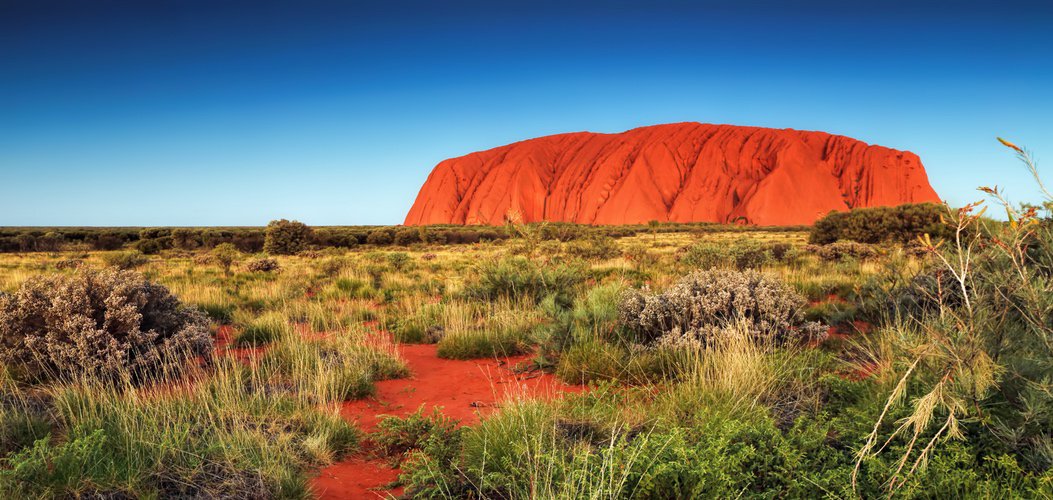
Uluru (; ), also known as Ayers Rock ( ) and officially gazetted as UluruAyers Rock, is a large sandstone monolith. It crops out near the centre of Australia in the southern part of the Northern Territory, south-west of Alice Springs.
Uluru, also known as Ayers Rock, is a massive sandstone rock formation located in central Australia near Alice Springs in the Northern Territory. It is significant as a prominent natural landmark in the Australian landscape and holds cultural importance for Indigenous Australian peoples.
AI-generated from the Wikipedia summary — may contain errors.
Key facts
- Mountain.name
- Uluru
- Mountain.other_name
- Ayers Rock
- Mountain.photo
- File:ULURU.jpg
- Mountain.photo_size
- 275px
- Mountain.elevation_m
- 863
- Mountain.prominence_m
- 348
- Mountain.location
- Northern Territory, Australia
- Mountain.map
- Northern Territory#Australia
- Mountain.type
- Inselberg
- Mountain.age
- 550–530 Ma
- Mountain.geology
- Arkose
- Mountain.mapframe
- yes
- Mountain.mapframe zoom
- 13
- Mountain.mapframe wikidata
- yes
- UNESCO World Heritage Site.Official_name
- Uluṟu-Kata Tjuṯa National Park
- UNESCO World Heritage Site.Criteria
- v, vi, vii, ix
- UNESCO World Heritage Site.ID
- 447
- UNESCO World Heritage Site.Year
- 1987
via Wikipedia infobox
Official website
Uluṟu-Kata Tjuṯa National Park | Parks Australia
Anangu welcome you to Uluru-Kata Tjuta National Park, a living cultural landscape where earth and memories exist as one.
environment.gov.au →Link to the official site · 12,258 chars · not written by Vinony
Wikidata facts
- Instance of
- inselberg
- Country
- Australia
- Located in
- Northern Territory
- Elevation
- 863
- Material used
- arkose
- Mass
- 1425000000
- Official website
- www.environment.gov.au/parks/uluru/index.html
- Image
- Sunset at Uluru on July 30, 2005.jpg
Show 9 more facts
- located in protected area
- Uluṟu-Kata Tjuṯa National Park
- topographic prominence
- 67
- Commons category
- Uluru
- Commons gallery
- Uluru
- time period
- Neoproterozoic
- topic's main category
- Category:Uluru
- name
- Roca de Ayers
- native label
- Uluru
- volume as quantity
- 0.6
Sources (6)
via Wikidata · CC0
~25 min read
Encyclopedic overview
26 sectionsContents
- Name
- Description
- History
- Early settlement
- Arrival of Europeans (1870s)
- Aboriginal reserve (1920)
- Tourism (1936–1960s)
- Aboriginal ownership since 1985
- Tourism
- Climbing
- Photography
- Waterfalls
- Geology
- Composition
- Age and origin
- Aboriginal myths, legends and traditions
- Creation of the rock
- Other stories
- Mala story
- Flora and fauna
- Climate and five seasons
- See also
- References
- Citations
- Bibliography
- External links
Uluru (; ), also known as Ayers Rock ( ) and officially gazetted as UluruAyers Rock, is a large sandstone monolith. It crops out near the centre of Australia in the southern part of the Northern Territory, south-west of Alice Springs.
Uluru is sacred to the Pitjantjatjara, the Aboriginal people of the area, known as the Aṉangu. The area around the formation is home to an abundance of springs, waterholes, rock caves and ancient paintings. Uluru is listed as a UNESCO World Heritage Site. Uluru and Kata Tjuta (also known as the Olgas) are the two major features of the Uluṟu-Kata Tjuṯa National Park.
Excerpted from Wikipedia’s “Uluru” article, available under the CC BY-SA 4.0 licence.
Gallery (39)
On the map
3 mapped locations
Available in 90 languages
- Español
- Français
- Deutsch
- 中文
- 日本語
- Русский
- Português
- Italiano
- العربية
- हिन्दी
- Afrikaans
- Albanian
- Albanian
- Armenian
- Azerbaijani
- Bahasa Indonesia
- Balinese
- Basque
Show 71 more
- be_x_old
- Belarusian
- Betawi
- Breton
- Bulgarian
- Catalan
- Cebuano
- Croatian
- Czech
- Danish
- Egyptian Arabic
- Esperanto
- Estonian
- Faroese
- Filipino
- Finnish
- Galician
- Georgian
- Greek
- Hebrew
- Hungarian
- Icelandic
- Ido
- Inari Sami
- Interlingua
- Irish
- Kazakh
- Khmer
- Latin
- Latvian
- Lezghian
- Limburgish
- Lithuanian
- Luxembourgish
- Macedonian
- Malay
- Malayalam
- Maltese
- Māori
- Nederlands
- Nepali
- Northern Frisian
- Norwegian
- Norwegian Nynorsk
- Occitan
- Polski
- Punjabi
- Quechua
- Romanian
- Serbian
- Serbian (Latin)
- simple
- Sinhala
- Slovak
- Slovenian
- Svenska
- Swahili
- Tamil
- Tiếng Việt
- Toki Pona
- Türkçe
- Ukrainian
- Urdu
- Waray
- Welsh
- Western Panjabi
- Wu Chinese
- zh_yue
- فارسی
- ไทย
- 한국어
via Wikidata sitelinks · CC0