Encyclopedia of Life · EOL (see source)
Ustilaginaceae
Sign in to saveThe Ustilaginaceae are a family of smut fungi in the order Ustilaginomycetes. Collectively, the family contains 17 genera and 607 species.
Species
FAMILY
- KingdomFungi
- PhylumBasidiomycota
- ClassUstilaginomycetes
- OrderUstilaginales
- FamilyUstilaginaceae
Dieser Artikel wurde aufgrund von formalen oder inhaltlichen Mängeln in der Qualitätssicherung Biologie im Abschnitt „Mykologie“ zur Verbesserung eingetragen. Dies geschieht, um die Qualität der Biologie-Artikel auf ein akzeptables Niveau zu bringen. Bitte hilf mit, diesen Artikel zu verbessern! Artikel, die nicht signifikant verbessert werden, können gegebenenfalls gelöscht werden. Lies dazu auch die näheren Informationen in den Mindestanforderungen an Biologie-Artikel. Die Brandpilzverwandten (Ustilaginaceae) sind eine Familie aus der Ordnung der Brandpilzartigen (Ustilaginales). Die Familie umfasst 17 Gattungen und 607 Arten.[1] Inhaltsverzeichnis 1 Biotechnologische Relevanz 2 Systematik 3 Einzelnachweise 4 Weblinks Biotechnologische Relevanz Viele Arten produzieren natürlicherweise ein großes Spektrum an wertvollen Chemikalien (z. B. Sekundärmetabolite, TCA-Zyklus Intermediate) mit wachsendem biotechnologischen Interesse.[2] Zu diesen Chemikalien zählen Polyole (Erythritol, Mannitol), organische Säuren (Itaconsäure, Malat, Succinat), extrazelluläre Glycolipide (Mannosylerythritol Lipide, Ustilaginsäure), Eisen-bindende Siderophore und Tryptophan-Derivate.[3][4] Systematik Ahma
via GBIF
Museum specimens
- Specimen records
- 17
- With media
- 9
- Family
- Ustilaginaceae
- Collections
- MICH, FH, BPBM, UFPE, IAP
- Recorded in
- Bulgaria, United States, China, South Africa, Philippines, áFrica Do Sul
Wikidata facts
- Instance of
- taxon
- Parent taxon
- Ustilaginales
- Image
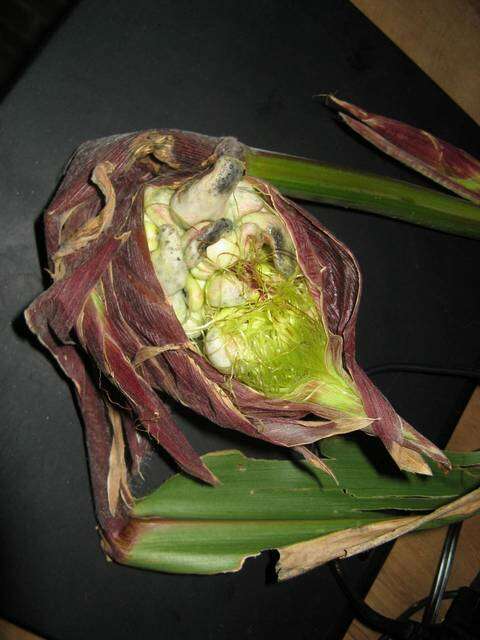
- Huitlacoche.jpg
Show 4 more facts
- Commons category
- Ustilaginaceae
- taxon name
- Ustilaginaceae
- taxon rank
- family
- topic's main category
- Category:Ustilaginaceae
Sources (1)
via Wikidata · CC0
~2 min read
Encyclopedic overview
4 sectionsContents
- Biotechnological relevance
- Genera
- References
- External links
The Ustilaginaceae are a family of smut fungi in the order Ustilaginomycetes. Collectively, the family contains 17 genera and 607 species.
==Biotechnological relevance== Ustilaginaceae naturally produce a wide range of value-added chemicals (e.g. secondary metabolites, TCA cycle intermediates) with growing biotechnological interest. Reported metabolites are polyols, organic acids, extracellular glycolipids, iron-chelating siderophores and tryptophan derivatives. Polyols, such as erythritol (ery) and mannitol, for example, have large markets as sweeteners for diabetics and as facilitating agents for the transportation of pharmaceuticals in medicine. Itaconic, L-malic, succinic, l-itatartaric, and l-2-hydroxyparaconic acid are organic acids produced by many Ustilaginomycetes. Applications for itaconic acid are for example the production of resins, plastics, adhesives, elastomers, coatings, and nowadays itaconate is discussed as a platform chemical in the production of biofuels. Malic acid is used in many food products, primarily as an acidulant. Succinic acid is utilized as a precursor to pharmaceutical ingredients, such as additives, solvents, and polymers, but also as a food additive and dietary supplement. Another category of metabolites produced by smut fungi contains extracellular glycolipids, such as mannosylerythritol lipids and ustilagic acid. These lipids have biosurfactant properties and can be used in pharmaceutical, cosmetic, and food applications and are known for their strong fungicidal activity on many species.
Excerpted from Wikipedia’s “Ustilaginaceae” article, available under the CC BY-SA 4.0 licence.