File:Water_valves_with_spigots.jpg · Wikimedia Commons · See Wikimedia Commons
valve
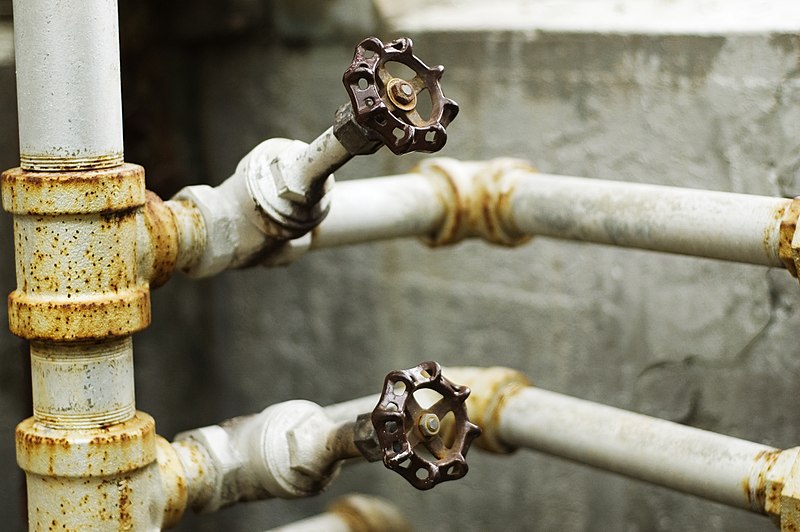
Sign in to savethumb|These water valves are operated by handle#Twist handles|rotary handles. A valve is a device or natural object that regulates, directs or controls the flow of a fluid (gases, liquids, fluidized solids, or slurries) by opening, closing, or partially obstructing various passageways. Valves are technically fittings, but are usually discussed as a separate category. In an open valve, fluid flows in a direction from higher pressure to lower pressure. The word is derived from the Latin valva, the moving part of a door, in turn from volvere, to turn, roll.
A valve is a device that controls the flow of fluids—such as gases, liquids, or slurries—by opening, closing, or partially blocking the passages they travel through. Valves matter because they allow us to manage and direct the movement of fluids in everything from water systems to industrial equipment, making them essential components in countless everyday applications.
AI-generated from the Wikipedia summary — may contain errors.
Wikidata facts
- Part of
- piping
- Image
- Valve cross-section.PNG
Show 4 more facts
- Commons category
- Valves
- Commons gallery
- Valve
- different from
- Q231775
- topic's main category
- Category:Valves
Sources (2)
via Wikidata · CC0
~21 min read
Encyclopedic overview
25 sectionsContents
- Applications
- Variation
- Types
- Components
- Body
- Bonnet
- Ports
- Handle or actuator
- Disc
- Seat
- Stem
- Gaskets
- Valve balls
- Spring
- Trim
- Valve operating positions
- Two-port valves
- Three-port valves
- Four-port valves
- Control
- Other considerations
- Images
- See also
- References
- External links
thumb|These water valves are operated by handle#Twist handles|rotary handles. A valve is a device or natural object that regulates, directs or controls the flow of a fluid (gases, liquids, fluidized solids, or slurries) by opening, closing, or partially obstructing various passageways. Valves are technically fittings, but are usually discussed as a separate category. In an open valve, fluid flows in a direction from higher pressure to lower pressure. The word is derived from the Latin valva, the moving part of a door, in turn from volvere, to turn, roll.
The simplest, and very ancient, valve is simply a freely hinged flap which swings down to obstruct fluid (gas or liquid) flow in one direction, but is pushed up by the flow itself when the flow is moving in the opposite direction. This is called a check valve, as it prevents or "checks" the flow in one direction. Modern control valves may regulate pressure or flow downstream and operate on sophisticated automation systems.
Excerpted from Wikipedia’s “valve” article, available under the CC BY-SA 4.0 licence.