File:Varangian_routes.png · Wikimedia Commons · See Wikimedia Commons
Varangians
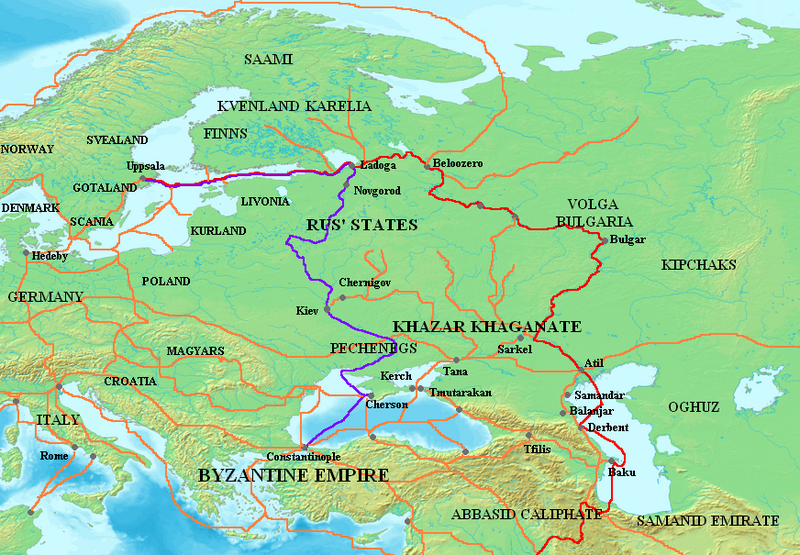
Sign in to savethumb|upright=1.5|Map showing the major Varangian trade routes: the Volga trade route (in red) and the Dnieper and Dniester routes (in purple). Other trade routes of the 8th–11th centuries shown in orange.
The Varangians were Norse merchants and warriors who established major trade routes through Eastern Europe from the 8th to 11th centuries, connecting Scandinavia to the Middle East and beyond via rivers like the Volga and Dnieper. They were historically significant because they facilitated extensive long-distance commerce across vast territories and played a foundational role in the early development of Eastern European states.
AI-generated from the Wikipedia summary — may contain errors.
Wikidata facts
- Instance of
- ethnic group
- Subclass of
- Scandinavians
- Image
- Scandinavian Pendants from Gnyozdovo 01.jpg
Show 4 more facts
- described by source
- Hustyn Chronicle
- Commons category
- Varangians
- topic's main category
- Category:Varangians
- on focus list of Wikimedia project
- WikiProject Ukraine
Sources (2)
via Wikidata · CC0
~21 min read
Encyclopedic overview
11 sectionsContents
- Etymology
- Runestones
- Kievan Rus'
- Islamic world
- Byzantine Empire
- Varangian Guard
- In popular culture
- See also
- References
- Further reading
- External links
thumb|upright=1.5|Map showing the major Varangian trade routes: the Volga trade route (in red) and the Dnieper and Dniester routes (in purple). Other trade routes of the 8th–11th centuries shown in orange.
The Varangians ( ; ; ; , or ) were Viking warriors, traders and settlers, mostly from present-day Sweden, who settled in the territories of present-day Belarus, Russia and Ukraine from the 8th and 9th centuries and established the state of Kievan Rus' as well as the principalities of Polotsk and Turov. They also formed the Byzantine Varangian Guard.
Excerpted from Wikipedia’s “Varangians” article, available under the CC BY-SA 4.0 licence.
Gallery (22)
Available in 60 languages
- Español
- Français
- Deutsch
- 中文
- 日本語
- Русский
- Português
- Italiano
- العربية
- हिन्दी
- Afrikaans
- Armenian
- Azerbaijani
- Bahasa Indonesia
- Basque
- be_x_old
- Belarusian
- Bosnian
Show 41 more
- Breton
- Bulgarian
- Catalan
- Croatian
- Czech
- Danish
- Esperanto
- Estonian
- Finnish
- Galician
- Georgian
- Greek
- Hebrew
- Icelandic
- Kazakh
- Kyrgyz
- Latin
- Latvian
- Lithuanian
- Malagasy
- Nederlands
- Norwegian
- Norwegian Nynorsk
- Polski
- Romanian
- Rusyn
- Serbian
- Serbian (Latin)
- simple
- Slovak
- Slovenian
- Svenska
- Tatar
- Türkçe
- Ukrainian
- Upper Sorbian
- Uzbek
- Welsh
- فارسی
- ไทย
- 한국어
via Wikidata sitelinks · CC0