File:Helianthus_stem_2_L.jpg · Wikimedia Commons · See Wikimedia Commons
Wikidata facts
- Image
- काष्ठीय तने की अनुप्रस्थ काट और संवहनी एधा.svg
Show 2 more facts
- on focus list of Wikimedia project
- Wikipedia:Vital articles/Level/4
- Commons category
- Cambium
via Wikidata · CC0
~6 min read
Encyclopedic overview
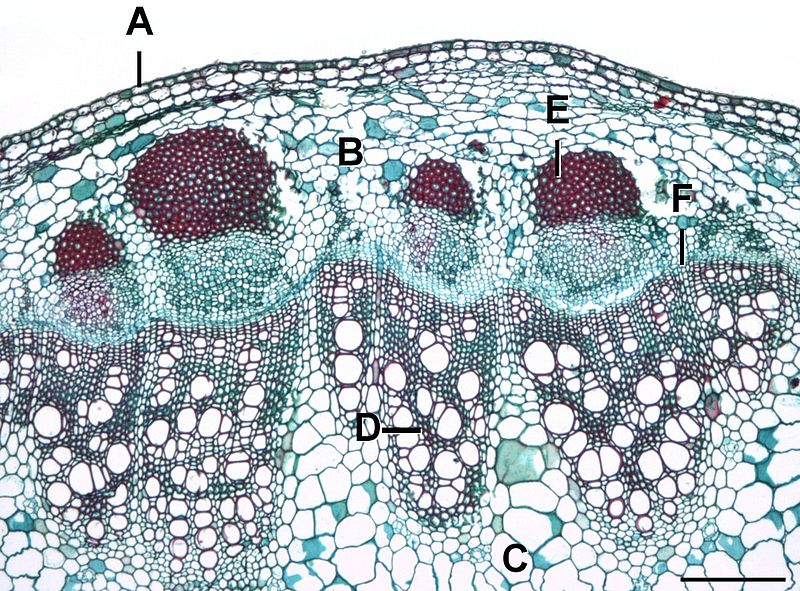
Helianthus stem in section. The cells of the vascular cambium (F) divide to form phloem on the outside, located beneath the bundle cap (E), and xylem (D) on the inside. Most of the vascular cambium is here in vascular bundles (ovals of phloem and xylem together) but it is starting to join these up as at point F between the bundles. The vascular cambium is the main growth tissue in the stems and roots of many plants exhibiting secondary growth, specifically in dicots such as buttercups and oak trees, gymnosperms such as pine trees, as well as in certain other vascular plants. It produces secondary xylem inwards, towards the pith, and secondary phloem outwards, towards the bark. Generally, more secondary xylem is produced than secondary phloem.
In herbaceous plants, it occurs in the vascular bundles which are often arranged like beads on a necklace forming an interrupted ring inside the stem. In woody plants, it forms a cylinder of unspecialized meristem cells, as a continuous ring from which the new tissues are grown. Unlike the xylem and phloem, it does not transport water, minerals or food through the plant. Other names for the vascular cambium are the main cambium, wood cambium, or bifacial cambium.
Excerpted from Wikipedia’s “vascular cambium” article, available under the CC BY-SA 4.0 licence.