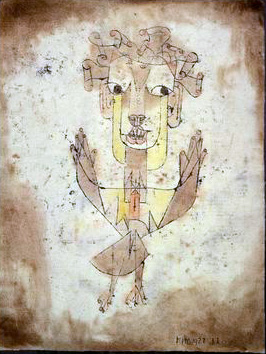
File:Klee,_Angelus_novus.png · Wikimedia Commons · See Wikimedia Commons
Walter Benjamin
Sign in to saveAlso known as Walter Bendix Schönflies Benjamin
German cultural critic, philosopher and social critic (1892–1940)
OverviewAI-generated
Walter Benjamin (1892–1940) was a male figure associated with critical theory, philosophy, and audio books. He is also identified as a British composer from the United Kingdom, with genres including 20th century and classical music. Benjamin wrote under the pseudonyms "Benedix Schönflies" and "Detlev Holz."
His literary output includes works such as *Radical Thinkers Set 4*, *Correspondência*, *Berliner Kindheit um Neunzehnhundert*, *Poésie et révolution*, and *Mythe et violence*. One of his recorded quotes is, "I would like to metamorphose into a mouse-mountain."
Synthesized by Vinony from 24 facts across 7 sources: Wikidata, Last.fm, Crossref, Wikiquote, MusicBrainz, Open Library, Vinony graph. Generated from structured data (not the Wikipedia text) and checked against those facts — may still contain errors.
Wikidata facts
- Instance of
- human
- Given name
- Walter
- Family name
- Benjamin
- Gender
- male
- Citizenship
- German Reich
- Place of birth
- Berlin
- Place of death
- Portbou
- Occupation
- translator
- Educated at
- University of Freiburg
- Languages spoken
- German
- Native language
- German
- Notable work
- The arcades project
- Field of work
- philosophy
- Movement
- Marxism
- Image
- Walter Benjamin vers 1928.jpg
- Work location
- Paris
- Significant event
- Nazi book burnings
Show 15 more facts
- influenced by
- Georg Lukács
- Commons category
- Walter Benjamin
- date of birth
- 1892-07-15
- date of death
- 1940-09-26
- topic's main category
- Category:Walter Benjamin
- manner of death
- Suicide
- described by source
- Pax Leksikon
- relative
- Arthur Moritz Schoenflies
- name in native language
- Walter Benjamin
- writing language
- German
- pseudonym
- Detlev Holz
- P8168
- Oomycetes
- on focus list of Wikimedia project
- Wikipedia:Vital articles/Level/4
- IPA transcription
- ˌvaltɐ ˈbɛnjamiːn
- hashtag
- WalterBenjamin
Sources (11)
via Wikidata · CC0
~40 min read
Encyclopedic overview
Walter Bendix Schönflies Benjamin (/ˈbɛnjəmɪn/ BEN-yə-min; German: [ˈvaltɐ ˈbɛnjamiːn] ; 15 July 1892 – 26 September 1940) was a German philosopher, cultural critic, media theorist, and essayist. An eclectic thinker who combined elements of German idealism, Jewish mysticism, Western Marxism, and post-Kantianism, he made contributions to the philosophy of history, metaphysics, historical materialism, criticism, and aesthetics, and had an oblique but overwhelmingly influential impact on the resurrection of the Kabbalah by virtue of his life-long epistolary relationship with Gershom Scholem.
In popular culture and left-wing journalism he often appears as an exemplar whose experience is representative of the tragedy of German Jewish intellectuals under Nazi Germany.
Excerpted from Wikipedia’s “Walter Benjamin” article, available under the CC BY-SA 4.0 licence.
Gallery (8)
Available in 71 languages
- Español
- Français
- Deutsch
- 中文
- 日本語
- Русский
- Português
- Italiano
- العربية
- Afrikaans
- Albanian
- Armenian
- Asturian
- Azerbaijani
- Bahasa Indonesia
- Bangla
- Basque
- Bosnian
Show 52 more
- btm
- Bulgarian
- Catalan
- Croatian
- Czech
- Danish
- Egyptian Arabic
- Esperanto
- Estonian
- Finnish
- Galician
- Greek
- Hebrew
- Hungarian
- Icelandic
- Ido
- Kazakh
- Latin
- Latvian
- Lithuanian
- Malagasy
- Malayalam
- Nederlands
- Norwegian
- Occitan
- Pashto
- Piedmontese
- Polski
- Punjabi
- Romanian
- Sardinian
- Scots
- Serbian
- Serbian (Latin)
- simple
- Slovak
- Slovenian
- Svenska
- Tamil
- Tiếng Việt
- Türkçe
- Ukrainian
- Urdu
- Waray
- Welsh
- Western Frisian
- Wu Chinese
- Yoruba
- zh_min_nan
- zh_yue
- فارسی
- 한국어
via Wikidata sitelinks · CC0