(c) Rafael Medina, some rights reserved (CC BY) · cc-by
Warionia
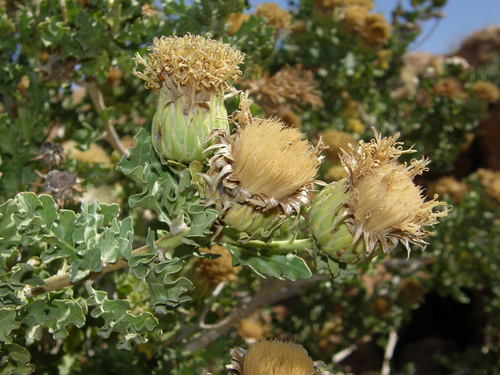
Sign in to saveWarionia is a genus in the tribe Cichorieae within the family Asteraceae. The only known species is Warionia saharae, an endemic of Algeria and Morocco, and it is locally known in the Berber language as afessas, abessas or tazart n-îfiss. It is an aromatic, thistle-like shrub of ½–2 m high, that contains a white latex, and has fleshy, pinnately divided, wavy leaves. It is not thorny or prickly. The aggregate flower heads contain yellow disk florets. It flowers from April till June. Because Warionia is deviant in many respects from any other Asteraceae, different scholars have placed it he
Species
GENUS
- KingdomPlantae
- PhylumTracheophyta
- ClassMagnoliopsida
- OrderAsterales
- FamilyAsteraceae
via GBIF · Kew POWO
Museum specimens
- Specimen records
- 12
- With media
- 12
- Family
- Asteraceae
- Collections
- GH, VT, MNHN
- Recorded in
- Morocco, Algeria
~8 min read
Encyclopedic overview
13 sectionsContents
- Description
- Root, stem and leaf
- Inflorescence
- Florets
- Fruit
- Phytochemistry
- Taxonomy
- Phylogeny
- Etymology
- Distribution and ecology
- Cultivation
- Use
- References
Warionia is a genus in the tribe Cichorieae within the family Asteraceae. The only known species is Warionia saharae, an endemic of Algeria and Morocco, and it is locally known in the Berber language as afessas, abessas or tazart n-îfiss. It is an aromatic, thistle-like shrub of ½–2 m high, that contains a white latex, and has fleshy, pinnately divided, wavy leaves. It is not thorny or prickly. The aggregate flower heads contain yellow disk florets. It flowers from April till June. Because Warionia is deviant in many respects from any other Asteraceae, different scholars have placed it hesitantly in the Cardueae, Gundelieae, Mutisieae, but now genetic analysis positions it as the sister group to all other Cichorieae.
== Description == Wariona is an aromatic shrub, usually between ½–2 m, occasionally only 15 cm or up to 3 m high, that has a network of latex-carrying canals throughout the plant with sticky, white, milky latex. It also has oil canals. It carries glandular hairs that consist of two parallel series of a few cells on top of each other (or biserial). It has thirty-four chromosomes (2n = 34).
Excerpted from Wikipedia’s “Warionia” article, available under the CC BY-SA 4.0 licence.
Gallery (3)
Available in 10 languages
via Wikidata sitelinks · CC0