Category
page 1Matter of France

Charlemagne
Charlemagne ( ; 2 April 748 – 28 January 814) was King of the Franks from 768, King of the Lombards from 774, and Emperor of what is now known as the Carolingian Empire from 800. He united most of Western and Central Europe and was the first recognised emperor to rule from the west after the fall of the Western Roman Empire approximately three centuries earlier. Charlemagne's reign was marked by political and social changes that had lasting influence on Europe throughout the Middle Ages.

Aachen
thumb|Location of Aachen in the Meuse (Dutch and German: Maas) river system ()

The Song of Roland
medieval epic work
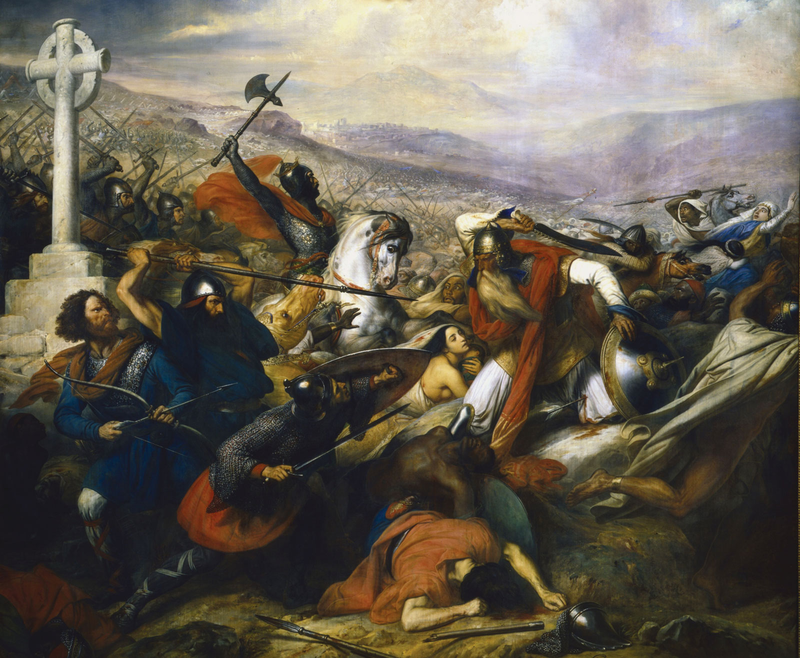
Battle of Tours
battle fought in 732 by Merovingian Franks against the Umayyad Caliphate

Roland
Roland (; ; or Rotholandus; or Rolando; died 15 August 778) was a Frankish military leader under Charlemagne who became an epic hero and one of the principal figures in the literary cycle known as the Matter of France. The historical Roland was military governor of the Breton March, responsible for defending Francia's frontier against the Bretons. His only historical attestation is in Einhard's Vita Karoli Magni, which notes he was part of the Frankish rearguard killed in retribution by the Basques in Iberia at the Battle of Roncevaux Pass.
chanson de geste
medieval narrative in poetic form

Orlando Furioso
epic Italian poem by Ludovico Ariosto

Morgan le Fay
enchantress in Arthurian legend

hippogriff
thumb|Roger délivrant Angélique (1824) by Louis-Édouard Rioult depicts the scene of [[Orlando Furioso where Ruggiero () rescues Angelica () while riding on a hippogriff.]]
The hippogriff (Italian: ) or hippogryph is a legendary creature with the front half of an eagle and the hind half of a horse.

paladin
thumb|upright=1.35|The death of Roland at the Battle of Roncevaux (manuscript illustration c. 1455–1460)
The Paladins, also called the Twelve Peers (), are twelve legendary knights, the foremost members of Charlemagne's court in the 8th century. They first appear in the medieval (12th century) chanson de geste cycle of the Matter of France, where they play a similar role to the Knights of the Round Table in Arthurian romance. In these romantic portrayals, the chivalric paladins represent Christianity against a Saracen (Muslim) invasion of Europe. The names of the paladins vary between sources,
Battle of Roncevaux Pass
778 battle between Charlemagne and Basques
Ogier the Dane
fictional character; legendary knight of Charlemagne

Durendal
thumb|Roland cleaving a rock with Durendal and blowing the Olifant (instrument)|olifant before death.

Oberon
thumb|The Reconciliation of Titania and Oberon by Joseph Noel Paton
Oberon () is a king of the fairies in medieval and Renaissance literature. He is best known as a character in William Shakespeare's play ''A Midsummer Night's Dream'', in which he is King of the Fairies and spouse of Titania, Queen of the Fairies.
olifant
type of horn instrument made from ivory
Codex Calixtinus
manuscript collection

Joyeuse
thumb|right|Albrecht Duerer portrait of [[Charlemagne with Joyeuse]]
In medieval legend, Joyeuse (; ; meaning 'joyous, joyful') was the sword wielded by Charlemagne as his personal weapon.

Abul-Abbas
Abul-Abbas ( – 810) was an Asian elephant brought back to the Carolingian emperor Charlemagne by his diplomat Isaac the Jew. The gift was from the Abbasid caliph Harun al-Rashid and symbolizes the beginning of Abbasid–Carolingian relations. The elephant's name and events from his life are recorded in the Carolingian Annales regni Francorum, and he is mentioned in Einhard's Vita Karoli Magni. However, no references to the gift or to interactions with Charlemagne have been found in Abbasid records.
%2C%20RP-P-1908-4306.jpg)
Astolfo
thumb|A print depicting Astolfo on horseback, 1510–1550
Girart de Roussillon
Frankish Burgundian leader and count of Paris, 790-877
Renaud de Montauban
legendary knight in chivalric romance, Christian saint

flamberge
thumb|Three flamberge examples
Matter of France
body of literature and legendary material associated with the history of France, in particular involving Charlemagne and his associates
Bayard
legendary magical horse in chivalric romance

Fierabras
thumb|The giant Fierabras. Engraving from the 1497 edition of Jehan Bagnyon's Roman de Fierabras le Géant (P. Maréchal et B. Chaussard, Lyon), BNF RES-Y2-993
Fierabras (from French: ', "brave/formidable arm") or Ferumbras' is a fictional Saracen knight (sometimes of gigantic stature) appearing in several chansons de geste'' and other material relating to the Matter of France. He is the son of Balan, king of Spain, and is frequently shown in conflict with Roland and the Twelve Peers, especially Oliver, whose prowess he almost rivals. Fierabras eventually converts to Christianity and fights for

Morgante
Morgante (sometimes also called , the name given to the complete 28-canto, 30,080-line edition published in 1483) is an Italian romantic epic by Luigi Pulci which appeared in its final form in 1483; a now-lost 23-canto version likely appeared in late 1478; two other 23-canto versions were published in 1481 and 1482. The work was commissioned by Lucrezia Tornabuoni.
thumb|Portrait of Luigi Pulci

Orlando Innamorato
epic poem by Matteo Maria Boiardo

Curtana
Curtana, also known as the Sword of Mercy, is a ceremonial sword used at the coronation of British kings and queens. One of the Crown Jewels of the United Kingdom, its end is blunt and squared to symbolise mercy.

The Nonexistent Knight
novel by Italo Calvino

Ganelon
thumb|300px|The torture of Ganelon. Grandes Chroniques de France, 14th century.
Karlamagnús saga
late-thirteenth-century Norse prose compilation and adaptation dealing with Charlemagne and his paladins
Rodomonte
right|thumb|Rodomonte defending the bridge; illustration by Gustave Dore to Orlando furioso
Rodomonte (or Rodamonte) is a major character in the Italian romantic epic poems Orlando innamorato by Matteo Maria Boiardo and Orlando furioso by Ludovico Ariosto. He is the King of Sarza and Algiers and the leader of the Saracen army which besieges Charlemagne in Paris. He is in love with Doralice, Princess of Granada, but she elopes with his rival Mandricardo. He tries to seduce Isabella but she tricks him into killing her by mistake. In remorse, Rodomonte builds a bridge in her memory and forces all
Montjoie Saint Denis!
battlecry of the Kingdom of France
Girart de Vienne
late twelfth-century Old French chanson de geste
Angelica
princess in the epic poem Orlando innamorato by Matteo Maria Boiardo
Maugris
thumb|Maugis on his horse Bayard, fighting against the Infidels, in Renaud de Montaubant. Loyset Liédet, Bruges, 1462-1470
thumb|Maugis fighting the Saracen wizard Noiron in Aigremont, in Renaud de Montaubant. David Aubert, Bruges, 1462-1470
Maugris or Maugis was one of the heroes of the chansons de geste and romances of chivalry and the Matter of France that tell of the legendary court of King Charlemagne. Maugis was cousin to Renaud de Montauban and his brothers, son of Beuves of Aygremont and brother to Vivien de Monbranc. He was brought up by Oriande the fairy, and became a great enchanter
Melissa
fictional sorceress
Entrée d'Espagne
14th-century Franco-Venetian epic poem
Template:Matter of France
Wikimedia template

Three Hearts and Three Lions
1961 novel by Poul Anderson
Historia Caroli Magni
book
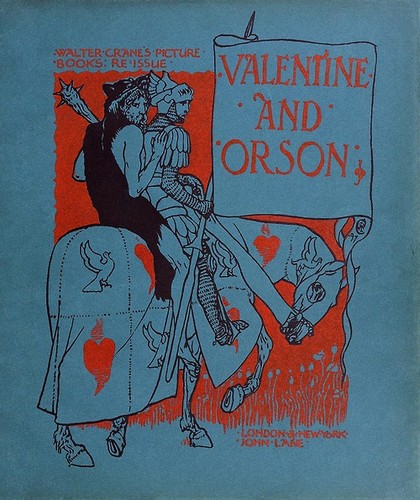
Valentine and Orson
medieval romance attached to the Carolingian circle

Bevis of Hampton
legendary hero
Doon de Mayence cycle
cycle of Old French epic poems
Atlantes
fictional character in Orlando Furioso
Yde et Olive
Old French chanson de geste