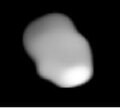
File:48_Doris_VLT_(2021),_deconvolved.pdf · Wikimedia Commons · See Wikimedia Commons
OverviewAI-generated
48 Doris is a C-type asteroid located in the asteroid belt, orbiting the Sun. It was discovered by Hermann Goldschmidt on September 19, 1857, at the Paris Observatory. The object is named after Doris and holds the provisional designations 1948 FE and A857 SA. In the sequence of minor planets, it follows 47 Aglaja and is followed by 49 Pales.
Physically, 48 Doris has a diameter of 216.473 kilometers and an albedo of 0.065. Its rotation period is 11.89 hours, and its absolute magnitude is listed as 7.12 in one source and 7.11 in another. Orbital parameters include a semi-major axis of 3.112870761577706 AU, an eccentricity of 0.06626352751034335, and an inclination of 6.557769140795678 degrees. The periapsis is 2.906600964231758 AU, while the apoapsis is 3.319140558923654 AU.
Synthesized by Vinony from 35 facts across 4 sources: Wikidata, NASA, Jpl Sbdb, Vinony graph. Generated from structured data (not the Wikipedia text) and checked against those facts — may still contain errors.
Picture of the Day · NASA
Pathfinder on Mars
2026-07-04
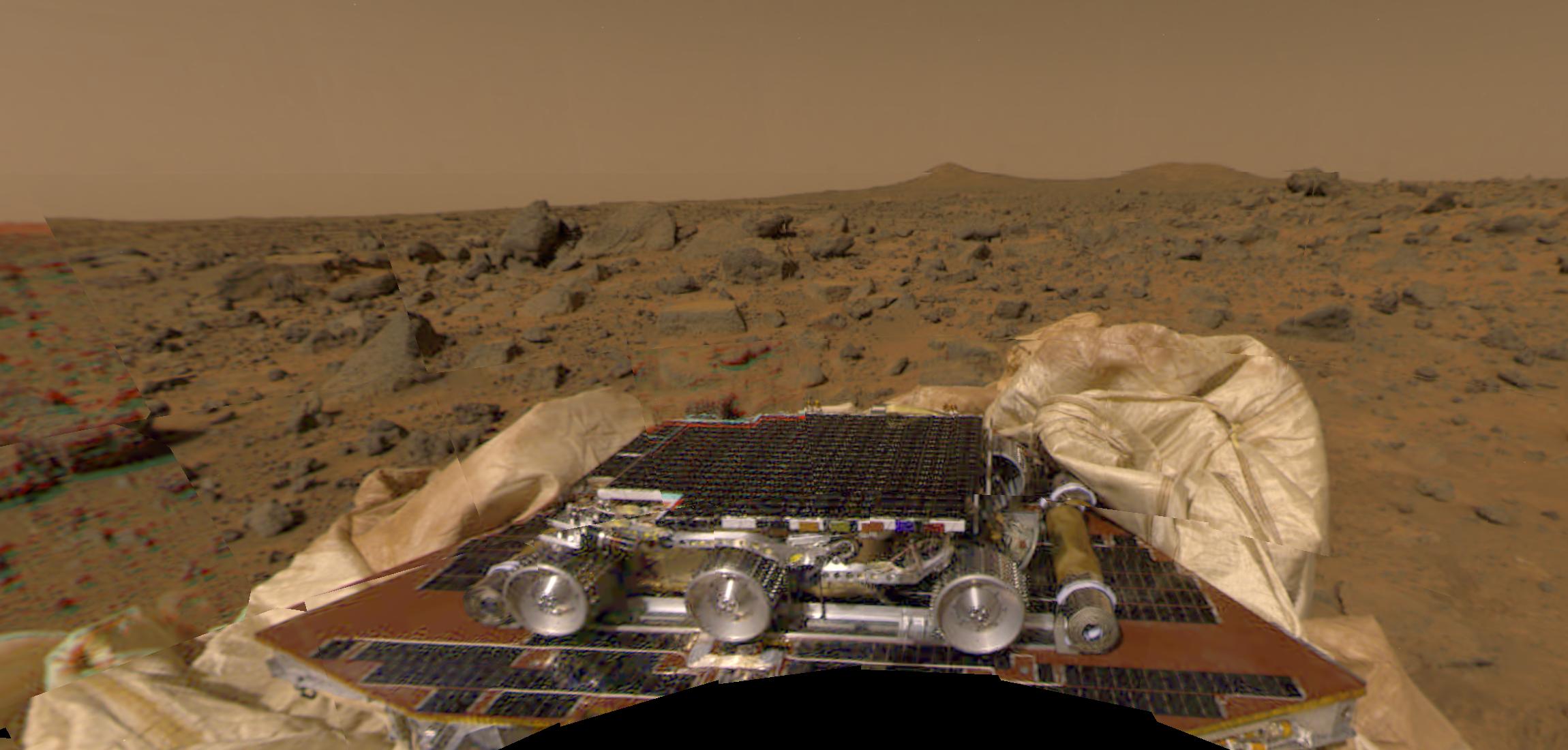
On July 4th, 1997, using its own array of fireworks, a parachute, and a cocoon of airbags, the Mars Pathfinder spacecraft bounced like a giant beach ball at least 15 times before it came to rest on the surface of Mars at 10:07 AM Pacific Daylight Time. After its then novel airbag-assisted landing sequence was completed, Pathfinder transmitted this color mosaic to mission operators on Earth. In the scene from another world, the Mars Sojourner robot rover is visible in the foreground, crouched on top of the unfolded Pathfinder. About the size of a large house cat, the six-wheeled, solar-powered Sojourner became the first successful Martian rover. Surrounding Pathfinder are deflated airbags and the rock-strewn terrain of the Ares Vallis floodplain. In the distance Martian hills appear against a dusty brownish sky. The Pathfinder lander was subsequently renamed the Carl Sagan Memorial Station.
via NASA APOD
Small body data
48 Doris (A857 SA)
- Orbit class
- Main-belt Asteroid
- Diameter
- 216.473 km
- Albedo
- 0.065
- Rotation period
- 11.890 h
- Absolute magnitude
- 7.110 H
- Earth MOID
- 1.930 AU
- Semi-major axis
- 3.114 AU
- Eccentricity
- 0.066
- Inclination
- 6.557 °
via NASA/JPL Small-Body Database · Minor Planet Center
Key facts
- Discovered by
- Hermann Mayer Salomon Goldschmidt
- Discovery date
- 19 September 1857
- Pronunciation
- / ˈ d ɔːr ɪ s /
- Named after
- Doris
- Alternative designations
- 1857 SA, 1948 FE
- Minor planet category
- Main belt
- Adjectives
- Dorian / ˈ d ɔːr i ə n /
- Aphelion
- 500.093 million km (3.343 AU)
- Perihelion
- 430.463 million km (2.877 AU)
- Semi major axis
- 465.278 million km (3.110 AU )
- Orbital period sidereal
- 2003.453 d (5.49 a )
- Mean anomaly
- 336.191°
- Inclination
- 6.554°
- Longitude of ascending node
- 183.754°
- Argument of perihelion
- 257.583°
- Dimensions
- 278 km × 142 km
- Mean diameter
- 215 ± 3 km , 221.8 ± 7.5 km ( IRAS )
- Mass
- (6.9 ± 2.9) × 10 kg , (12.3 ± 6.0) × 10 kg
via Wikipedia infobox
Wikidata facts
- Instance of
- asteroid
- Named after
- Doris
- Followed by
- 49 Pales
- Follows
- 47 Aglaja
- Parent body
- Sun
- Minor-planet group
- asteroid belt
- Diameter
- 216.473
- Orbital period
- 2006.042188317724
- Image
- A570.M936.shape.png
Show 20 more facts
- discoverer or inventor
- Hermann Goldschmidt
- provisional designation
- A857 SA
- time of discovery or invention
- 1857-09-19
- orbital inclination
- 6.557769140795678
- site of astronomical discovery
- Paris Observatory, PSL University
- albedo
- 0.065
- described by source
- Brockhaus and Efron Encyclopedic Dictionary
- Commons category
- 48 Doris
- rotation period
- 11.89
- asteroid spectral type
- C-type asteroid
- absolute magnitude
- 7.12
- orbital eccentricity
- 0.06626352751034335
- semi-major axis of an orbit
- 3.112870761577706
- periapsis
- 2.906600964231758
- apoapsis
- 3.319140558923654
- longitude of ascending node
- 183.4280111676846
- argument of periapsis
- 251.355355562238
- mean anomaly
- 141.7452781681893
- time of periapsis
- 2460210.6471999995
- epoch
- November 21, 2025
Sources (3)
via Wikidata · CC0
~1 min read
Encyclopedic overview
48 Doris is one of the largest main belt asteroids. It was discovered on 19 September 1857 by Hermann Goldschmidt from his balcony in Paris.
To find a name for the object, Jacques Babinet of the Academy of Sciences created a shortlist and asked the geologist Élie de Beaumont to make the selection. De Beaumont chose Doris, after an Oceanid in Greek mythology. Since Doris was discovered on the same night as 49 Pales, de Beaumont suggested naming the two "The Twins".
Excerpted from Wikipedia’s “48 Doris” article, available under the CC BY-SA 4.0 licence.