File:Adenosin.svg · Wikimedia Commons · See Wikimedia Commons
adenosine
Sign in to saveAlso known as Adenocard®, 9-beta-D-ribofuranosyl-9H-purin-6-amine, Ade-Rib, Ado, Adenosin, (2R,3R,4S,5R)-2-(6-aminopurin-9-yl)-5-(hydroxymethyl)oxolane-3,4-diol, beta-D-Adenosine, 9-beta-D-Ribofuranosidoadenine
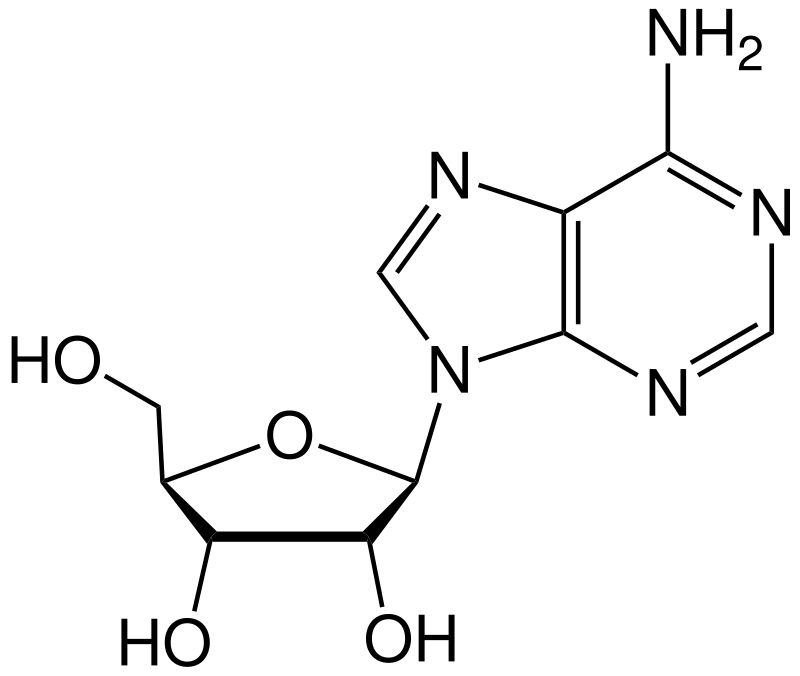
Adenosine (symbol A) is an organic compound that occurs widely in nature in the form of diverse derivatives. The molecule consists of an adenine attached to a ribose via a β-N9-glycosidic bond. Adenosine is one of the four nucleoside building blocks of RNA (and its derivative deoxyadenosine is a building block of DNA), which are essential for all life on Earth. Its derivatives include the energy carriers adenosine mono-, di-, and triphosphate, also known as AMP/ADP/ATP. Cyclic adenosine monophosphate (cAMP) is pervasive in signal transduction. Adenosine is used as an intravenous medication for
Adenosine is a natural organic compound made of an adenine molecule attached to a ribose sugar, and it serves as a fundamental building block of RNA and DNA that all living things depend on. Beyond its role in genetic material, adenosine and its variants are crucial for energy storage in cells (like ATP), cell signaling, and even medical applications.
AI-generated from the Wikipedia summary — may contain errors.
Chemical data
- Formula
- C10H13N5O4
- Molecular weight
- 267.24 g/mol
- IUPAC name
- (2R,3R,4S,5R)-2-(6-aminopurin-9-yl)-5-(hydroxymethyl)oxolane-3,4-diol
- SMILES
- C1=NC(=C2C(=N1)N(C=N2)[C@H]3[C@@H]([C@@H]([C@H](O3)CO)O)O)N
- InChIKey
- OIRDTQYFTABQOQ-KQYNXXCUSA-N
- XLogP
- -1.1
- Polar surface area
- 140 Ų
- H-bond donors
- 4
- H-bond acceptors
- 8
- Formal charge
- 0
via PubChem
Research
326,381 papers- Adenosine in Interventional Cardiology: Physiopathologic and Pharmacologic Effects in Coronary Artery Disease.ReviewInternational journal of molecular sciences · 2024Marchi E, Muraca I, Berteotti M et al.DOI: 10.3390/ijms25115852
- Adenosine kinase and ADAL coordinate detoxification of modified adenosines to safeguard metabolism.Cell · 2025Ogawa A, Watanabe S, Ozerova I et al.DOI: 10.1016/j.cell.2025.07.041
- Adenosine as a Key Mediator of Neuronal Survival in Cerebral Ischemic Injury.ReviewNeurochemical research · 2022Khan H, Kaur P, Singh TG et al.DOI: 10.1007/s11064-022-03737-3
- Adenosine-associated delivery systems.ReviewJournal of drug targeting · 2015Kazemzadeh-Narbat M, Annabi N, Tamayol A et al.DOI: 10.3109/1061186X.2015.1058803
- Adenosine: The common target between cancer immunotherapy and glaucoma in the eye.ReviewLife sciences · 2021Hallaj S, Mirza-Aghazadeh-Attari M, Arasteh A et al.DOI: 10.1016/j.lfs.2021.119796
- The adenosine-mediated, neuronal-glial, homeostatic sleep response.ReviewCurrent opinion in neurobiology · 2017Greene RW, Bjorness TE, Suzuki ADOI: 10.1016/j.conb.2017.05.015
- Adenosine-assisted embolization of cerebral arteriovenous malformations: a systematic review and meta-analysis.Journal of neurointerventional surgery · 2025Bocanegra-Becerra JE, Andreão FF, Acha Sánchez JL et al.DOI: 10.1136/jnis-2024-021866
- Adenosine as an antiarrhythmic agent.ReviewThe American journal of cardiology · 1997Wilbur SL, Marchlinski FEDOI: 10.1016/s0002-9149(97)00261-0
via PubMed
Wikidata facts
- Mass
- 267.097
Show 8 more facts
- chemical formula
- C₁₀H₁₃N₅O₄
- Commons category
- Adenosine
- canonical SMILES
- C1=NC2=C(C(=N1)N)N=CN2C3C(C(C(O3)CO)O)O
- isomeric SMILES
- C1=NC2=C(C(=N1)N)N=CN2[C@H]3[C@@H]([C@@H]([C@H](O3)CO)O)O
- defined daily dose
- 15
- melting point
- 235
- pKa
- 12.4
- solubility
- 5.1
Sources (9)
via Wikidata · CC0
~14 min read
Article
21 sectionsContents
- Medical uses
- Supraventricular tachycardia
- Nuclear stress test
- Dosage
- Adverse effects
- Drug interactions
- Contraindications
- Pharmacological effects
- Adenosine receptors
- Ghrelin/growth hormone secretagogue receptor
- Mechanism of action
- Metabolism
- Research
- Viruses
- Anti-inflammatory properties
- Central nervous system
- Hair
- Sleep
- Vasodilation
- See also
- References
Adenosine (symbol A) is an organic compound that occurs widely in nature in the form of diverse derivatives. The molecule consists of an adenine attached to a ribose via a β-N9-glycosidic bond. Adenosine is one of the four nucleoside building blocks of RNA (and its derivative deoxyadenosine is a building block of DNA), which are essential for all life on Earth. Its derivatives include the energy carriers adenosine mono-, di-, and triphosphate, also known as AMP/ADP/ATP. Cyclic adenosine monophosphate (cAMP) is pervasive in signal transduction. Adenosine is used as an intravenous medication for some cardiac arrhythmias.
Adenosyl (abbreviated Ado or '''5'-dAdo''') is the chemical group formed by removal of the 5′-hydroxy (OH) group. It is found in adenosylcobalamin (an active form of vitamin B12) and as a radical in the radical SAM enzymes.