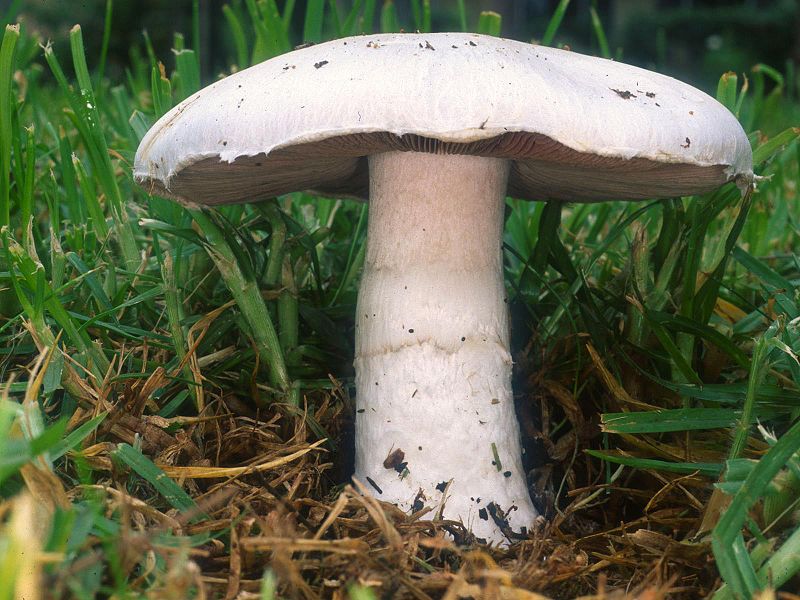
File:Agaricus_campestris.jpg · Wikimedia Commons · See Wikimedia Commons
Agaricaceae
Sign in to saveThe Agaricaceae are a family of basidiomycete fungi and include the genus Agaricus, as well as basidiomycetes previously classified in the families Tulostomataceae, Lepiotaceae, and Lycoperdaceae.
OverviewAI-generated
Agaricaceae is a family of fungi within the order Agaricales. It belongs to the class Agaricomycetes and the phylum Basidiomycota, under the kingdom Fungi. The family was described by Chevall. in 1826 and has the taxonomic type Agaricus. Mycenastraceae is listed as a synonym for this group.
Records indicate that Agaricaceae has an accepted status in taxonomic databases. Habitat data from WoRMS lists marine and brackish environments. Specimens have been documented in the United States, Guyana, Brazil, Panama, and Australia. These records are held by institutions including CINC, LSUM, NEB, MIN, and US. The family has 903,616 occurrences recorded in GBIF and 1,225 records in iDigBio.
Synthesized by Vinony from 33 facts across 6 sources: Wikidata, GBIF, Gbif Occ, WoRMS, iDigBio, Vinony graph. Generated from structured data (not the Wikipedia text) and checked against those facts — may still contain errors.
Species
FAMILY
- KingdomFungi
- PhylumBasidiomycota
- ClassAgaricomycetes
- OrderAgaricales
- FamilyAgaricaceae
via GBIF
Museum specimens
- Specimen records
- 1,225
- With media
- 318
- Family
- Agaricaceae
- Collections
- CINC, LSUM, NEB, MIN, US, USNM
- Recorded in
- United States, Guyana, Brazil, Panama, Australia
Wikidata facts
- Instance of
- taxon
- Parent taxon
- Agaricales
- Image
- Agaricus campestris.jpg
Show 9 more facts
- Commons category
- Agaricaceae
- taxon name
- Agaricaceae
- taxon rank
- family
- topic's main category
- Category:Agaricaceae
- topic has template
- Template:Taxonomy/Agaricaceae
- taxon synonym
- Mycenastraceae
- taxon author citation
- Chevall.
- partially coincident with
- agaric
- taxonomic type
- Agaricus
via Wikidata · CC0
~4 min read
Encyclopedic overview
8 sectionsContents
- Taxonomy
- Description
- Genera
- Ecology
- Economic significance
- See also
- References
- External links
The Agaricaceae are a family of basidiomycete fungi and include the genus Agaricus, as well as basidiomycetes previously classified in the families Tulostomataceae, Lepiotaceae, and Lycoperdaceae.
==Taxonomy== The family Agaricaceae was published by French botanist François Fulgis Chevallier in 1826. It is named after the type genus Agaricus, originally circumscribed by Carl Linnaeus in his 1753 work Species Plantarum. In his authoritative 1986 classification of the Agaricales, Rolf Singer divided the Agaricaceae into four tribes distinguished largely by spore color: Leucocoprineae, Agariceae, Lepioteae, and Cystodermateae. Genera once classified in the families Tulostomataceae, Battarreaceae, Lycoperdaceae, and Mycenastraceae have since been moved to the Agaricaceae based on molecular phylogenetics studies. According to a standard reference text, the Agaricaceae contains 85 genera and 1340 species. In 2024 several Leucoagaricus and Leucocoprinus species were reclassified creating the new genera of Macropsalliota and Candelolepiota.
Excerpted from Wikipedia’s “Agaricaceae” article, available under the CC BY-SA 4.0 licence.