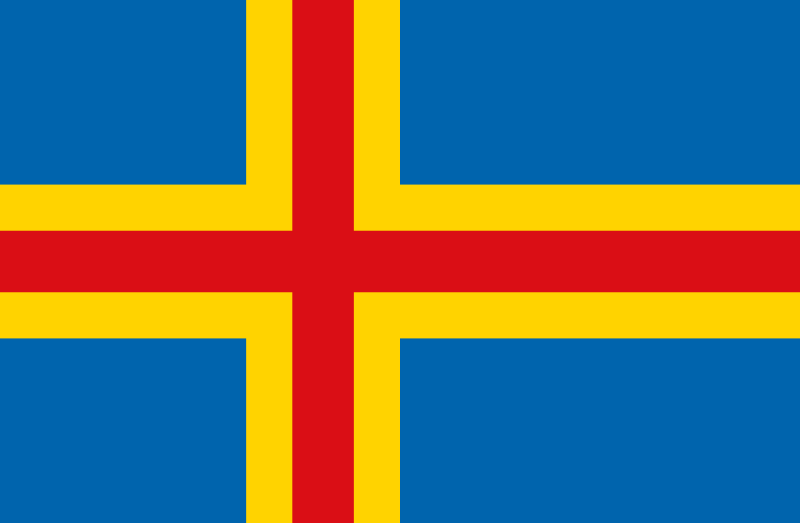
File:Flag_of_Åland.svg · Wikimedia Commons · See Wikimedia Commons
Åland
Sign in to saveAlso known as Aland Isles, Ahvenanmaa, ax, Åland region, Aaland, Aaland Islands, Aland, Aland Islands
Åland ( , ; ) is an autonomous and demilitarised region of Finland. Receiving its autonomy by a 1920 decision of the League of Nations, it is the smallest region of Finland by both area () and population (30,654), constituting 0.51% of Finland's land area and 0.54% of its population. Its official language is Swedish and the capital city is Mariehamn.
Åland is an autonomous and demilitarized region of Finland with its own government, located between Finland and Sweden, where Swedish is the official language rather than Finnish. It received its special status in 1920 through a League of Nations decision and remains Finland's smallest region by area and population, with about 30,600 residents.
AI-generated from the Wikipedia summary — may contain errors.
Key facts
- Political division.name
- Åland
- Political division.other_name
- Region of Åland
- Political division.settlement_type
- Autonomous region
- Political division.image_flag
- Flag of Åland.svg
- Political division.flag_size
- 125
- Political division.image_shield
- Coat of arms of Åland 3.svg
- Political division.shield_size
- 75
- Political division.anthem
- ()File:Song of the Ålanders (local version).ogg
- Political division.image_map
- Ahvenanmaa in Finland.svg
- Political division.mapsize
- 190px
- Political division.map_caption
- Location of Åland within Finland
- Political division.subdivision_type
- Country
- Political division.subdivision_name
- Finland
- Political division.established_title
- Autonomy granted
- Political division.established_date
- 7 May 1920
- Political division.established_title2
- First Regional Assembly
- Political division.established_date2
- 9 June 1922 (Autonomy Day)
- Political division.established_title3
- EU accession
via Wikipedia infobox
Wikidata facts
- Instance of
- historical province of Finland
- Part of
- Northern Europe
- Official name
- Åland
- Demonym
- prebivalka Alandskih otokov
- Country
- Sweden
- Located in
- Finland
- Capital
- Mariehamn
- Official language
- Swedish
- Currency
- Finnish markka
- Population
- 30836
- Area
- 1582.93
- Elevation
- 129
- Time zone
- UTC+03:00
- Body of water
- Archipelago Sea
- Head of government
- Katrin Sjögren
- Legislature
- Parliament of Åland
- Anthem
- Ålänningens sång
- Shares border with
- international waters
- Highest point
- Orrdalsklint
- Official website
- www.regeringen.ax
- Image
- Alands flag.jpg
- GDP per capita
- 1194000000
- Dialing code
- +358 (18)
- Licence plate code
- AX
Show 24 more facts
- Coat of arms
- coat of arms of Åland
- Significant event
- Åland convention
- P12749
- Calascio
- P11012
- Sikkim
- executive body
- Government of Åland
- history of topic
- history of the Åland Islands
- different from
- Oland
- language used
- Swedish
- Unicode character
- 🇦🇽
- top-level Internet domain
- .ax
- Commons category
- Åland
- member of
- Nordic Council
- topic's main category
- Category:Åland
- category for people born here
- Category:Births in Åland
- category of associated people
- Category:People from Åland
- Commons gallery
- Åland
- geography of topic
- geography of Åland
- emergency phone number
- 112
- driving side
- right
- office held by head of government
- lantråd
- native label
- Åland
- contains the statistical territorial entity
- Mariehamn sub-region
- NCI Thesaurus ID
- C44481
Sources (14)
via Wikidata · CC0
~25 min read
Encyclopedic overview
36 sectionsContents
- Autonomy
- Etymology
- History
- Politics
- Self-government
- Elections and parties
- Public services and symbols
- Civil rights
- European Union
- Administration
- Governor and state office
- Municipalities
- Geography
- Climate
- Economy
- Overview
- Infrastructure and transport
- Fiscal and tax system
- Employment and workforce
- Key industries and enterprises
- Economic impact of COVID-19
- Demographics
- Age structure
- Education
- Religion
- Literature
- Cinema and television
- Sport
- Heraldry
- Notable people
- Arts, literature, and public life
- Sport
- See also
- References
- Further reading
- External links
Åland ( , ; ) is an autonomous and demilitarised region of Finland. Receiving its autonomy by a 1920 decision of the League of Nations, it is the smallest region of Finland by both area () and population (30,654), constituting 0.51% of Finland's land area and 0.54% of its population. Its official language is Swedish and the capital city is Mariehamn.
Åland is situated in an archipelago, called the Åland Islands, at the entrance to the Gulf of Bothnia in the Baltic Sea. It comprises Fasta Åland, on which 90% of the population resides, and about 6,500 skerries and islands to its east, of which about 60–80 are inhabited. Fasta Åland is separated from the coast of Roslagen in Sweden by of open water to the west. In the east, the Åland archipelago is contiguous with the Finnish archipelago. Åland's only land border is located on the uninhabited skerry of Märket, which it shares with Sweden. From Mariehamn, there is a ferry distance of about to Turku, a coastal city of mainland Finland, and also to Stockholm, the capital of Sweden.
Excerpted from Wikipedia’s “Åland” article, available under the CC BY-SA 4.0 licence.
Gallery (32)
On the map
4 mapped locations
Available in 146 languages
- Español
- Français
- Deutsch
- 中文
- 日本語
- Русский
- Português
- Italiano
- العربية
- हिन्दी
- Achinese
- Afrikaans
- Albanian
- Amharic
- Angika
- Aragonese
- Armenian
- Arpitan
Show 127 more
- Asturian
- Azerbaijani
- Bahasa Indonesia
- Balinese
- Bangla
- Bashkir
- Basque
- Bavarian
- be_x_old
- Belarusian
- Betawi
- Bikol
- Bislama
- Bosnian
- Breton
- Bulgarian
- Catalan
- cdo
- Cebuano
- Central Kurdish
- Chechen
- Cherokee
- Cornish
- Croatian
- Czech
- Danish
- Erzya
- Esperanto
- Estonian
- Faroese
- Filipino
- Finnish
- fiu_vro
- Gagauz
- Galician
- Georgian
- Greek
- Hakka Chinese
- Hausa
- Hawaiian
- Hebrew
- Hungarian
- Icelandic
- Ido
- Inari Sami
- Irish
- Javanese
- Kazakh
- Kinyarwanda
- Komi
- Kurdish
- Kyrgyz
- Latin
- Latvian
- Ligurian
- Limburgish
- Lithuanian
- Lombard
- Lower Sorbian
- Luxembourgish
- Macedonian
- Malay
- Malayalam
- Manx
- Māori
- Marathi
- Mazanderani
- Mingrelian
- nds_nl
- Nederlands
- Northern Frisian
- Northern Sami
- Norwegian
- Norwegian Nynorsk
- Novial
- Occitan
- Old English
- Ossetic
- Papiamento
- Pashto
- Polski
- Punjabi
- Quechua
- Romanian
- Rusyn
- Sardinian
- Scots
- Scottish Gaelic
- Serbian
- Serbian (Latin)
- Shan
- simple
- Sindhi
- Slovak
- Slovenian
- Sundanese
- Svenska
- Swahili
- Tajik
- Tamil
- Tatar
- Telugu
- Tetum
- Tiếng Việt
- Türkçe
- Ukrainian
- Upper Sorbian
- Urdu
- Uzbek
- Venetian
- Veps
- Waray
- Welsh
- West Flemish
- Western Frisian
- Western Panjabi
- Wolof
- Wu Chinese
- Xhosa
- Yoruba
- Zaza
- Zeelandic
- zh_min_nan
- zh_yue
- فارسی
- ไทย
- 한국어
via Wikidata sitelinks · CC0