File:Diamond_and_graphite.jpg · Wikimedia Commons · See Wikimedia Commons
allotropy
Sign in to saveAlso known as allotropism
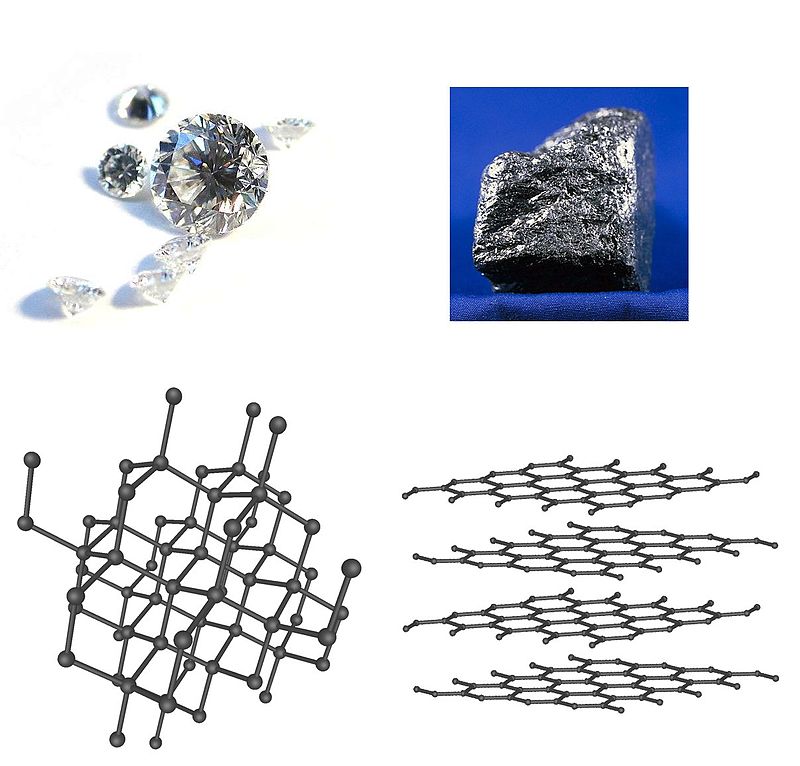
thumb|193x193px|Diamond and [[graphite are two allotropes of carbon: pure forms of the same element that differ in crystalline structure.]]
Allotropy is when the same chemical element exists in different pure forms that have different structures and properties—like how carbon can be either diamond or graphite. This matters because the same element can behave very differently depending on how its atoms are arranged, which affects what uses it can have.
AI-generated from the Wikipedia summary — may contain errors.
Wikidata facts
- Instance of
- chemical property
- Part of
- chemistry
- Image
- Diamond and graphite.jpg
Show 5 more facts
- topic's main category
- Category:Allotropy
- Commons category
- Allotropy
- on focus list of Wikimedia project
- Wikipedia:Vital articles/Level/4
- characteristic of
- simple substance
- partially coincident with
- isomerism
Sources (2)
via Wikidata · CC0
~16 min read
Encyclopedic overview
12 sectionsContents
- History
- Differences in properties of an element's allotropes
- List of allotropes
- Non-metals
- Metalloids
- Metals
- Lanthanides and actinides
- Nanoallotropes
- See also
- Notes
- References
- External links
thumb|193x193px|Diamond and [[graphite are two allotropes of carbon: pure forms of the same element that differ in crystalline structure.]]
Allotropy or allotropism () is the property of some chemical elements to exist in two or more different forms, in the same physical state, known as allotropes of the elements. Allotropes are different structural modifications of an element: the atoms of the element are bonded together in different manners. For example, the allotropes of carbon include diamond (the carbon atoms are bonded together to form a cubic lattice of tetrahedra), graphite (the carbon atoms are bonded together in sheets of a hexagonal lattice), graphene (single sheets of graphite), and fullerenes (the carbon atoms are bonded together in spherical, tubular, or ellipsoidal formations).
Excerpted from Wikipedia’s “allotropy” article, available under the CC BY-SA 4.0 licence.
Gallery (65)
Available in 73 languages
- Español
- Français
- Deutsch
- 中文
- Русский
- Português
- Italiano
- العربية
- हिन्दी
- Afrikaans
- Armenian
- Asturian
- Azerbaijani
- Bahasa Indonesia
- Bangla
- Basque
- Belarusian
- Bosnian
Show 54 more
- Bulgarian
- Catalan
- Central Kurdish
- Croatian
- Czech
- Danish
- Esperanto
- Estonian
- Finnish
- Galician
- Georgian
- Greek
- Haitian Creole
- Hebrew
- Hungarian
- Icelandic
- Irish
- Kannada
- Kazakh
- Kyrgyz
- Latvian
- Limburgish
- Lithuanian
- Luxembourgish
- Macedonian
- Malayalam
- Mongolian
- Nederlands
- Norwegian
- Norwegian Nynorsk
- Occitan
- Oromo
- Polski
- Punjabi
- Romanian
- Serbian
- Serbian (Latin)
- simple
- Sinhala
- Slovak
- Slovenian
- Svenska
- Tajik
- Tamil
- Telugu
- Tiếng Việt
- Türkçe
- Ukrainian
- Urdu
- Uzbek
- Welsh
- zh_yue
- فارسی
- ไทย
via Wikidata sitelinks · CC0