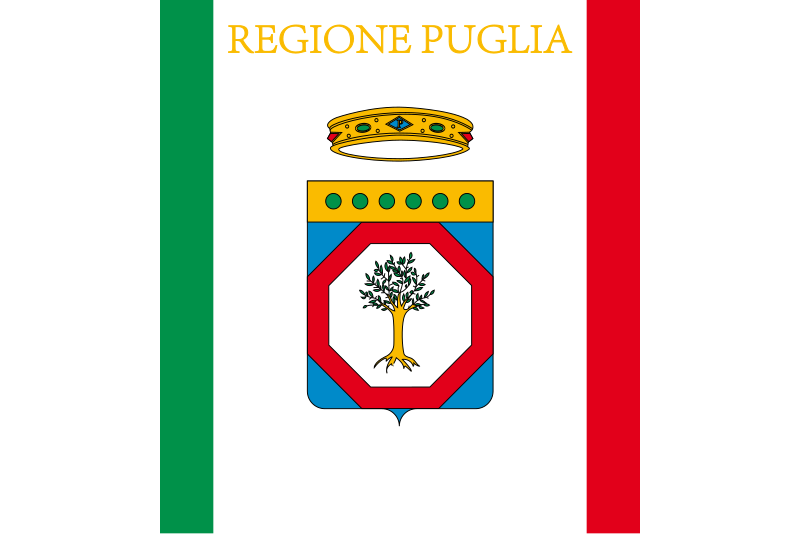
File:Flag_of_Apulia.svg · Wikimedia Commons · See Wikimedia Commons
Apulia
Sign in to saveAlso known as Puglia, Puglia region, Apulia region
Apulia ( ), also known by its Italian name Puglia (), is a region of Italy, located in the southern peninsular section of the country, bordering the Adriatic Sea to the east, the Strait of Otranto and Ionian Sea to the southeast and the Gulf of Taranto to the south. The region comprises , and has 3,874,166 inhabitants as of 2025. It is bordered by the other Italian regions of Molise to the north, Campania to the west, and Basilicata to the southwest. The regional capital is Bari.
Apulia, also known as Puglia, is a region in southern Italy that forms the peninsular "heel" of the country, bordered by the Adriatic Sea and other surrounding waters, with a population of nearly 3.9 million people and its capital in Bari. It matters as a significant geographic and demographic part of Italy, positioned at a strategic location where multiple seas converge in the southeastern part of the country.
AI-generated from the Wikipedia summary — may contain errors.
Key facts
- Settlement.official_name
- Apulia
- Settlement.native_name
- Puglia
- Settlement.native_name_lang
- it
- Settlement.settlement_type
- Region
- Settlement.image_flag
- Flag of Apulia.svg
- Settlement.image_shield
- Coat of Arms of Apulia.svg
- Settlement.shield_size
- 50px
- Settlement.image_map
- Apulia in Italy.svg
- Settlement.subdivision_type
- Country
- Settlement.subdivision_name
- Italy
- Settlement.seat_type
- Capital
- Settlement.seat
- Bari
- Settlement.leader_party
- PD
- Settlement.leader_title
- President
- Settlement.leader_name
- Antonio Decaro
- Settlement.area_total_km2
- 19358
- Settlement.population_total
- 3874166
- Settlement.population_as_of
- 2025
via Wikipedia infobox
Research organization · ROR
- Type
- Funder, Government
- Location
- Bari, Italy
- Status
- Active
GRID grid.466996.2 · ISNI 0000 0004 1754 9737
Wikidata facts
- Instance of
- region of Italy
- Part of
- Southern Italy
- Official name
- -
- Demonym
- Apulijec
- Country
- Italy
- Located in
- Italy
- Contains
- province of Matera
- Capital
- Bari
- Population
- 3866174
- Area
- 19365.8
- Time zone
- UTC+02:00
- Head of government
- Raffaele Fitto
- Shares border with
- Molise
- Official website
- www.regione.puglia.it
- Image
- Alberobello con il drone.jpg
- Flag
- flag of Apulia
- Patron saint
- Saint Nicholas
Show 11 more facts
- located in/on physical feature
- Italian Peninsula
- Commons category
- Apulia
- topic's main category
- Category:Apulia
- category for people born here
- Category:Births in Apulia
- category for people who died here
- Category:Deaths in Apulia
- category for films shot at this location
- Category:Films shot in Apulia
- category of associated people
- Category:People from Apulia
- Commons gallery
- Puglia
- native label
- Puglia
- P11012
- hydrogen iodide
- P8168
- Csörög
Sources (8)
via Wikidata · CC0
~26 min read
Encyclopedic overview
34 sectionsContents
- Geography
- History
- Antiquity
- Middle Ages and Renaissance period
- Early modern period
- Modern period
- Economy
- Unemployment
- Fishing and aquaculture
- Agriculture
- Viticulture
- Oliviculture
- ''Xylella fastidiosa'' disease
- Tourism
- Transport
- Demographics
- Government and politics
- Administrative divisions
- Culture
- Cuisine
- Language
- Famous musicians
- Famous politicians
- Saints and religious figures
- Cinema personalities
- Intellectuals and cultural figures
- Famous athletes
- Sports
- See also
- Explanatory notes
- References
- Sources
- Further reading
- External links
Apulia ( ), also known by its Italian name Puglia (), is a region of Italy, located in the southern peninsular section of the country, bordering the Adriatic Sea to the east, the Strait of Otranto and Ionian Sea to the southeast and the Gulf of Taranto to the south. The region comprises , and has 3,874,166 inhabitants as of 2025. It is bordered by the other Italian regions of Molise to the north, Campania to the west, and Basilicata to the southwest. The regional capital is Bari.
In ancient times, more precisely at the beginning of the first millennium BC, the region of Apulia was inhabited by the Iapygians, while during the 8th century BC its coastal areas were populated by ancient Greeks. Later, the region was conquered by the ancient Romans. It was then conquered by the Byzantines, followed by the Normans, the Aragonese and the Spanish. Subsequently, it became part of the Kingdom of the Two Sicilies, to then be annexed to the unified Kingdom of Italy after the Expedition of the Thousand.
Excerpted from Wikipedia’s “Apulia” article, available under the CC BY-SA 4.0 licence.
Gallery (30)
On the map
3 mapped locations
Available in 132 languages
- Español
- Français
- Deutsch
- 中文
- 日本語
- Русский
- Português
- Italiano
- العربية
- हिन्दी
- Afrikaans
- Albanian
- Albanian
- Amharic
- Aragonese
- Armenian
- Arpitan
- Asturian
Show 113 more
- azb
- Azerbaijani
- Bahasa Indonesia
- Balinese
- Bangla
- Basque
- be_x_old
- Belarusian
- Bikol
- Bosnian
- Breton
- Bulgarian
- Catalan
- cdo
- Cebuano
- Central Kurdish
- Chechen
- Chuvash
- Cornish
- Corsican
- Crimean Tatar
- Croatian
- Czech
- Danish
- Egyptian Arabic
- eml
- Esperanto
- Estonian
- Faroese
- Filipino
- Finnish
- Friulian
- Galician
- Georgian
- Greek
- Hakka Chinese
- Hausa
- Hebrew
- Hungarian
- Icelandic
- Ido
- Iloko
- Interlingua
- Interlingue
- Irish
- Javanese
- Kazakh
- Kikuyu
- Kurdish
- Ladino
- Latin
- Latvian
- Ligurian
- Limburgish
- Lithuanian
- lld
- Lombard
- Macedonian
- Malay
- Maltese
- Marathi
- Mazanderani
- Mingrelian
- Neapolitan
- Nederlands
- Northern Frisian
- Northern Sami
- Norwegian
- Norwegian Nynorsk
- Occitan
- Old English
- Ossetic
- Pampanga
- Papiamento
- Pashto
- Picard
- Piedmontese
- Polski
- Punjabi
- roa_tara
- Romanian
- Sardinian
- Scots
- Scottish Gaelic
- Serbian
- Serbian (Latin)
- Sicilian
- simple
- Slovak
- Slovenian
- Svenska
- Swahili
- Tajik
- Tatar
- Tiếng Việt
- Türkçe
- Ukrainian
- Urdu
- Uzbek
- Venetian
- Walloon
- Waray
- Welsh
- West Flemish
- Western Frisian
- Western Panjabi
- Wu Chinese
- Zaza
- zh_min_nan
- zh_yue
- فارسی
- ไทย
- 한국어
via Wikidata sitelinks · CC0