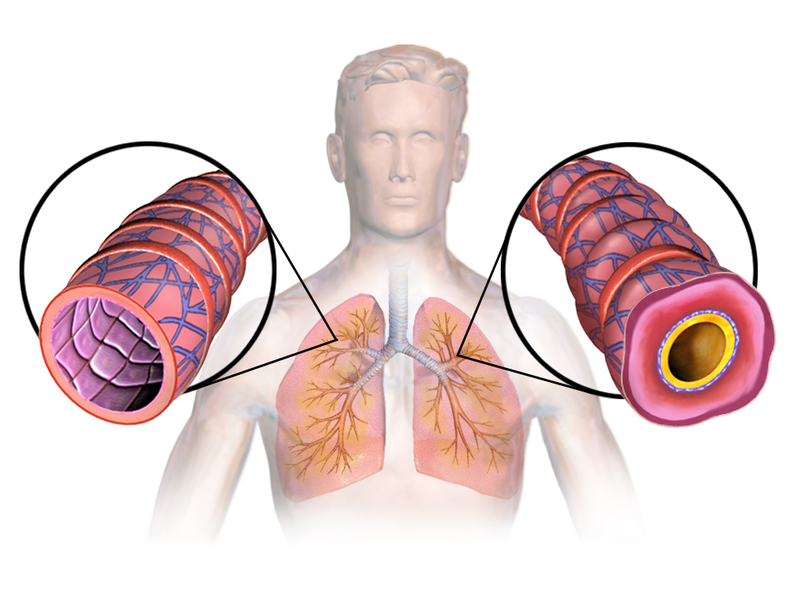
File:Asthma_(Lungs).png · Wikimedia Commons · See Wikimedia Commons
asthma
Sign in to saveAlso known as exercise-induced asthma, chronic obstructive asthma, chronic obstructive asthma with status asthmaticus, chronic obstructive asthma with acute exacerbation, bronchial hyperreactivity, Exercise induced asthma, asthma brionchiole
I don't see any context provided for me to base an overview on. Could you please share the context you'd like me to use to write the asthma overview?
AI-generated from the Wikipedia summary — may contain errors.
Key facts
- Medical condition.name
- Asthma
- Medical condition.image
- Asthma (Lungs).png
- Medical condition.alt
- Diagram of asthma
- Medical condition.caption
- During an asthma attack, the airways become swollen and full of mucus.
- Medical condition.field
- Pulmonology
- Medical condition.symptoms
- Recurring episodes of wheezing, coughing, chest tightness, shortness of breath
- Medical condition.complications
- Gastroesophageal reflux disease (GERD), sinusitis, obstructive sleep apnea
- Medical condition.onset
- Childhood
- Medical condition.duration
- Long term
- Medical condition.causes
- Genetic and environmental factors
- Medical condition.risks
- Air pollution, allergens
- Medical condition.diagnosis
- Based on symptoms, response to therapy, spirometry
- Medical condition.treatment
- Avoiding triggers, inhaled corticosteroids, salbutamol
- Medical condition.frequency
- Approximately 262million (2019)
- Medical condition.deaths
- Approximately 461,000 (2019)
via Wikipedia infobox
Research
242,716 papersvia PubMed
Wikidata facts
- Image
- Asthma.jpg
Show 6 more facts
- Commons category
- Asthma
- Commons gallery
- Asthma
- ICPC 2 ID
- R96
- exact match
- identifiers.org/doid/DOID:2841
- ICD-9-CM
- 493.9
- NCI Thesaurus ID
- C28397
Sources (15)
via Wikidata · CC0
~20 min read
Article
32 sectionsContents
- Signs and symptoms
- Associated conditions
- Classification
- Severity and symptom control
- Phenotyping and endotyping
- Asthma exacerbation<span class="anchor" id="Asthma attack"></span>
- Causes
- Risk factors
- Genetics
- Exacerbations
- Pathophysiology
- Diagnosis
- Spirometry
- Others
- Differential diagnosis
- Prevention
- Management
- Lifestyle modification
- Medications<span class="anchor" id="Anti-asthmatic"></span>
- Adherence to asthma treatments
- Prognosis
- Epidemiology
- Health disparities
- Economics
- History
- 19th century
- 20th century
- Global mortality rates
- Notes
- References
- Further reading
- External links
Asthma is a common long-term inflammatory disease of the airways. It is characterized by variable and recurring symptoms and reduced lung function. Symptoms include episodes of wheezing, coughing, chest tightness, and shortness of breath. A sudden worsening of asthma symptoms sometimes called an 'asthma attack' or an 'asthma exacerbation' can occur when allergens, pollen, dust, or other particles, are inhaled into the lungs, causing the bronchioles to constrict and produce mucus, which then restricts oxygen flow to the alveoli. These may occur a few times a day or a few times per week. Depending on the person, asthma symptoms may become worse at night or with exercise.
Asthma is thought to be caused by a combination of genetic and environmental factors. Environmental factors include exposure to air pollution and allergens. Other potential triggers include medications such as aspirin and beta blockers. Diagnosis is usually based on the pattern of symptoms, response to therapy over time, and spirometry lung function testing. Asthma is classified according to the amount of medication required to control symptoms or mechanisms underlying the condition.
Gallery (20)
Available in 123 languages
- Español
- Français
- Deutsch
- 中文
- 日本語
- Русский
- Português
- Italiano
- العربية
- हिन्दी
- Afrikaans
- Aragonese
- Armenian
- Assamese
- Asturian
- Awadhi
- azb
- Azerbaijani
Show 104 more
- Bahasa Indonesia
- Bangla
- Banjar
- Bashkir
- Basque
- bat_smg
- Bavarian
- bdr
- Belarusian
- Bikol
- Bosnian
- Bulgarian
- Catalan
- cdo
- Cebuano
- Central Kurdish
- Cherokee
- Croatian
- Czech
- Danish
- Egyptian Arabic
- Esperanto
- Estonian
- Filipino
- Finnish
- Fula
- Galician
- gcr
- Georgian
- gpe
- Greek
- Gujarati
- Haitian Creole
- Hakka Chinese
- Hausa
- Hebrew
- Hungarian
- hyw
- Icelandic
- Ido
- Interlingua
- Irish
- Javanese
- Kabyle
- Kannada
- Kazakh
- Kyrgyz
- Lao
- Latin
- Latvian
- Lithuanian
- Macedonian
- Malagasy
- Malay
- Malayalam
- Marathi
- Nederlands
- Nepali
- Newari
- Northern Sami
- Norwegian
- Norwegian Nynorsk
- Occitan
- Odia
- Pampanga
- Pashto
- Polski
- Punjabi
- Quechua
- Romanian
- Rundi
- Sanskrit
- Serbian
- Serbian (Latin)
- simple
- Sindhi
- Sinhala
- Slovak
- Slovenian
- Somali
- Sundanese
- Svenska
- Swahili
- Tamil
- Tatar
- Telugu
- Tibetan
- Tiếng Việt
- Türkçe
- Turkmen
- Ukrainian
- Urdu
- Uzbek
- Walloon
- Waray
- Welsh
- Wu Chinese
- Yakut
- zh_min_nan
- zh_yue
- Zhuang
- فارسی
- ไทย
- 한국어
via Wikidata sitelinks · CC0