File:Atlantis_Kircher_Mundus_subterraneus_1678.jpg · Wikimedia Commons · See Wikimedia Commons
Atlantis
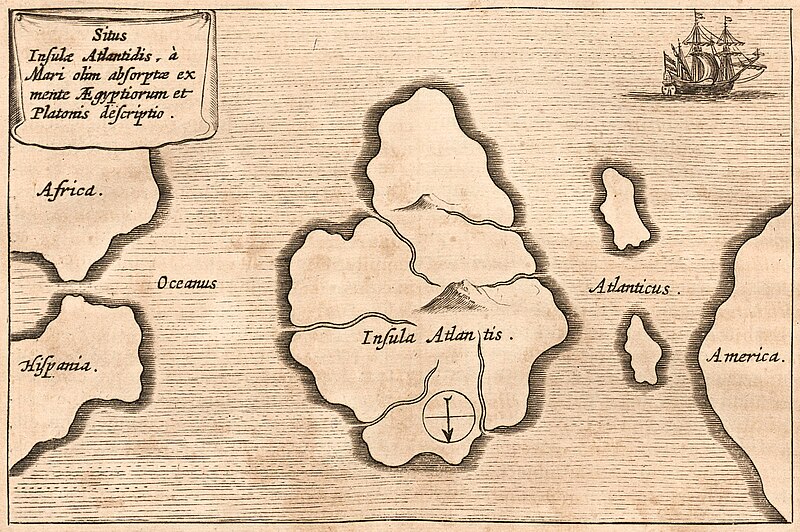
Sign in to savethumb|upright=1.6|Athanasius Kircher's map of Atlantis, placing it in the middle of the Atlantic Ocean, from Mundus Subterraneus 1669, published in Amsterdam. The map is oriented with south at the top.
Atlantis is a fictional island first described by the ancient Greek philosopher Plato in his dialogues, which has captured people's imaginations for thousands of years as a legendary lost civilization. It matters because the story has inspired countless theories, artistic works, and scientific expeditions, making it one of history's most enduring myths despite having no archaeological evidence of its actual existence.
AI-generated from the Wikipedia summary — may contain errors.
Described at
Atlantis (plats) - Seriewikin
seriewikin.serieframjandet.se →Link to a page describing this subject · 6,125 chars · not written by Vinony
Wikidata facts
- Part of
- ancient Greek literature
- Body of water
- Atlantic Ocean
- Image
- Atlantis Monsu Desiderio.jpg
Show 5 more facts
- Commons category
- Atlantis
- topic's main category
- Category:Atlantis
- described at URL
- seriewikin.serieframjandet.se/index.php/Atlantis_(plats)
- present in work
- Atlantis: The Lost Empire
- on focus list of Wikimedia project
- Wikipedia:Vital articles/Level/4
Sources (7)
via Wikidata · CC0
~47 min read
Encyclopedic overview
31 sectionsContents
- Plato's dialogues
- ''Timaeus''
- ''Critias''
- Interpretations
- Ancient
- Jewish and Christian
- Modern
- Early influential literature
- Impact of Mayanism
- Ignatius Donnelly
- Madame Blavatsky and the Theosophists
- Nazism and occultism
- Edgar Cayce
- Recent times
- Location hypotheses
- In or near the Mediterranean Sea
- In the Atlantic Ocean
- In Europe
- Other locations
- Literary interpretations
- Ancient versions
- Utopias and dystopias
- A land lost in the distance
- Verse narratives
- Artistic representations
- Music
- Painting and sculpture
- See also
- Notes
- References
- Further reading
thumb|upright=1.6|Athanasius Kircher's map of Atlantis, placing it in the middle of the Atlantic Ocean, from Mundus Subterraneus 1669, published in Amsterdam. The map is oriented with south at the top.
Atlantis () is a fictional island mentioned in Plato's works Timaeus and Critias as part of an allegory on the hubris of nations. By describing Atlantis as a naval empire from the west that had conquered most of Europe and Libya, Plato purposely created a literary contrast with the Achaemenid Empire, the great land-based power that ruled the east (what the Greeks called Asia). In Plato's account, Atlantis loses divine favor after an ill-fated campaign against a fictionalized Athens, and subsequently submerges into the Atlantic Ocean. By portraying the victorious Athens in the image of his ideal state from the Republic, Plato intended the Atlantis story to bear witness to the superiority of his concept of a state.
Excerpted from Wikipedia’s “Atlantis” article, available under the CC BY-SA 4.0 licence.
Gallery (446)
Available in 94 languages
- Español
- Français
- Deutsch
- 中文
- 日本語
- Русский
- Português
- Italiano
- العربية
- हिन्दी
- Abkhazian
- Afrikaans
- Albanian
- Aragonese
- Armenian
- Asturian
- azb
- Azerbaijani
Show 75 more
- Bahasa Indonesia
- Bangla
- Basque
- Belarusian
- Bosnian
- Bulgarian
- Burmese
- Catalan
- Chuvash
- Croatian
- Czech
- Danish
- Esperanto
- Estonian
- Finnish
- Fula
- Galician
- Georgian
- Greek
- Hebrew
- Hungarian
- hyw
- Icelandic
- Ido
- Interlingua
- Kazakh
- Kurdish
- Kyrgyz
- Latin
- Latvian
- Lingua Franca Nova
- Lithuanian
- Macedonian
- Malagasy
- Malay
- Malayalam
- Mongolian
- nds_nl
- Nederlands
- Northern Frisian
- Norwegian
- Norwegian Nynorsk
- Occitan
- Pashto
- Polski
- Punjabi
- pwn
- Romanian
- Rusyn
- Scottish Gaelic
- Serbian
- Serbian (Latin)
- simple
- Slovak
- Slovenian
- Svenska
- Tachelhit
- Tajik
- Tamil
- Tatar
- Tiếng Việt
- Türkçe
- Ukrainian
- Urdu
- Uzbek
- Waray
- West Flemish
- Western Frisian
- Western Panjabi
- Wu Chinese
- Zaza
- zh_yue
- فارسی
- ไทย
- 한국어
via Wikidata sitelinks · CC0