File:Boilingkettle.jpg · Wikimedia Commons · See Wikimedia Commons
boiling
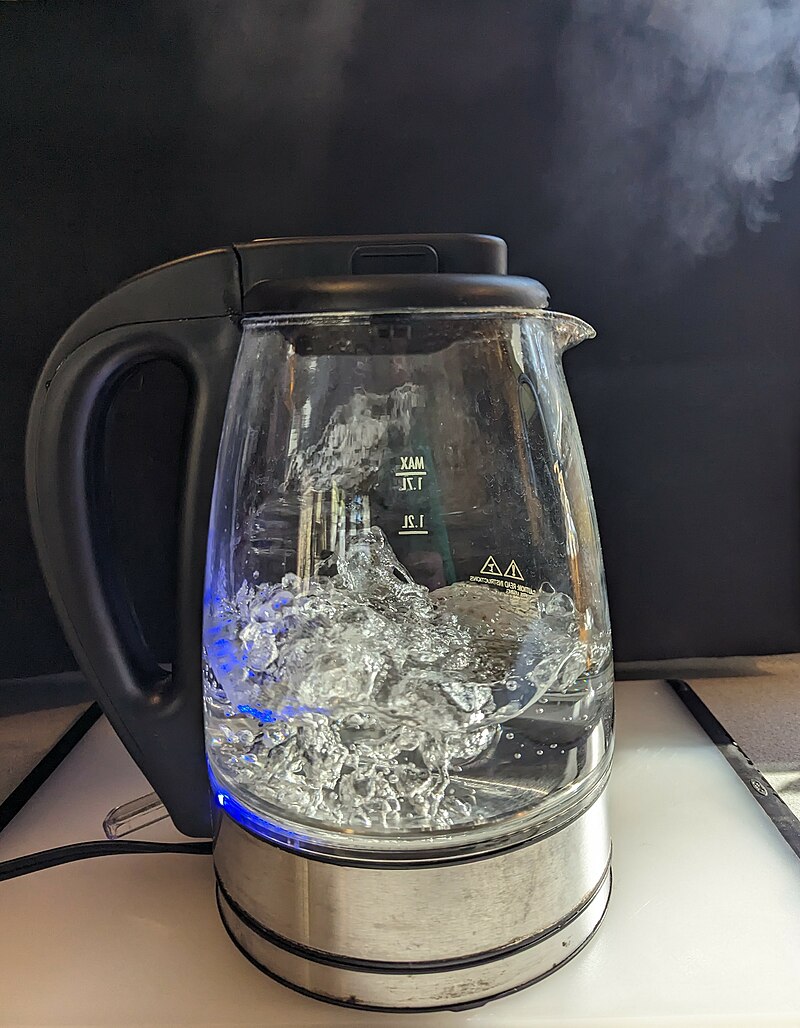
Sign in to savethumb|right|Rolling boil of water in an electric kettle
Boiling is the process where a liquid gets hot enough that it rapidly turns into vapor, creating bubbles that rise to the surface—you can see this happening in the image of water in an electric kettle. It matters because boiling is one of the most common ways people heat water for cooking, making tea and coffee, and sterilizing water to make it safe to drink.
AI-generated from the Wikipedia summary — may contain errors.
Wikidata facts
- Instance of
- phase change
- Subclass of
- vaporization
- Image
- Kochendes wasser02.jpg
Show 5 more facts
- different from
- vaporization
- has characteristic
- temperature
- Commons category
- Boiling
- studied by
- thermodynamics
- on focus list of Wikimedia project
- Wikipedia:Vital articles/Level/4
via Wikidata · CC0
~12 min read
Encyclopedic overview
20 sectionsContents
- Types
- Free convection
- Nucleate
- Critical heat flux
- Transition
- Film
- Influence of geometry
- Pool boiling
- Flow boiling
- Confined boiling
- Physics
- Distillation
- Uses
- Refrigeration and air conditioning
- For making water potable
- In cooking
- Boil-in-the-bag
- Contrast with evaporation
- See also
- References
thumb|right|Rolling boil of water in an electric kettle
Boiling or ebullition is the rapid phase transition from liquid to gas or vapour; the reverse of boiling is condensation. Boiling occurs when a liquid is heated to its boiling point, so that the vapour pressure of the liquid is equal to the pressure exerted on the liquid by the surrounding atmosphere. Boiling and evaporation are the two main forms of liquid vapourization.
Excerpted from Wikipedia’s “boiling” article, available under the CC BY-SA 4.0 licence.
Gallery (8)
Available in 85 languages
- Español
- Français
- Deutsch
- 中文
- 日本語
- Русский
- Português
- Italiano
- العربية
- हिन्दी
- Albanian
- Armenian
- Asturian
- Azerbaijani
- Bahasa Indonesia
- Basque
- be_x_old
- Belarusian
Show 66 more
- Bhojpuri
- Bikol
- Bulgarian
- Burmese
- Catalan
- Central Kurdish
- Chuvash
- Croatian
- Czech
- Danish
- Erzya
- Esperanto
- Estonian
- Fijian
- Finnish
- Galician
- Greek
- Haitian Creole
- Hebrew
- Hungarian
- Icelandic
- Javanese
- Kabyle
- Kazakh
- Kyrgyz
- Latin
- Latvian
- Lithuanian
- Lombard
- Macedonian
- Malay
- Malayalam
- Mongolian
- Nederlands
- Norwegian
- Norwegian Nynorsk
- Occitan
- Polski
- Quechua
- roa_rup
- Romanian
- Scottish Gaelic
- Serbian
- Serbian (Latin)
- Shona
- Sicilian
- simple
- Slovak
- Slovenian
- Svenska
- Tamil
- Tatar
- Tiếng Việt
- Türkçe
- Ukrainian
- Urdu
- Uzbek
- Walloon
- Waray
- Welsh
- Wu Chinese
- zh_min_nan
- zh_yue
- فارسی
- ไทย
- 한국어
via Wikidata sitelinks · CC0