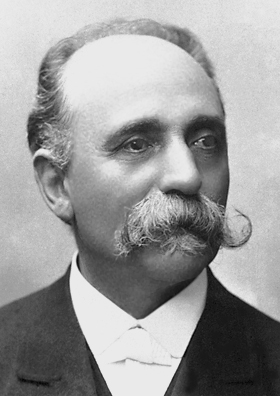
File:Camillo_Golgi_nobel.jpg · Wikimedia Commons · See Wikimedia Commons
Camillo Golgi
Sign in to saveItalian physician, pathologist, scientist, and Nobel laureate (1843-1926)
OverviewAI-generated
Camillo Golgi was an Italian physician, neurologist, professor, and pathologist born in Corteno Golgi in 1843. He studied at the University of Pavia, where he earned a Doctor of Medicine degree under Cesare Lombroso. His professional career included positions at the University of Siena and the University of Pavia, where he also served as rector. Golgi’s work focused on malaria, medicine, histology, and anatomy.
He received the Nobel Prize in Physiology or Medicine. Golgi was a member of several scientific academies, including the German Academy of Sciences Leopoldina, the Göttingen Academy of Sciences and Humanities in Lower Saxony, the Academy of Sciences of the USSR, and the Saint Petersburg Academy of Sciences. He died in Pavia on January 21, 1926.
Synthesized by Vinony from 31 facts across 4 sources: Wikidata, Open Library, Nobel Prize, Vinony collections. Generated from structured data (not the Wikipedia text) and checked against those facts — may still contain errors.
Person · Open Library
- Born
- 1843
- Died
- 1926
- Works
- 8
Top works
- Sulla fine anatomia del midollo spinale
- Sulle alterazioni dei vais linfatici del cervello
- Di nuovo sulla struttura delle cellule nervose dei gangli spinali
- Gli studi di Camillo Golgi sulla malaria
- Emilio Veratti e Camillo Golgi
via Open Library + Wikidata
Nobel Prize
- The Nobel Prize in Physiology or Medicine1906
“in recognition of their work on the structure of the nervous system”
Shared · 1/2 portion
Wikidata facts
- Instance of
- human
- Gender
- male
- Citizenship
- Kingdom of Sardinia
- Place of birth
- Corteno Golgi
- Place of death
- Pavia
- Occupation
- university teacher
- Position held
- rector
- Educated at
- University of Pavia
- Employer
- University of Pavia
- Languages spoken
- Italian
- Academic degree
- Doctor of Medicine
- Doctoral advisor
- Cesare Lombroso
- Student of
- Cesare Lombroso
- Field of work
- pathology
- Image
- Camillo Golgi nobel.jpg
Show 9 more facts
- Commons category
- Camillo Golgi
- date of death
- 1926-01-21
- member of
- Accademia Nazionale dei Lincei
- nominated for
- Nobel Prize in Physiology or Medicine
- date of birth
- 1843-07-07
- writing language
- Italian
- ethnic group
- Italians
- interested in
- pathology
Sources (6)
via Wikidata · CC0
~18 min read
Encyclopedic overview
Camillo Golgi ( Italian: [kaˈmilːo ˈɡɔldʒi]; 7 July 1843 – 21 January 1926) was an Italian biologist and pathologist who was awarded the 1906 Nobel Prize in Physiology or Medicine for his works on the central nervous system. He studied medicine at the University of Pavia (where he later spent most of his professional career) between 1860 and 1868 under the tutelage of Cesare Lombroso. Inspired by pathologist Giulio Bizzozero, he pursued research in the nervous system. His discovery of a staining technique called black reaction (sometimes called Golgi's method or Golgi's staining in his honour) in 1873 was a major breakthrough in neuroscience. Several structures and phenomena in anatomy and physiology are named for him, including the Golgi apparatus, the Golgi tendon organ and the Golgi tendon reflex.
Golgi and the Spanish biologist Santiago Ramón y Cajal were jointly awarded the Nobel Prize in Physiology or Medicine in 1906 "in recognition of their work on the structure of the nervous system".
Excerpted from Wikipedia’s “Camillo Golgi” article, available under the CC BY-SA 4.0 licence.
Gallery (5)
Available in 77 languages
- Español
- Français
- Deutsch
- 中文
- 日本語
- Русский
- Português
- Italiano
- العربية
- हिन्दी
- Albanian
- Armenian
- azb
- Azerbaijani
- Bahasa Indonesia
- Bangla
- Basque
- Belarusian
Show 58 more
- Bosnian
- Bulgarian
- Catalan
- Central Kurdish
- Croatian
- Czech
- Danish
- Egyptian Arabic
- Esperanto
- Estonian
- Finnish
- Galician
- Georgian
- Greek
- Hebrew
- Hungarian
- Ido
- Irish
- Javanese
- Kannada
- Kazakh
- Latin
- Latvian
- Lombard
- Macedonian
- Malay
- Malayalam
- Mazanderani
- Mingrelian
- Nederlands
- Norwegian
- Occitan
- Polski
- Quechua
- Romanian
- Serbian
- simple
- skr
- Slovak
- Slovenian
- Svenska
- Swahili
- Tamil
- Tatar
- Türkçe
- Ukrainian
- Urdu
- Uzbek
- Venetian
- Waray
- Welsh
- Western Panjabi
- Wu Chinese
- Yoruba
- zh_min_nan
- zh_yue
- فارسی
- 한국어
via Wikidata sitelinks · CC0