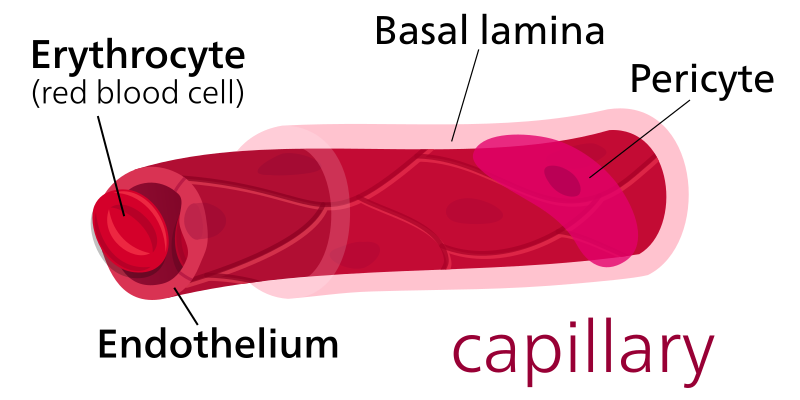
File:Capillary.svg · Wikimedia Commons · See Wikimedia Commons
capillary
Sign in to saveAlso known as capillary vessel, blood capillary, Capillary vessel, capillary, capillaries
A capillary is a small blood vessel, from 5 to 10 micrometres in diameter, and is part of the microcirculation system. Capillaries are microvessels and the smallest blood vessels in the body. They are composed of only the tunica intima (the innermost layer of an artery or vein), consisting of a thin wall of simple squamous endothelial cells. They are the site of the exchange of many substances from the surrounding interstitial fluid, and they convey blood from the smallest branches of the arteries (arterioles) to those of the veins (venules). Other substances which cross capillaries include wa
Capillaries are the tiniest blood vessels in your body, measuring just 5 to 10 micrometers across, and they form the final connection between arteries and veins. They matter because their extremely thin walls allow oxygen, nutrients, and other substances to pass between your blood and the surrounding tissues, making them essential for keeping your cells alive.
AI-generated from the Wikipedia summary — may contain errors.
Key facts
- Anatomy.Name
- Capillary
- Anatomy.Latin
- vas capillare
- Anatomy.Image
- Capillary.svg
- Anatomy.Caption
- Diagram of a capillary
- Anatomy.Image2
- Capillary system CERT.jpg
- Anatomy.Caption2
- A simplified illustration of a capillary network
- Anatomy.System
- Circulatory system
- Anatomy.Pronunciation
- ,
via Wikipedia infobox
Research
199,620 papers- Capillary circulation in the brain.ReviewCerebrovascular and brain metabolism reviews · 1992Kuschinsky W, Paulson OB
- Pulmonary capillary hemangiomatosis: a rare cause of pulmonary hypertension.ReviewArchives of pathology & laboratory medicine · 2015O'Keefe MC, Post MDDOI: 10.5858/arpa.2013-0500-RS
- Skeletal muscle capillary function: contemporary observations and novel hypotheses.ReviewExperimental physiology · 2013Poole DC, Copp SW, Ferguson SK et al.DOI: 10.1113/expphysiol.2013.073874
- Physiological factors influencing capillary growth.ReviewActa physiologica (Oxford, England) · 2011Egginton SDOI: 10.1111/j.1748-1716.2010.02194.x
- Blood flow in the cerebral capillary network: a review emphasizing observations with intravital microscopy.ReviewMicrocirculation (New York, N.Y. : 1994) · 1997Hudetz AGDOI: 10.3109/10739689709146787
- Characterization of the capillary network in skeletal muscles from 3D data.ReviewPhysiological research · 2011Eržen I, Janáček J, Kubínová LDOI: 10.33549/physiolres.931988
- Capillary flow disturbances after experimental subarachnoid hemorrhage: A contributor to delayed cerebral ischemia?Microcirculation (New York, N.Y. : 1994) · 2019Anzabi M, Angleys H, Aamand R et al.DOI: 10.1111/micc.12516
- Capillary resistance tests.A.M.A. archives of dermatology and syphilology · 1951HARE FW Jr, MILLER AJDOI: 10.1001/archderm.1951.01570100066012
via PubMed
Wikidata facts
- Instance of
- blood vessel
- Part of
- blood vessel
- Image
- 2101 Blood Flow Through the Heart.jpg
- Connects with
- venule
Show 3 more facts
- Commons category
- Capillaries
- NCI Thesaurus ID
- C32212
- different from
- Capillary
Sources (7)
via Wikidata · CC0
~14 min read
Encyclopedic overview
16 sectionsContents
- Etymology
- Structure
- Types
- Continuous
- Fenestrated
- Sinusoidal
- Development
- Function
- Starling equation
- Clinical significance
- Therapeutics
- Blood sampling
- History
- See also
- References
- External links
A capillary is a small blood vessel, from 5 to 10 micrometres in diameter, and is part of the microcirculation system. Capillaries are microvessels and the smallest blood vessels in the body. They are composed of only the tunica intima (the innermost layer of an artery or vein), consisting of a thin wall of simple squamous endothelial cells. They are the site of the exchange of many substances from the surrounding interstitial fluid, and they convey blood from the smallest branches of the arteries (arterioles) to those of the veins (venules). Other substances which cross capillaries include water, oxygen, carbon dioxide, urea, glucose, uric acid, lactic acid and creatinine. Lymph capillaries connect with larger lymph vessels to drain lymphatic fluid collected in microcirculation.
== Etymology == Capillary comes from the Latin word , meaning "of or resembling hair", with use in English beginning in the mid-17th century. The meaning stems from the tiny, hairlike diameter of a capillary. While capillary is usually used as a noun, the word also is used as an adjective, as in "capillary action", in which a liquid flows without influence of external forces, such as gravity.
Excerpted from Wikipedia’s “capillary” article, available under the CC BY-SA 4.0 licence.
Gallery (17)
Available in 79 languages
- Español
- Français
- Deutsch
- 中文
- 日本語
- Русский
- Português
- Italiano
- العربية
- हिन्दी
- Afrikaans
- Albanian
- Aragonese
- Armenian
- Azerbaijani
- Bahasa Indonesia
- Bangla
- Basque
Show 60 more
- be_x_old
- Belarusian
- Bosnian
- Bulgarian
- Catalan
- Central Kurdish
- Chechen
- Croatian
- Czech
- Danish
- Esperanto
- Estonian
- Filipino
- Finnish
- Galician
- Greek
- Haitian Creole
- Hebrew
- Icelandic
- Interlingua
- Irish
- Kazakh
- Kurdish
- Latin
- Latvian
- Limburgish
- Lithuanian
- Low German
- Macedonian
- Malay
- Malayalam
- Marathi
- Nederlands
- Norwegian
- Oromo
- Polski
- Quechua
- Romanian
- Serbian
- Serbian (Latin)
- Shona
- simple
- Slovak
- Slovenian
- Svenska
- Swahili
- Tiếng Việt
- Türkçe
- Ukrainian
- Urdu
- Uzbek
- Waray
- Welsh
- Wu Chinese
- Yakut
- zh_min_nan
- zh_yue
- فارسی
- ไทย
- 한국어
via Wikidata sitelinks · CC0