File:Catalysts.JPG · Wikimedia Commons · See Wikimedia Commons
catalysis
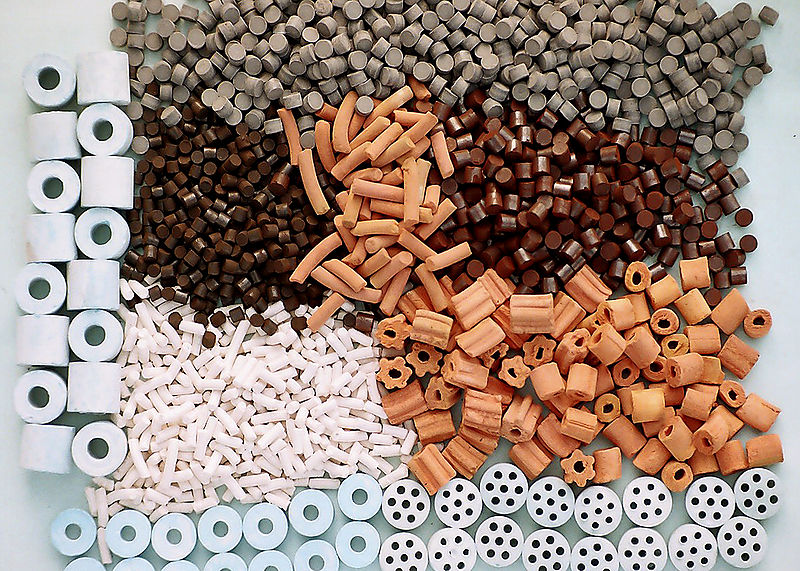
Sign in to savethumb|A range of industrial catalysts in pellet form thumb|An air filter that uses a low-temperature oxidation catalyst to convert [[carbon monoxide to less toxic carbon dioxide at room temperature. It can also remove formaldehyde from the air.]] Catalysis (, ) is the increase in rate of a chemical reaction due to an added substance known as a catalyst ( ). Catalysts are not consumed by the reaction and remain unchanged after the reaction. If the reaction is rapid and the catalyst is recycled quickly, a very small amount of catalyst often suffices; mixing, surface area, and temperature are imp
Catalysis is the process of speeding up a chemical reaction by adding a substance called a catalyst, which itself remains unchanged and unconsumed by the reaction. Because catalysts aren't used up and can be recycled, small amounts of them can make reactions happen much faster, which is why they're valuable in industrial applications and environmental solutions like air filtration.
AI-generated from the Wikipedia summary — may contain errors.
Research
263,457 papers- Enzymatic catalysis by Friedel-Crafts-type reactions.ReviewDie Naturwissenschaften · 1996Rétey JDOI: 10.1007/BF01144012
- Molecular recognition and catalysis in translation termination complexes.ReviewTrends in biochemical sciences · 2011Klaholz BPDOI: 10.1016/j.tibs.2011.02.001
- The reactivity of beta-lactams, the mechanism of catalysis and the inhibition of beta-lactamases.ReviewCurrent pharmaceutical design · 1999Page MI
- Structure, folding and catalysis of the small nucleolytic ribozymes.ReviewCurrent opinion in structural biology · 1999Lilley DMDOI: 10.1016/S0959-440X(99)80044-X
- Mechanisms of RNA catalysis.Philosophical transactions of the Royal Society of London. Series B, Biological sciences · 2011Lilley DMDOI: 10.1098/rstb.2011.0132
- Peroxygenase-catalysed oxyfunctionalisation reactions.ReviewMethods in enzymology · 2025Hilberath T, Hollmann F, Tieves F et al.DOI: 10.1016/bs.mie.2025.01.041
- Catalytic promiscuity enabled by photoredox catalysis in nicotinamide-dependent oxidoreductases.Nature chemistry · 2018Biegasiewicz KF, Cooper SJ, Emmanuel MA et al.DOI: 10.1038/s41557-018-0059-y
- New perspectives into Gluconobacter-catalysed biotransformations.ReviewBiotechnology advances · 2023Ripoll M, Lerma-Escalera JA, Morones-Ramírez JR et al.DOI: 10.1016/j.biotechadv.2023.108127
via PubMed
Wikidata facts
- Has part
- catalyst
Show 8 more facts
- on focus list of Wikimedia project
- Wikipedia:Vital articles/Level/4
- described by source
- Granat Encyclopedic Dictionary
- Commons category
- Catalysis
- topic's main category
- Category:Catalysis
- discoverer or inventor
- Jöns Jacob Berzelius
- uses
- catalyst
- exact match
- purl.obolibrary.org/obo/GO_0003824
- hashtag
- catalysis
Sources (3)
via Wikidata · CC0
~26 min read
Encyclopedic overview
25 sectionsContents
- General principles
- Example
- Units
- Catalytic reaction mechanisms
- Reaction energetics
- Related concepts
- Classification
- Heterogeneous catalysis
- Electrocatalysts
- Homogeneous catalysis
- Organocatalysis
- Photocatalysts
- Enzymes and biocatalysts
- Significance
- Energy processing
- Bulk chemicals
- Fine chemicals
- Food processing
- Environment
- History
- Inhibitors, poisons, and promoters{{anchor|Catalyst modifiers}}
- Prebiotic catalysis in the origin of life
- See also
- References
- External links
thumb|A range of industrial catalysts in pellet form thumb|An air filter that uses a low-temperature oxidation catalyst to convert [[carbon monoxide to less toxic carbon dioxide at room temperature. It can also remove formaldehyde from the air.]] Catalysis (, ) is the increase in rate of a chemical reaction due to an added substance known as a catalyst ( ). Catalysts are not consumed by the reaction and remain unchanged after the reaction. If the reaction is rapid and the catalyst is recycled quickly, a very small amount of catalyst often suffices; mixing, surface area, and temperature are important factors in reaction rate. Catalysts generally react with one or more reactants to form intermediates that subsequently give the final reaction product, in the process of regenerating the catalyst.
The rate increase occurs because the catalyst allows the reaction to occur by an alternative mechanism which may be much faster than the noncatalyzed mechanism. However the noncatalyzed mechanism does remain possible, so that the total rate (catalyzed plus noncatalyzed) can only increase in the presence of the catalyst and never decrease.
Excerpted from Wikipedia’s “catalysis” article, available under the CC BY-SA 4.0 licence.
Gallery (26)
Available in 83 languages
- Español
- Français
- Deutsch
- 中文
- 日本語
- Русский
- Português
- Italiano
- العربية
- हिन्दी
- Afrikaans
- Armenian
- Asturian
- Bahasa Indonesia
- Bangla
- Basque
- be_x_old
- Belarusian
Show 64 more
- Bosnian
- Bulgarian
- Catalan
- Central Kurdish
- Croatian
- Czech
- Esperanto
- Estonian
- Filipino
- Galician
- gcr
- Georgian
- Greek
- Haitian Creole
- Hausa
- Hebrew
- Icelandic
- Ido
- Irish
- Jamaican Creole English
- Kannada
- Kazakh
- Kurdish
- Kyrgyz
- Latin
- Latvian
- Lithuanian
- Macedonian
- Malay
- Malayalam
- Mongolian
- Nederlands
- Norwegian
- Novial
- Occitan
- Polski
- Punjabi
- Quechua
- Romanian
- Serbian
- Serbian (Latin)
- Shona
- simple
- Slovak
- Slovenian
- Sundanese
- Svenska
- Swahili
- Tamil
- Telugu
- Tiếng Việt
- Türkçe
- Ukrainian
- Urdu
- Uzbek
- Waray
- Welsh
- Western Panjabi
- Wu Chinese
- zh_min_nan
- zh_yue
- فارسی
- ไทย
- 한국어
via Wikidata sitelinks · CC0