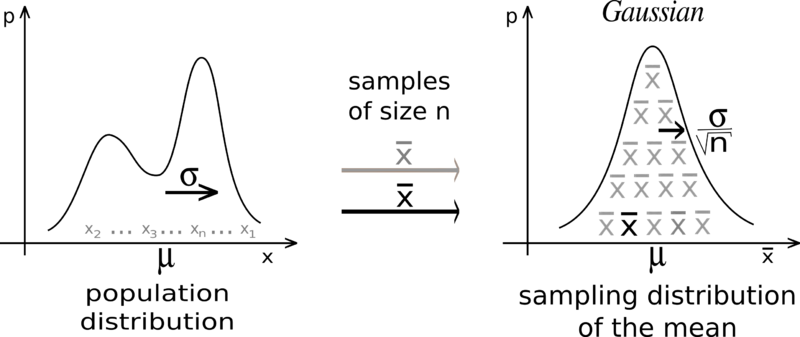
File:IllustrationCentralTheorem.png · Wikimedia Commons · See Wikimedia Commons
Key facts
- Type
- Theorem
- Field
- Probability theory
- Statement
- The scaled sum of a sequence of i.i.d. random variables with finite positive variance converges in distribution to the normal distribution .
- Generalizations
- Lindeberg's CLT
via Wikipedia infobox
Wikidata facts
- Instance of
- theorem
- Part of
- list of theorems
- Image
- CLTBinomConvergence.svg
Show 6 more facts
- short name
- CLT
- studied by
- probability theory
- maintained by WikiProject
- WikiProject Mathematics
- Commons category
- Central limit theorem
- topic's main category
- Category:Central limit theorem
- on focus list of Wikimedia project
- Wikipedia:Vital articles/Level/4
Sources (3)
via Wikidata · CC0
~40 min read
Encyclopedic overview
In probability theory, the central limit theorem (CLT) states that, under appropriate conditions, the distribution of a normalized version of the sample mean converges to a standard normal distribution. This holds even if the original variables themselves are not normally distributed. There are several versions of the CLT, each applying in the context of different conditions.
The theorem is a key concept in probability theory because it implies that probabilistic and statistical methods that work for normal distributions can be applicable to many problems involving other types of distributions.
Excerpted from Wikipedia’s “central limit theorem” article, available under the CC BY-SA 4.0 licence.