File:Finding_the_median.png · Wikimedia Commons · See Wikimedia Commons
median
Sign in to saveAlso known as statistical median, 2nd quartile, 5th decile, 50th percentile, 2-quantile
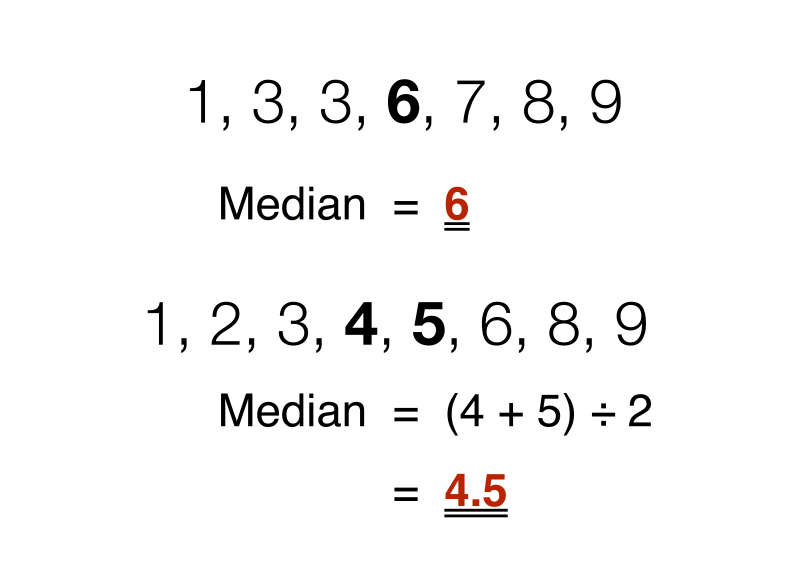
thumb|Calculating the median in data sets of odd (above) and even (below) observations The median of a set of numbers is the value separating the higher half from the lower half of a data sample, a population, or a probability distribution. For a data set, it may be thought of as the “middle" value. The basic feature of the median in describing data compared to the mean (often simply described as the "average") is that it is not skewed by a small proportion of extreme values, and therefore provides a better representation of the center. Median income, for example, may be a better way to descri
The median is the middle value in a set of numbers, separating the higher half of the data from the lower half. It matters because unlike the average, the median isn't thrown off by extreme values, making it often a better way to describe where the typical value actually sits.
AI-generated from the Wikipedia summary — may contain errors.
Wikidata facts
- Subclass of
- quantile
- Image
- Finding the median.png
Show 8 more facts
- facet of
- robust statistics
- NCI Thesaurus ID
- C280079
- Commons category
- Median
- Stack Exchange tag
- stackoverflow.com/tags/median
- literal translation
- 中央値
- different from
- arithmetic mean
- on focus list of Wikimedia project
- Wikipedia:Vital articles/Level/4
- maintained by WikiProject
- WikiProject Mathematics
Sources (3)
via Wikidata · CC0
~32 min read
Encyclopedic overview
38 sectionsContents
- Finite set of numbers
- Definition and notation
- Uses
- Probability distributions
- Medians of particular distributions
- Properties
- Optimality property
- Inequality relating means and medians
- Unimodal distributions
- Mean, median, and skew
- Jensen's inequality for medians
- Medians for samples
- {{anchor|Ninther}} {{anchor|Remedian}} Efficient computation of the sample median
- Sampling distribution
- Derivation of the asymptotic distribution
- Empirical local density
- Estimation of variance from sample data
- Efficiency{{anchor|Efficiency}}
- Other estimators
- Multivariate median
- Marginal median
- Geometric median
- Median in all directions
- Centerpoint
- Conditional median
- Other median-related concepts
- Interpolated median
- Pseudo-median
- Variants of regression
- Median filter
- Cluster analysis
- Median–median line
- Median-unbiased estimators
- History
- See also
- Notes
- References
- External links
thumb|Calculating the median in data sets of odd (above) and even (below) observations The median of a set of numbers is the value separating the higher half from the lower half of a data sample, a population, or a probability distribution. For a data set, it may be thought of as the “middle" value. The basic feature of the median in describing data compared to the mean (often simply described as the "average") is that it is not skewed by a small proportion of extreme values, and therefore provides a better representation of the center. Median income, for example, may be a better way to describe the center of the income distribution because increases in the largest incomes alone have no effect on the median. For this reason, the median is of central importance in robust statistics. Median is a 2-quantile; it is the value that partitions a set into two equal parts.
==Finite set of numbers== The median of a finite list of numbers is the "middle" number, when those numbers are listed in order from smallest to greatest.
Excerpted from Wikipedia’s “median” article, available under the CC BY-SA 4.0 licence.
Gallery (12)
Available in 68 languages
- Español
- Français
- Deutsch
- 中文
- 日本語
- Русский
- Português
- Italiano
- العربية
- हिन्दी
- Afrikaans
- Albanian
- Armenian
- Azerbaijani
- Bahasa Indonesia
- Bangla
- Basque
- Belarusian
Show 49 more
- Bosnian
- Bulgarian
- Catalan
- Central Kurdish
- Croatian
- Czech
- Danish
- Esperanto
- Estonian
- Finnish
- Galician
- Greek
- Hebrew
- Hungarian
- Icelandic
- Ido
- Latvian
- Lithuanian
- Macedonian
- Malay
- Nederlands
- Norwegian
- Norwegian Nynorsk
- Polski
- Romanian
- Serbian
- Serbian (Latin)
- Shona
- Sicilian
- simple
- Sindhi
- Sinhala
- Slovak
- Slovenian
- Sundanese
- Svenska
- Swahili
- Tajik
- Tamil
- Tiếng Việt
- Türkçe
- Ukrainian
- Uzbek
- Welsh
- Wu Chinese
- zh_yue
- فارسی
- ไทย
- 한국어
via Wikidata sitelinks · CC0