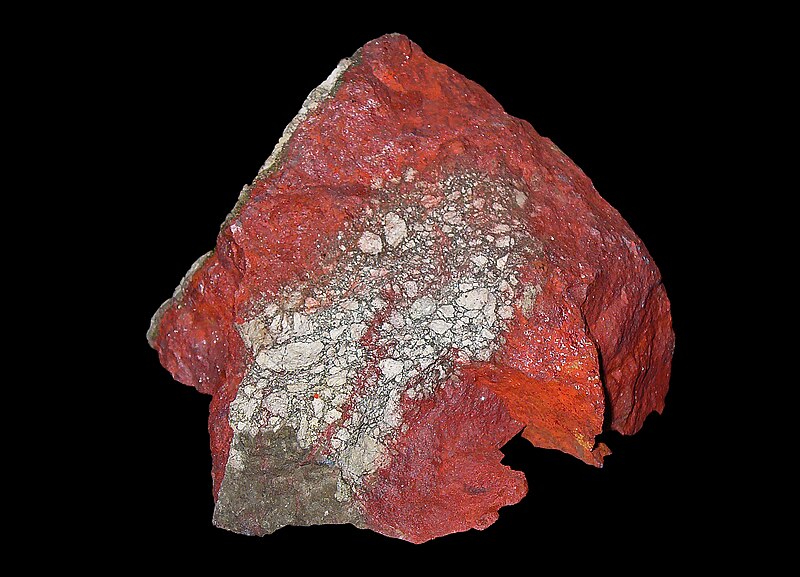
File:Cinnabarit_01.jpg · Wikimedia Commons · See Wikimedia Commons
cinnabar
Sign in to saveCinnabar (; ), also called cinnabarite () or mercurblende, is the bright scarlet to brick-red form of mercury(II) sulfide (HgS). It is the most common source ore for refining elemental mercury and is the historic source for the brilliant red or scarlet pigment termed vermilion and associated red mercury pigments.
Cinnabar is a bright red mineral form of mercury sulfide that serves as the primary ore for extracting mercury metal. Historically and today, it has been valued as the source of vermilion, a brilliant red pigment used in paints and dyes.
AI-generated from the Wikipedia summary — may contain errors.
Key facts
- Mineral.name
- Cinnabar
- Mineral.category
- Sulfide mineral
- Mineral.boxbgcolor
- B0120C
- Mineral.boxtextcolor
- fff
- Mineral.image
- Cinnabarit 01.jpg
- Mineral.imagesize
- 260px
- Mineral.caption
- Cinnabar, Staatliches Museum für Naturkunde Karlsruhe, Germany
- Mineral.formula
- Mercury(II) sulfide, HgS
- Mineral.IMAsymbol
- Cin
- Mineral.strunz
- 2.CD.15a
- Mineral.system
- Trigonal
- Mineral.class
- Trapezohedral (32) (same H–M symbol)
- Mineral.symmetry
- P3121, P3221
- Mineral.unit cell
- a = 4.145(2) Å, c = 9.496(2) Å, Z = 3
- Mineral.color
- Cochineal-red, towards brownish red and lead-gray
- Mineral.habit
- Rhombohedral to tabular; granular to massive and as incrustations
- Mineral.twinning
- Simple contact twins, twin plane {0001}
- Mineral.cleavage
- Prismatic {100}, perfect
via Wikipedia infobox
Wikidata facts
- Subclass of
- sulfide class of minerals
- Has part
- mercury(II) sulfide
- Image
- Cinnabar.jpg
Show 10 more facts
- described by source
- New International Encyclopedia
- Commons category
- Cinnabar
- Nickel-Strunz '10th ed', review of (9th ed/ 2009 update)
- 2.CD.15a
- Nickel-Strunz 9th edition (updated 2009)
- 2.CD.15a
- chemical formula
- HgS
- crystal system
- trigonal crystal system
- density
- 8.10
- Mohs' hardness
- 2.3
- IMA Mineral Symbol
- Cin
- Strunz 8th edition (series ID, updated)
- II/B.14
Sources (6)
via Wikidata · CC0
~11 min read
Encyclopedic overview
14 sectionsContents
- Etymology
- Properties and structure
- Properties
- Structure
- Occurrence
- Mining and extraction of mercury
- Toxicity
- Decorative use
- Other forms
- See also
- References
- Further reading
- External links
- See also
{{Infobox mineral | name = Cinnabar | category = Sulfide mineral | boxwidth = | boxbgcolor =#B0120C | boxtextcolor = #fff | image = Cinnabarit 01.jpg | imagesize = 260px | caption = Cinnabar, Staatliches Museum für Naturkunde Karlsruhe, Germany | formula = Mercury(II) sulfide, HgS | IMAsymbol = Cin | molweight = | strunz = 2.CD.15a | system = Trigonal | class = Trapezohedral (32) (same H–M symbol) | symmetry = P3121, P3221 | unit cell = a = 4.145(2) Å, c = 9.496(2) Å, Z = 3 | color = Cochineal-red, towards brownish red and lead-gray | habit = Rhombohedral to tabular; granular to massive and as incrustations | twinning = Simple contact twins, twin plane {0001} | cleavage = Prismatic {100}, perfect | fracture = Uneven to subconchoidal | tenacity = Slightly sectile | mohs = 2.0–2.5 | luster = Adamantine to dull | refractive = nω = 2.905 nε = 3.256 | opticalprop = Uniaxial (+); very high relief | birefringence = δ = 0.351 | pleochroism = | streak = Scarlet | gravity = 8.176 | density = | melt = | fusibility = | diagnostic = | solubility = water(Ksp at 25 °C = ) | diaphaneity = Transparent in thin pieces | other = | references = }}
Cinnabar (; ), also called cinnabarite () or mercurblende, is the bright scarlet to brick-red form of mercury(II) sulfide (HgS). It is the most common source ore for refining elemental mercury and is the historic source for the brilliant red or scarlet pigment termed vermilion and associated red mercury pigments.
Excerpted from Wikipedia’s “cinnabar” article, available under the CC BY-SA 4.0 licence.
Gallery (19)
Available in 66 languages
- Español
- Français
- Deutsch
- 中文
- 日本語
- Русский
- Português
- Italiano
- العربية
- Armenian
- Asturian
- Azerbaijani
- Bahasa Indonesia
- Basque
- Belarusian
- Bosnian
- Bulgarian
- Burmese
Show 47 more
- Catalan
- Croatian
- Czech
- Danish
- Esperanto
- Estonian
- Finnish
- Galician
- Georgian
- Greek
- Hebrew
- Hungarian
- Ido
- Irish
- Kazakh
- Kyrgyz
- Latvian
- Lithuanian
- Low German
- Macedonian
- Malay
- Mongolian
- Nederlands
- Norwegian
- Norwegian Nynorsk
- Occitan
- Ossetic
- Polski
- Romanian
- Serbian
- Serbian (Latin)
- simple
- Sindhi
- Slovak
- Slovenian
- Svenska
- Tatar
- Tiếng Việt
- Türkçe
- Ukrainian
- Uzbek
- Wu Chinese
- Yoruba
- zh_yue
- فارسی
- ไทย
- 한국어
via Wikidata sitelinks · CC0