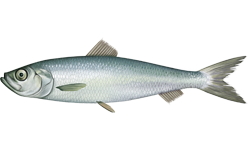
File:Clupea_harengus.png · Wikimedia Commons · See Wikimedia Commons
Clupea
Sign in to saveAlso known as True herring
Clupea is a genus of planktivorous bony fish belonging to the family Clupeidae, commonly known as herrings. They are found in the shallow, temperate waters of the North Pacific and the North Atlantic oceans, including the Baltic Sea. Two main species of Clupea are currently recognized: the Atlantic herring (Clupea harengus) and the Pacific herring (Clupea pallasii), which have each been divided into subspecies. Herrings are forage fish moving in vast schools, coming in spring to the shores of Europe and America, where they form important commercial fisheries.
OverviewAI-generated
Clupea is a genus of fish within the family Clupeidae and order Clupeiformes. It belongs to the class Teleostei, phylum Chordata, and kingdom Animalia. The scientific name Clupea was established by Linnaeus in 1758, and the taxon is currently accepted. The genus has existed for approximately 55 million years.
The organisms in this genus inhabit marine, brackish, and freshwater environments. The Japanese common name for the group is ニシン属. Records of Clupea have been documented in Italy, the United States, and Canada, with specimens held by institutions including CM and UWFC.
Synthesized by Vinony from 28 facts across 6 sources: Wikidata, GBIF, Gbif Occ, iDigBio, WoRMS, Vinony graph. Generated from structured data (not the Wikipedia text) and checked against those facts — may still contain errors.
Species
ニシン属
Clupea
GENUS
- KingdomAnimalia
- PhylumChordata
- ClassTeleostei
- OrderClupeiformes
- FamilyClupeidae
Echte Heringe (Clupea) sind eine Gattung der Familie Heringe (Clupeidae). Es handelt sich um Fische, die in großen Schwärmen leben. Ihre Hauptnahrung sind Copepoden, kleine Krebse, die im Plankton leben. Der Körper ist länglich, der Bauch rundlicher als bei der Sprotte. Die Schuppen am Bauch sind nicht gekielt. Eine Fettflosse fehlt. Der Hering wird maximal um 45 cm lang, ist weiß geschuppt und glänzt silbergrün. Der frische Fisch wird grüner Hering genannt, in Abgrenzung vom Salzhering, der mittels Salz oder Salzlake haltbar gemacht ist. Inhaltsverzeichnis 1 Arten 2 Anale Kommunikation 3 Einzelnachweise 4 Weblinks Arten Atlantischer Hering (Clupea harengus Linnaeus 1758), die wirtschaftlich bedeutendste Art im Nordatlantik Clupea manulensis Marion de Procé, 1822 Pazifischer Hering (Clupea pallasii Valenciennes 1847) Anale Kommunikation Sowohl pazifische als auch atlantische Heringe drücken Luft aus ihrer Schwimmblase über den Analtrakt nach außen und erzeugen damit pulsierende Töne (Fast Repetetive Tick, FRT). FRTs dauern 0,6 bis 7,6 Sekunden und erzeugen Schallwellen im Bereich von 1,7 bis 22 kHz. Deren genaue Funktion ist noch nicht erforscht. Da sie aber vermehrt in dichten Sch
via GBIF
Museum specimens
- Specimen records
- 607
- With media
- 27
- Family
- Clupeidae
- Collections
- CM, UWFC
- Recorded in
- Italy, United States, Canada
Wikidata facts
- Instance of
- taxon
- Subclass of
- fish as food
- Parent taxon
- Clupeinae
- Image
- Herringadultkils.jpg
Show 6 more facts
- taxon name
- Clupea
- taxon rank
- genus
- Commons category
- Clupea
- topic's main category
- Category:Clupea
- MCN code
- 0304.86.00
- start time
- 55000000-0
Sources (3)
via Wikidata · CC0
~8 min read
Encyclopedic overview
7 sectionsContents
- Morphology
- Species
- Fossil species
- Ecology
- Fisheries
- Sources
- References
Clupea is a genus of planktivorous bony fish belonging to the family Clupeidae, commonly known as herrings. They are found in the shallow, temperate waters of the North Pacific and the North Atlantic oceans, including the Baltic Sea. Two main species of Clupea are currently recognized: the Atlantic herring (Clupea harengus) and the Pacific herring (Clupea pallasii), which have each been divided into subspecies. Herrings are forage fish moving in vast schools, coming in spring to the shores of Europe and America, where they form important commercial fisheries.
== Morphology == The species of Clupea belong to the larger family Clupeidae (herrings, shads, sardines, menhadens), which comprises some 200 species that share similar features. They are silvery-colored fish that have a single dorsal fin, which is soft, without spines. They have no lateral line and have a protruding lower jaw. Their size varies between subspecies: the Baltic herring (Clupea harengus membras) is small, 14 to 18 centimeters; the proper Atlantic herring (C. h. harengus) can grow to about and weigh up ; and Pacific herring grow to about .
Excerpted from Wikipedia’s “Clupea” article, available under the CC BY-SA 4.0 licence.