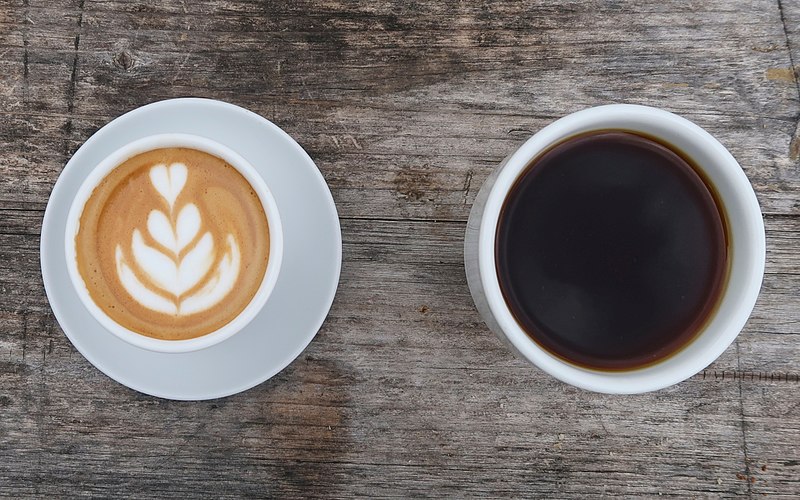
File:Latte_and_dark_coffee.jpg · Wikimedia Commons · See Wikimedia Commons
coffee
Sign in to saveCoffee is a beverage brewed from roasted, ground coffee beans. Darkly colored, bitter, and slightly acidic, coffee has a stimulating effect on humans, primarily due to its caffeine content, but decaffeinated coffee is also commercially available. There are also various coffee substitutes.
OverviewAI-generated
Coffee is a stimulant foodstuff and non-alcoholic beverage characterized by bitterness. It is made from coffee beans, which are natural products of the taxons Coffea arabica, kapeng barako, Coffea charrieriana, and Coffea stenophylla. The drink has its origins in Ethiopia and Yemen. Its preparation involves fabrication methods such as boiling or steeping.
Nutritional data for coffees indicates an energy content of 204 kcal per serving, with 6 grams of fat, 34.3 grams of carbohydrates, and 3.9 grams of protein. It contains 20.3 grams of sugars, 2.8 grams of fiber, and 10.94 grams of salt. The beverage has a pH value of 5.0 and carries a Nutri-Score of b. It is classified as nova 4. The Unicode character ☕ represents the subject.
Synthesized by Vinony from 36 facts across 4 sources: Wikidata, PubMed, Openfoodfacts, Vinony graph. Generated from structured data (not the Wikipedia text) and checked against those facts — may still contain errors.
Key facts
- Drink.name
- Coffee
- Drink.image
- Latte and dark coffee.jpg
- Drink.image_size
- 250px
- Drink.caption
- Latte and black filtered coffee
- Drink.type
- Usually hot, can be iced
- Drink.introduced
- 15th century
- Drink.color
- Black, dark brown, light brown, beige
- Drink.origin
- Yemen
- Drink.flavor
- Distinctive, somewhat bitter
- Drink.ingredients
- Roasted coffee beans
- Drink.drinkware
- Mug
via Wikipedia infobox
Nutrition · Open Food Facts
Typical values per 100 g · averaged across 979 products
- Energy
- 204 kcal
- Fat
- 6 g
- — of which saturates
- 5.2 g
- Carbohydrates
- 34.3 g
- — of which sugars
- 20.3 g
- Fibre
- 2.8 g
- Protein
- 3.9 g
- Salt
- 10.94 g
via Open Food Facts · ODbL
Research
24,779 papers- Effects of coffee on cognitive function.ReviewProgress in brain research · 2024Raise-Abdullahi P, Raeis-Abdollahi E, Meamar M et al.DOI: 10.1016/bs.pbr.2024.06.016
- Coffee for Cardioprotection and Longevity.ReviewProgress in cardiovascular diseases · 2018O'Keefe JH, DiNicolantonio JJ, Lavie CJDOI: 10.1016/j.pcad.2018.02.002
- Coffee's Impact on Health and Well-Being.ReviewNutrients · 2025Emadi RC, Kamangar FDOI: 10.3390/nu17152558
- Coffee, antioxidants, and brain inflammation.ReviewProgress in brain research · 2024Rai SP, Ansari AH, Singh D et al.DOI: 10.1016/bs.pbr.2024.06.005
- Coffee's protective mechanisms against neurodegeneration.ReviewProgress in brain research · 2024Raeis-Abdollahi E, Raise-Abdullahi P, Rashidy-Pour A et al.DOI: 10.1016/bs.pbr.2024.06.017
- Coffee.ReviewIARC monographs on the evaluation of carcinogenic risks to humans · 1991
- Effects of habitual coffee consumption on cardiometabolic disease, cardiovascular health, and all-cause mortality.ReviewJournal of the American College of Cardiology · 2013O'Keefe JH, Bhatti SK, Patil HR et al.DOI: 10.1016/j.jacc.2013.06.035
- Coffee substitutes: A review of the technology, characteristics, application, and future perspective.ReviewComprehensive reviews in food science and food safety · 2024Tahmouzi S, Nasab SS, Alizadeh-Salmani B et al.DOI: 10.1111/1541-4337.70041
via PubMed
Wikidata facts
Show 17 more facts
- Commons category
- Coffee
- topic's main category
- Category:Coffee
- Commons gallery
- Coffee
- history of topic
- history of coffee
- has characteristic
- bitterness
- Unicode character
- ☕
- on focus list of Wikimedia project
- Wikipedia:Vital articles/Level/4
- topic has template
- Template:Coffee
- WordLift URL
- data.thenextweb.com/tnw/entity/coffee
- Stack Exchange site URL
- coffee.stackexchange.com
- pH value
- 5.0
- different from
- Joe
- fabrication method
- steeping
- NCI Thesaurus ID
- C178190
- water footprint
- 18925
- social media followers
- 1166582
- natural product of taxon
- Coffea stenophylla
Sources (14)
via Wikidata · CC0
~56 min read
Encyclopedic overview
47 sectionsContents
- Etymology
- History
- Legendary accounts and myths
- Historical transmission
- As a colonial import
- Mass production
- Biology
- Cultivation and production
- Species variations
- Pests and treatments
- Fungi
- Animals
- Ecological effects
- Preprocessing
- Processing
- Roasting
- Grading roasted beans
- Roast characteristics
- Decaffeination
- Storage
- Preparation
- Brewing
- Serving
- "Functional coffee"
- Instant coffee
- Economics
- World production
- Commodity market
- Consumption
- Economic impacts
- Fair trade
- Specialty coffee and new trading relationships
- Composition
- Pharmacology
- Caffeine content
- Society and culture
- Coffeehouses
- Break
- Prohibition and condemnation
- Folklore and culture
- See also
- Footnotes
- References
- Citations
- Works cited
- Further reading
- External links
Coffee is a beverage brewed from roasted, ground coffee beans. Darkly colored, bitter, and slightly acidic, coffee has a stimulating effect on humans, primarily due to its caffeine content, but decaffeinated coffee is also commercially available. There are also various coffee substitutes.
Coffee production begins when the seeds from coffee cherries (the Coffea plant's fruits) are separated to produce unroasted green coffee beans. The "beans" are roasted and then ground into fine particles. Coffee is brewed from the ground roasted beans, which are typically steeped in hot water before being filtered out. It is usually served hot, although chilled or iced coffee is common. Coffee can be prepared and presented in a variety of ways (e.g., espresso, French press, caffè latte, or already-brewed canned coffee). Sugar, sugar substitutes, milk, and cream are often added to mask the bitter taste or enhance the flavor.
Excerpted from Wikipedia’s “coffee” article, available under the CC BY-SA 4.0 licence.
Gallery (52)
Available in 212 languages
- Español
- Français
- Deutsch
- 中文
- 日本語
- Русский
- Português
- Italiano
- العربية
- हिन्दी
- abstract
- Afrikaans
- Albanian
- Albanian
- Amharic
- Angika
- Aragonese
- Armenian
Show 193 more
- Assamese
- Asturian
- Atikamekw
- Awadhi
- azb
- Azerbaijani
- Bahasa Indonesia
- Balinese
- Bangla
- Banjar
- Bashkir
- Basque
- bat_smg
- Bavarian
- bdr
- be_x_old
- Belarusian
- Betawi
- Bikol
- Bislama
- Bosnian
- Breton
- Bulgarian
- Buriat
- Burmese
- Catalan
- cdo
- Central Dusun
- Central Kurdish
- Chechen
- Cherokee
- Cheyenne
- Chuvash
- Croatian
- Czech
- dag
- Danish
- dty
- Egyptian Arabic
- Esperanto
- Estonian
- Extremaduran
- Faroese
- Fiji Hindi
- Filipino
- Finnish
- fiu_vro
- Friulian
- Galician
- Gan Chinese
- gcr
- Georgian
- Gothic
- Greek
- Guarani
- Haitian Creole
- Hakka Chinese
- Hawaiian
- Hebrew
- Hungarian
- hyw
- Iban
- Icelandic
- Ido
- Igbo
- Iloko
- Inari Sami
- Interlingua
- Interlingue
- Inupiaq
- Irish
- Jamaican Creole English
- Javanese
- Jju
- Kabardian
- Kannada
- Kanuri
- Karachay-Balkar
- Kashmiri
- Kashubian
- Kazakh
- kbp
- kge
- Khmer
- Kinyarwanda
- Kurdish
- Kyrgyz
- Ladino
- Lao
- Latin
- Latvian
- Lezghian
- Ligurian
- Limburgish
- Lingala
- Lingua Franca Nova
- Lithuanian
- Lojban
- Lombard
- Low German
- Luxembourgish
- Macedonian
- Madurese
- Maithili
- Malagasy
- Malay
- Malayalam
- Marathi
- Minangkabau
- Mingrelian
- Mongolian
- Moroccan Arabic
- Navajo
- nds_nl
- Nederlands
- Nepali
- Nias
- Northern Frisian
- Northern Sami
- Norwegian
- Norwegian Nynorsk
- nrm
- Obolo
- Occitan
- Old English
- olo
- Oromo
- Ossetic
- Papiamento
- Pashto
- Piedmontese
- Polski
- Punjabi
- Quechua
- roa_rup
- Romanian
- Romansh
- Rusyn
- Sanskrit
- Santali
- Sardinian
- Saterland Frisian
- Scots
- Scottish Gaelic
- Serbian
- Serbian (Latin)
- Shona
- Sicilian
- Silesian
- simple
- Sindhi
- Sinhala
- Slovak
- Slovenian
- Somali
- Sundanese
- Svenska
- Swahili
- szy
- Tajik
- Tamil
- Tatar
- Telugu
- Tibetan
- Tiếng Việt
- Tok Pisin
- Toki Pona
- Türkçe
- Turkmen
- Ukrainian
- Urdu
- Uyghur
- Uzbek
- Venetian
- Veps
- Walloon
- Waray
- Wayuu
- Welsh
- West Flemish
- Western Panjabi
- Wu Chinese
- Yakut
- Yiddish
- Zeelandic
- zh_classical
- zh_min_nan
- zh_yue
- Zhuang
- Zulu
- فارسی
- ไทย
- 한국어
via Wikidata sitelinks · CC0