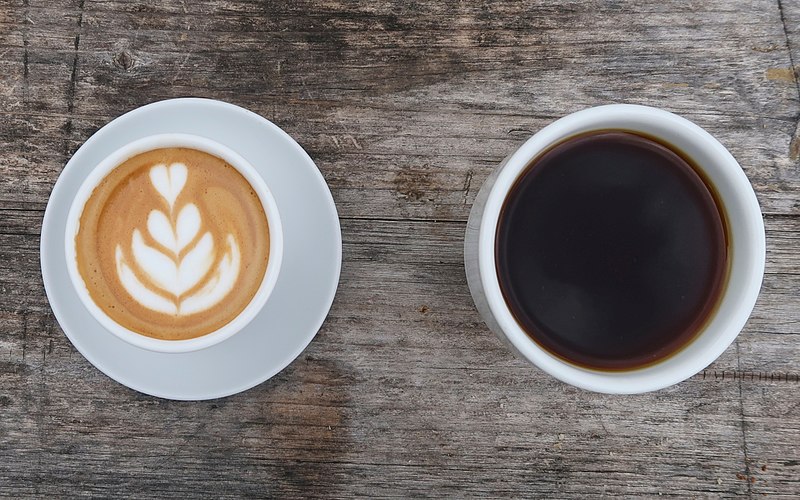
File:Latte_and_dark_coffee.jpg · Wikimedia Commons · See Wikimedia Commons
café
Sign in to savebebida elaborada a base de granos de café
OverviewAI-generated
Coffee is a stimulant foodstuff and non-alcoholic beverage characterized by bitterness. It is made from coffee beans, which are natural products of the taxons Coffea arabica, kapeng barako, Coffea charrieriana, and Coffea stenophylla. The drink has its origins in Ethiopia and Yemen. Its preparation involves fabrication methods such as boiling or steeping.
Nutritional data for coffees indicates an energy content of 204 kcal per serving, with 6 grams of fat, 34.3 grams of carbohydrates, and 3.9 grams of protein. It contains 20.3 grams of sugars, 2.8 grams of fiber, and 10.94 grams of salt. The beverage has a pH value of 5.0 and carries a Nutri-Score of b. It is classified as nova 4. The Unicode character ☕ represents the subject.
Synthesized by Vinony from 36 facts across 4 sources: Wikidata, PubMed, Openfoodfacts, Vinony graph. Generated from structured data (not the Wikipedia text) and checked against those facts — may still contain errors.
Key facts
- Drink.name
- Coffee
- Drink.image
- Latte and dark coffee.jpg
- Drink.image_size
- 250px
- Drink.caption
- Latte and black filtered coffee
- Drink.type
- Usually hot, can be iced
- Drink.introduced
- 15th century
- Drink.color
- Black, dark brown, light brown, beige
- Drink.origin
- Yemen
- Drink.flavor
- Distinctive, somewhat bitter
- Drink.ingredients
- Roasted coffee beans
- Drink.drinkware
- Mug
via Wikipedia infobox
Nutrition · Open Food Facts
Typical values per 100 g · averaged across 979 products
- Energy
- 204 kcal
- Fat
- 6 g
- — of which saturates
- 5.2 g
- Carbohydrates
- 34.3 g
- — of which sugars
- 20.3 g
- Fibre
- 2.8 g
- Protein
- 3.9 g
- Salt
- 10.94 g
via Open Food Facts · ODbL
Research
24,779 papers- Effects of coffee on cognitive function.ReviewProgress in brain research · 2024Raise-Abdullahi P, Raeis-Abdollahi E, Meamar M et al.DOI: 10.1016/bs.pbr.2024.06.016
- Coffee for Cardioprotection and Longevity.ReviewProgress in cardiovascular diseases · 2018O'Keefe JH, DiNicolantonio JJ, Lavie CJDOI: 10.1016/j.pcad.2018.02.002
- Coffee's Impact on Health and Well-Being.ReviewNutrients · 2025Emadi RC, Kamangar FDOI: 10.3390/nu17152558
- Coffee, antioxidants, and brain inflammation.ReviewProgress in brain research · 2024Rai SP, Ansari AH, Singh D et al.DOI: 10.1016/bs.pbr.2024.06.005
- Coffee's protective mechanisms against neurodegeneration.ReviewProgress in brain research · 2024Raeis-Abdollahi E, Raise-Abdullahi P, Rashidy-Pour A et al.DOI: 10.1016/bs.pbr.2024.06.017
- Coffee.ReviewIARC monographs on the evaluation of carcinogenic risks to humans · 1991
- Effects of habitual coffee consumption on cardiometabolic disease, cardiovascular health, and all-cause mortality.ReviewJournal of the American College of Cardiology · 2013O'Keefe JH, Bhatti SK, Patil HR et al.DOI: 10.1016/j.jacc.2013.06.035
- Coffee substitutes: A review of the technology, characteristics, application, and future perspective.ReviewComprehensive reviews in food science and food safety · 2024Tahmouzi S, Nasab SS, Alizadeh-Salmani B et al.DOI: 10.1111/1541-4337.70041
via PubMed
Wikidata facts
Show 17 more facts
- Commons category
- Coffee
- topic's main category
- Category:Coffee
- Commons gallery
- Coffee
- history of topic
- history of coffee
- has characteristic
- bitterness
- Unicode character
- ☕
- on focus list of Wikimedia project
- Wikipedia:Vital articles/Level/4
- topic has template
- Template:Coffee
- WordLift URL
- data.thenextweb.com/tnw/entity/coffee
- Stack Exchange site URL
- coffee.stackexchange.com
- pH value
- 5.0
- different from
- Joe
- fabrication method
- steeping
- NCI Thesaurus ID
- C178190
- water footprint
- 18925
- social media followers
- 1166582
- natural product of taxon
- Coffea stenophylla
Sources (14)
via Wikidata · CC0
Article · Español
El café es la bebida que se obtiene a partir de los granos tostados y molidos de los frutos de la planta del café (cafeto); es altamente estimulante por su contenido de cafeína, una sustancia psicoactiva. Es uno de los productos más comercializados a nivel mundial, además de estar entre las tres bebidas más consumidas por el ser humano (junto con el agua y el té). Suele tomarse durante o después del desayuno, y puede llegar a ser considerado para muchas personas como único desayuno, aunque también se toma en diferentes ocasiones y a diversas horas del día, como en la merienda, después del almuerzo o cena; y es ideal para entablar conversaciones, y en muchos países por costumbre o tradición se reparte en reuniones familiares como funerales; Es por ello que es valorada en diferentes países del mundo como una de las bebidas sin alcohol más socializadoras que existen. El gusto por el café no siempre ha sido espontáneo en las culturas mundiales y las nuevas generaciones, sino que casi siempre debe ser cultivado, puesto que su sabor original es fuerte y amargo. Las formas más populares de tomarlo son negro (solo) y con leche (con o sin azúcar); también se le suele añadir: miel, crema o nata, leche condensada, chocolate o algún licor, es decir, dependiendo de la receta hay diversas formas de prepararlo. Se sirve habitualmente caliente, pero también se toma frío o con hielo. En Argentina, Uruguay, España, Portugal y Paraguay es frecuente el consumo de café torrado o torrefacto, es decir, tostado con azúcar, de baja calidad. El cafeto es originario de la provincia de Kaffaen las tierras altas de Abisinia, actual Etiopía, en donde crece de forma silvestre. Las cualidades energéticas del café ya eran conocidas por la tribu Galla de Etiopía en el siglo XI, quienes lo mezclaban con grasa animal. Posteriormente, sería introducido a Arabia, de donde se expandiría al resto del mundo con el dominio turco de Anatolia. Actualmente, la planta se cultiva principalmente en países tropicales y subtropicales como Brasil, Vietnam y Colombia (principales productores de café). Brasil concentra poco más de un tercio de la producción mundial. Los granos del café son uno de los principales productos de origen agrícola que se comercializan en los mercados internacionales y a menudo suponen una gran contribución a los rubros de exportación de las regiones productoras. El cultivo del café está culturalmente ligado a la historia y al progreso de muchos países que lo han producido por más de un siglo. Durante el periodo 2012-2013 se produjeron 87 millones de toneladas de café, de los cuales se exportó aproximadamente un 80 % por un valor de 19 100 millones de dólares, mientras que el valor bruto de la industria total asociada al comercio del café se estima en 173 400 millones de dólares. Actualmente, más de 25 millones de fincas familiares en unos ochenta países cultivan alrededor de 15 000 millones de cafetos, cuya producción termina en los 2250 millones de tazas de café que se consumen a diario.[cita requerida] Un café o cafetería es un establecimiento dedicado al consumo de café y algunos alimentos.
Abstract from DBpedia / Wikipedia · CC BY-SA
Gallery (52)
Available in 212 languages
- Español
- Français
- Deutsch
- 中文
- 日本語
- Русский
- Português
- Italiano
- العربية
- हिन्दी
- abstract
- Afrikaans
- Albanian
- Albanian
- Amharic
- Angika
- Aragonese
- Armenian
Show 193 more
- Assamese
- Asturian
- Atikamekw
- Awadhi
- azb
- Azerbaijani
- Bahasa Indonesia
- Balinese
- Bangla
- Banjar
- Bashkir
- Basque
- bat_smg
- Bavarian
- bdr
- be_x_old
- Belarusian
- Betawi
- Bikol
- Bislama
- Bosnian
- Breton
- Bulgarian
- Buriat
- Burmese
- Catalan
- cdo
- Central Dusun
- Central Kurdish
- Chechen
- Cherokee
- Cheyenne
- Chuvash
- Croatian
- Czech
- dag
- Danish
- dty
- Egyptian Arabic
- Esperanto
- Estonian
- Extremaduran
- Faroese
- Fiji Hindi
- Filipino
- Finnish
- fiu_vro
- Friulian
- Galician
- Gan Chinese
- gcr
- Georgian
- Gothic
- Greek
- Guarani
- Haitian Creole
- Hakka Chinese
- Hawaiian
- Hebrew
- Hungarian
- hyw
- Iban
- Icelandic
- Ido
- Igbo
- Iloko
- Inari Sami
- Interlingua
- Interlingue
- Inupiaq
- Irish
- Jamaican Creole English
- Javanese
- Jju
- Kabardian
- Kannada
- Kanuri
- Karachay-Balkar
- Kashmiri
- Kashubian
- Kazakh
- kbp
- kge
- Khmer
- Kinyarwanda
- Kurdish
- Kyrgyz
- Ladino
- Lao
- Latin
- Latvian
- Lezghian
- Ligurian
- Limburgish
- Lingala
- Lingua Franca Nova
- Lithuanian
- Lojban
- Lombard
- Low German
- Luxembourgish
- Macedonian
- Madurese
- Maithili
- Malagasy
- Malay
- Malayalam
- Marathi
- Minangkabau
- Mingrelian
- Mongolian
- Moroccan Arabic
- Navajo
- nds_nl
- Nederlands
- Nepali
- Nias
- Northern Frisian
- Northern Sami
- Norwegian
- Norwegian Nynorsk
- nrm
- Obolo
- Occitan
- Old English
- olo
- Oromo
- Ossetic
- Papiamento
- Pashto
- Piedmontese
- Polski
- Punjabi
- Quechua
- roa_rup
- Romanian
- Romansh
- Rusyn
- Sanskrit
- Santali
- Sardinian
- Saterland Frisian
- Scots
- Scottish Gaelic
- Serbian
- Serbian (Latin)
- Shona
- Sicilian
- Silesian
- simple
- Sindhi
- Sinhala
- Slovak
- Slovenian
- Somali
- Sundanese
- Svenska
- Swahili
- szy
- Tajik
- Tamil
- Tatar
- Telugu
- Tibetan
- Tiếng Việt
- Tok Pisin
- Toki Pona
- Türkçe
- Turkmen
- Ukrainian
- Urdu
- Uyghur
- Uzbek
- Venetian
- Veps
- Walloon
- Waray
- Wayuu
- Welsh
- West Flemish
- Western Panjabi
- Wu Chinese
- Yakut
- Yiddish
- Zeelandic
- zh_classical
- zh_min_nan
- zh_yue
- Zhuang
- Zulu
- فارسی
- ไทย
- 한국어
via Wikidata sitelinks · CC0