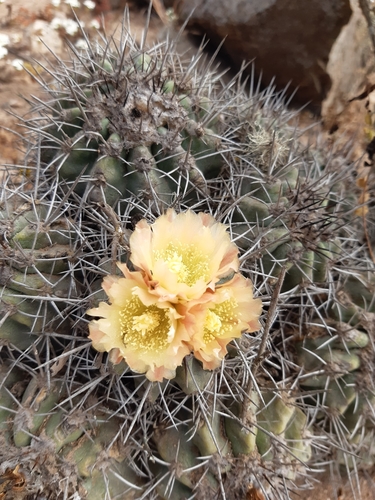
(c) Francisco Riquelme Tapia, some rights reserved (CC BY-NC), uploaded by Francisco Riquelme Tapia · cc-by-nc
Copiapoa
Sign in to saveCopiapoa is a genus of flowering plants in the cactus family Cactaceae, from the dry coastal deserts, particularly the Atacama Desert, of northern Chile.
Species
GENUS
- KingdomPlantae
- PhylumTracheophyta
- ClassMagnoliopsida
- OrderCaryophyllales
- FamilyCactaceae
Copiapoa laui in Kultur Copiapoa montana in Kultur Copiapoa ist eine Pflanzengattung aus der Familie der Kakteengewächse (Cactaceae). Der botanische Name der Gattung leitet sich von der in der Atacamawüste gelegenen chilenischen Stadt Copiapó ab.[1] Inhaltsverzeichnis 1 Beschreibung 2 Systematik und Verbreitung 2.1 Systematik nach N.Korotkova et al. (2021) 2.2 Systematik nach E.F.Anderson/Eggli (2005) 3 Botanische Geschichte 4 Nachweise 4.1 Literatur 4.2 Einzelnachweise 5 Weiterführende Literatur 6 Weblinks Beschreibung Die Gattung Copiapoa ist für dichte Polster aus Hunderten von großen Einzelpflanzen bekannt. Daneben gibt es auch Arten, die nur einzeln stehende Pflanzen ausbilden. Die Triebe sind kugelförmig oder verlängert-zylindrisch. Auf dem Scheitel sind die Arten meist dicht wollig behaart. Die Rippen sind deutlich ausgebildet. Die meist vorhandenen Dornen sind variabel geformt. Die gelben Blüten erscheinen im Scheitel. Sie sind glocken- bis trichterförmig und öffnen sich tagsüber. Das kurze, kreiselförmige Perikarpell ist kahl. Die Blütenröhre ist kurz und breit. Die kleinen, glatten Früchte enthalten große, glänzende schwarze Samen mit einem großen Hilum. Systematik und Ve
via GBIF · Kew POWO
Museum specimens
- Specimen records
- 33
- With media
- 26
- Family
- Cactaceae
- Collections
- NY, GH, CAS, DES, TEX, F
- Recorded in
- Chile, Peru, United States
Wikidata facts
- Instance of
- taxon
- Parent taxon
- Cactoideae
- Image
- Copiapoa marginata 10.jpg
Show 6 more facts
- taxon rank
- genus
- taxon name
- Copiapoa
- Commons category
- Copiapoa
- topic's main category
- Category:Copiapoa
- taxon common name
- 龙爪玉属
Sources (1)
via Wikidata · CC0
~4 min read
Encyclopedic overview
6 sectionsContents
- Description
- Taxonomy
- Species
- See also
- References
- External links
Copiapoa is a genus of flowering plants in the cactus family Cactaceae, from the dry coastal deserts, particularly the Atacama Desert, of northern Chile.
==Description== Copiapoa comprises 32 morphologically defined species and five heterotypic subspecies. The species in this genus form dense cushions of hundreds of large, individual plants or produce only solitary plants. The shoots are spherical or elongated cylindrical. The spines, which are usually present, are variably shaped. On the apex, the species are usually densely woolly-haired. The ribs are clearly developed. These species vary in form from spherical to slightly columnar and in color from a brownish to blue-green bodies. They have warty ribs and spiny areoles, and they usually produce tubular yellow flowers, which grow from woolly crowns on the apex in summer. They are bell- to funnel-shaped and open during the day. The short, circular pericarp is glabrous. The flower tube is short and broad. The small, smooth fruits contain large, shiny, black seeds.
Excerpted from Wikipedia’s “Copiapoa” article, available under the CC BY-SA 4.0 licence.