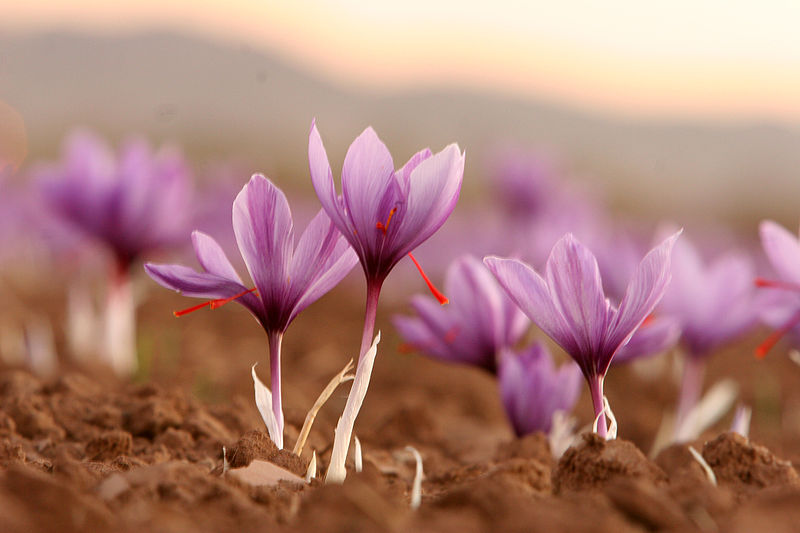
File:860808-Saffronfarm-01-IMG_7707-2.jpg · Wikimedia Commons · See Wikimedia Commons
Crocus
Sign in to saveAlso known as Crocus genus, crocuses, croci
Crocus (; plural: crocuses or croci) is a genus of seasonal flowering plants in the family Iridaceae (iris family) comprising about 100 species of perennials growing from corms.
OverviewAI-generated
Crocus is a genus within the family Iridaceae, belonging to the order Asparagales and class Liliopsida. The scientific name is Crocus L., and the type species is Crocus sativus. Common names for the genus include crocus, زعفران, Zəfəran, and Минзухар. The parent taxon is Crocoideae, and the genus produces fruit in the form of a capsule.
One species, Crocus sieberi, is native to Kriti and has been introduced to Germany, Great Britain, and New York. Records indicate occurrences in Mexico, Italy, the Russian Federation, Turkey, and Greece. The genus has been described in sources such as the Brockhaus and Efron Encyclopedic Dictionary and the Encyclopædia Britannica 11th edition.
Synthesized by Vinony from 43 facts across 8 sources: Wikidata, GBIF, PubMed, iNaturalist, Gbif Occ, Plants of the World, iDigBio, Vinony graph. Generated from structured data (not the Wikipedia text) and checked against those facts — may still contain errors.
Species
prairie pasqueflower
Crocus
GENUS
- KingdomPlantae
- PhylumTracheophyta
- ClassLiliopsida
- OrderAsparagales
- FamilyIridaceae
General: The genus (a group of related species) Crocus contains Common Name: Sieber’s crocus
via GBIF · Kew POWO
Museum specimens
- Specimen records
- 493
- With media
- 323
- Family
- Iridaceae
- Collections
- MADUG-UG, MICH, WIS, US, CAS, CM
- Recorded in
- Mexico, Italy, Russian Federation, Turkey, Greece, United States, India, Germany
Research
2,123 papers- The Effects of Crocus sativus (Saffron) on ADHD: A Systematic Review.Journal of attention disorders · 2024Seyedi-Sahebari S, Farhang S, Araj-Khodaei M et al.DOI: 10.1177/10870547231203176
- Saffron (Crocus sativus L.): A Source of Nutrients for Health and for the Treatment of Neuropsychiatric and Age-Related Diseases.ReviewNutrients · 2022El Midaoui A, Ghzaiel I, Vervandier-Fasseur D et al.DOI: 10.3390/nu14030597
- Saffron (Crocus sativus) for depression: a systematic review of clinical studies and examination of underlying antidepressant mechanisms of action.Human psychopharmacology · 2014Lopresti AL, Drummond PDDOI: 10.1002/hup.2434
- Crocus Sativus for Insomnia: A Systematic Review and Meta-Analysis.International journal of environmental research and public health · 2022Munirah MP, Norhayati MN, Noraini MDOI: 10.3390/ijerph191811658
- New horizons for the study of saffron (Crocus sativus L.) and its active ingredients in the management of neurological and psychiatric disorders: A systematic review of clinical evidence and mechanisms.Phytotherapy research : PTR · 2024Han S, Cao Y, Wu X et al.DOI: 10.1002/ptr.8110
- Saffron (Crocus sativus L.) and Its By-Products: Healthy Effects in Internal Medicine.ReviewNutrients · 2024Marrone G, Urciuoli S, Di Lauro M et al.DOI: 10.3390/nu16142319
- Therapeutic effects of saffron (Crocus sativus L) on female reproductive system disorders: A systematic review.Phytotherapy research : PTR · 2024Hasheminasab FS, Azimi M, Raeiszadeh MDOI: 10.1002/ptr.8186
- affron(®) a novel saffron extract (Crocus sativus L.) improves mood in healthy adults over 4 weeks in a double-blind, parallel, randomized, placebo-controlled clinical trial.Complementary therapies in medicine · 2017Kell G, Rao A, Beccaria G et al.DOI: 10.1016/j.ctim.2017.06.001
via PubMed
Wikidata facts
- Instance of
- taxon
- Parent taxon
- Crocoideae
- Image
- Crocus sativus1.jpg
Show 10 more facts
- Commons category
- Crocus
- taxon name
- Crocus
- taxon rank
- genus
- taxonomic type
- Crocus sativus
- topic's main category
- Category:Crocus
- Commons gallery
- Crocus
- taxon common name
- žafran
- uses
- corm
- has fruit type
- capsule
Sources (6)
via Wikidata · CC0
~41 min read
Encyclopedic overview
42 sectionsContents
- Description
- General
- Leaves
- Flowers
- Fruit and seed
- Karyology
- Phytochemistry
- Taxonomy
- History
- Botanical illustration
- Phylogeny
- Subdivision
- Speciation
- Molecular phylogeny
- Sections and species
- Similarly named species
- Etymology
- Distribution and habitat
- Ecology
- Pests and diseases
- Cultivation
- Saffron
- Horticulture and floriculture
- Autumn crocus
- Uses
- Culture
- Notes
- References
- Bibliography
- Books
- Gardening, horticulture and floriculture
- Dictionaries and encyclopedias
- Historical sources (chronological)
- Chapters
- Articles
- Phylogeny and taxonomy
- Novel taxa
- Historical accounts
- Websites
- Organisations and collections
- Databases and flora
- External links
Crocus (; plural: crocuses or croci) is a genus of seasonal flowering plants in the family Iridaceae (iris family) comprising about 100 species of perennials growing from corms.
They are low growing plants, whose flower stems remain underground, that bear relatively large white, yellow, orange or purple flowers and then become dormant after flowering. Many are cultivated for their flowers, appearing in autumn, winter, or spring. The flowers close at night and in overcast weather conditions.
Excerpted from Wikipedia’s “Crocus” article, available under the CC BY-SA 4.0 licence.
Gallery (29)
Available in 68 languages
- Español
- Français
- Deutsch
- 中文
- 日本語
- Русский
- Português
- Italiano
- العربية
- Afrikaans
- Armenian
- azb
- Azerbaijani
- Bahasa Indonesia
- Basque
- bat_smg
- Breton
- Bulgarian
Show 49 more
- Catalan
- Cebuano
- Chuvash
- Croatian
- Czech
- Danish
- Egyptian Arabic
- Esperanto
- Estonian
- Finnish
- Georgian
- Greek
- Hebrew
- Hungarian
- Icelandic
- Irish
- Kazakh
- Kurdish
- Kyrgyz
- Latin
- Latvian
- Lingua Franca Nova
- Lithuanian
- lld
- Luxembourgish
- Macedonian
- Malagasy
- Malayalam
- Nederlands
- Northern Frisian
- Norwegian
- Norwegian Nynorsk
- Ossetic
- Polski
- Romanian
- simple
- Slovak
- Svenska
- Türkçe
- Ukrainian
- Upper Sorbian
- Waray
- Western Frisian
- Western Panjabi
- Wu Chinese
- Zaza
- zh_yue
- فارسی
- 한국어
via Wikidata sitelinks · CC0