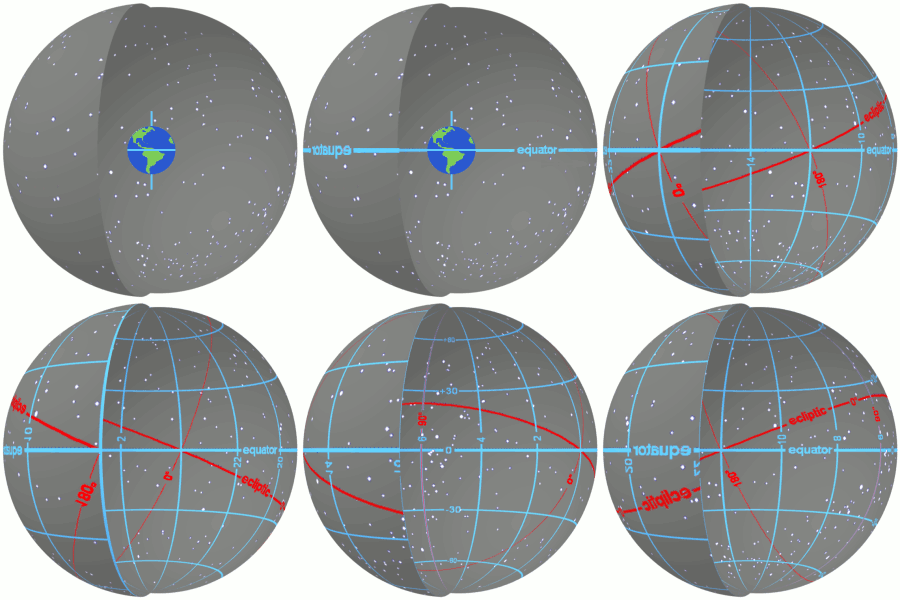
File:Ra_and_dec_demo_animation_small.gif · Wikimedia Commons · See Wikimedia Commons
declinação
Sign in to saveIn astronomy, declination (abbreviated dec; symbol δ) is one of the two angles that locate a point on the celestial sphere in the equatorial coordinate system, the other being hour angle. The declination angle is measured north (positive) or south (negative) of the celestial equator, along the hour circle passing through the point in question.
Declination is an astronomical measurement that describes how far north or south a celestial object appears in the sky, measured from an imaginary line called the celestial equator. This measurement is one of two coordinates astronomers use to pinpoint the exact location of stars and other objects in the sky, much like latitude and longitude are used to locate places on Earth.
AI-generated from the Wikipedia summary — may contain errors.
Wikidata facts
- Subclass of
- angular measure
- Part of
- equatorial coordinate system
Show 6 more facts
- opposite of
- right ascension
- lower limit
- -90
- upper limit
- 90
- described by source
- Brockhaus and Efron Encyclopedic Dictionary
- topic has template
- Template:DEC
- on focus list of Wikimedia project
- Wikipedia:Vital articles/Level/4
Sources (3)
via Wikidata · CC0
Article · Português
Em astronomia, a declinação de um astro é o arco do meridiano do astro compreendido entre o plano do equador celeste e o astro. Mede-se de 0º a 90º para Norte ou para Sul, sendo por vezes representado com um valor entre + 90º e − 90º (positivo representando o Norte e negativo o Sul). É um dos valores angulares utilizados para definir a posição de um astro em um sistema de coordenadas equatoriais, o outro sendo o ângulo horário ou a ascensão reta.
Abstract from DBpedia / Wikipedia · CC BY-SA
Gallery (9)
Available in 75 languages
- Español
- Français
- Deutsch
- 中文
- 日本語
- Русский
- Português
- Italiano
- العربية
- हिन्दी
- Afrikaans
- Armenian
- Asturian
- Azerbaijani
- Bahasa Indonesia
- Bangla
- Basque
- be_x_old
Show 56 more
- Belarusian
- Bosnian
- Bulgarian
- Catalan
- Croatian
- Czech
- Danish
- Esperanto
- Estonian
- Filipino
- Finnish
- Galician
- Georgian
- Greek
- Hebrew
- Hungarian
- Icelandic
- Igbo
- Irish
- Javanese
- Kabyle
- Kazakh
- Latin
- Latvian
- Lithuanian
- Luxembourgish
- Macedonian
- Malay
- Malayalam
- Marathi
- Nederlands
- Norwegian
- Norwegian Nynorsk
- Occitan
- Polski
- Romanian
- Serbian
- Serbian (Latin)
- simple
- Slovak
- Slovenian
- Svenska
- Tajik
- Tamil
- Tatar
- Telugu
- Tiếng Việt
- Türkçe
- Ukrainian
- Urdu
- Western Panjabi
- Wu Chinese
- zh_yue
- فارسی
- ไทย
- 한국어
via Wikidata sitelinks · CC0