Encyclopedia of Life · EOL (see source)
Species
Least ConcernЗаяц-песчаник (лат. Lepus tibetanus) — вид рода Lepus из отряда зайцеобразных.
via IUCN
Wikidata facts
- Instance of
- taxon
- Image
- Tibetan Hare - on the banks of the Mansarovar (6115450099).jpg
Show 7 more facts
- taxon rank
- species
- IUCN conservation status
- Least Concern
- taxon name
- Lepus tibetanus
- Commons category
- Lepus tibetanus
- taxon common name
- Cho'l quyoni
- habitat
- grassland
- short name
- L. tibetanus
Sources (1)
via Wikidata · CC0
~8 min read
Encyclopedic overview
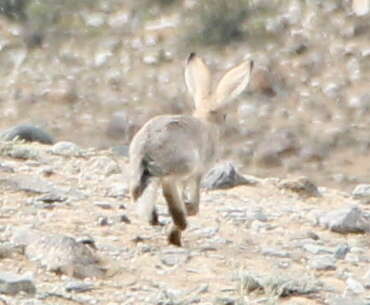
The desert hare (Lepus tibetanus) is a species of hare found in Central Asia, Northwest China, and the western Indian subcontinent. It is a slender, sandy brown hare with black-tipped, tufted ears. It is an herbivore that feeds on roots, seeds, foliage, stems, berries, and the occasional cactus. It inhabits grassland, scrub areas of desert and semi-desert, and steppe habitats. The desert hare is most active during dusk, otherwise resting in a shallow depression or the burrow of another animal. Females produce 3 to 10 young in each litter, of which they may have up to three annually.
It is closely related to the Yarkand hare, with which it interbreeds and forms a hybrid species in regions near the Pamir Mountains. There has been much confusion regarding the taxonomy of the desert hare from the 1930s onwards due to the species complex present in the Cape hare species. China and the International Union for Conservation of Nature has assessed the desert hare as a least-concern species due to its wide distribution and a lack of evidence that its population is declining. Potential threats include human population expansion and hunting for food.
Excerpted from Wikipedia’s “desert hare” article, available under the CC BY-SA 4.0 licence.