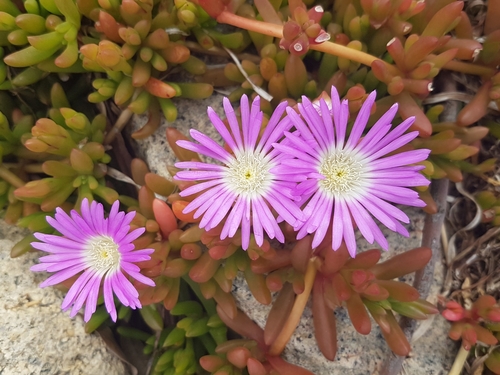
(c) Kaitlyn, some rights reserved (CC BY-NC), uploaded by Kaitlyn · cc-by-nc
Disphyma
Sign in to saveDisphyma is a genus of flowering plants in the family Aizoaceae that are native to New Zealand, Australia, and the Cape Provinces of South Africa. Plants in this genus are prostrate, annual or short-lived perennial shrubs with succulent leaves and daisy-like flowers arranged singly on the ends of shoots with petal-like staminodes, many stamens and usually five styles.
In the Vinony graph
Within Vinony's link graph, Disphyma is referenced by 28 other articles, and connects out to plant, Carl Linnaeus and Wikidata.
It sits within the topics Aizoaceae, Aizoaceae genera and Flora of Australia.
Its subject is documented across 14 Wikipedia language editions.
Species
Purple Dewplant
GENUS
- KingdomPlantae
- PhylumTracheophyta
- ClassMagnoliopsida
- OrderCaryophyllales
- FamilyAizoaceae
Disphyma is een geslacht van succulente struiken uit de ijskruidfamilie (Aizoaceae). Het geslacht telt slechts een soort die voorkomt in Zuid-Afrika, Australië en Nieuw-Zeeland.
via GBIF · Kew POWO
Museum specimens
- Specimen records
- 9
- With media
- 8
- Family
- Aizoaceae
- Collections
- UNIVERSITY OF ALBERTA MUSEUMS, CAS, US, MEL, RSA, MO
- Recorded in
- Australia, United States, New Zealand, South Africa
Wikidata facts
Show 6 more facts
- taxon name
- Disphyma
- taxon rank
- genus
- topic's main category
- Category:Disphyma
- Commons category
- Disphyma
- taxonomic type
- Disphyma crassifolium
Sources (1)
via Wikidata · CC0
~2 min read
Encyclopedic overview
3 sectionsContents
- Description
- Taxonomy
- References
Disphyma is a genus of flowering plants in the family Aizoaceae that are native to New Zealand, Australia, and the Cape Provinces of South Africa. Plants in this genus are prostrate, annual or short-lived perennial shrubs with succulent leaves and daisy-like flowers arranged singly on the ends of shoots with petal-like staminodes, many stamens and usually five styles.
==Description== Plants in the genus Disphyma are prostrate, annual plants or short-lived perennials with branches that root at nodes. The leaves are arranged alternately and fused at the base, succulent and round to more or less triangular in cross-section. The flowers are usually arranged singly, sometimes in pairs or three, on the ends of branches or on short side shoots, each flower on a pedicel up to long. The perianth is tube-shaped with five sepals, two larger and leaf-like and three smaller, slightly succulent and not leaf-like. There are many petal-like, purplish staminodes in two rows and many stamens in four or five rows. The ovary is inferior and there are usually five styles. The fruit is a capsule.
Excerpted from Wikipedia’s “Disphyma” article, available under the CC BY-SA 4.0 licence.