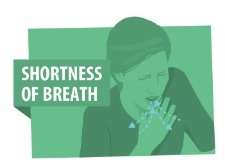
File:SymptomsFeverCoughSOB_(cropped).jpg · Wikimedia Commons · See Wikimedia Commons
dyspnea
Sign in to saveAlso known as dyspnoea, breathlessness, shortness of breath
feelings associated with impaired breathing
Dyspnea is the medical term for the uncomfortable sensation of having difficulty breathing or feeling short of breath. It matters because it can signal underlying health problems and significantly affect a person's quality of life and ability to function.
AI-generated from the Wikipedia summary — may contain errors.
Research
82,788 papers- [Differentiation of dyspnea in patients with asthma and lung sarcoidosis].ReviewPolski merkuriusz lekarski : organ Polskiego Towarzystwa Lekarskiego · 2018Płusa T
- Dyspnoea: Pathophysiology and a clinical approach.ReviewSouth African medical journal = Suid-Afrikaanse tydskrif vir geneeskunde · 2016Coccia CB, Palkowski GH, Schweitzer B et al.DOI: 10.7196/samj.2016.v106i1.10324
- Multidimensional Dyspnea Profile: an instrument for clinical and laboratory research.ReviewThe European respiratory journal · 2015Banzett RB, O'Donnell CR, Guilfoyle TE et al.DOI: 10.1183/09031936.00038914
- [Quantifying dyspnea].ReviewPresse medicale (Paris, France : 1983) · 1994Noseda A, Yernault JC
- [Dyspnoea].Nederlands tijdschrift voor geneeskunde · 2022Makowska AM, Jorstad HT, van den Brink RBA et al.
- [Dyspnea remains a complicated medical (clinical) problem].ReviewCasopis lekaru ceskych · 2000Smejkal V
- The role of invasive cardiopulmonary exercise testing in patients with unexplained dyspnea: a systemic review.Acta cardiologica · 2023Behrooz L, Barillas-Lara M, Fattouh M et al.DOI: 10.1080/00015385.2022.2141434
- [Unexplained dyspnoea].ReviewUgeskrift for laeger · 2019Wolsk E, Rossing K, Carlsen J et al.
via PubMed
Wikidata facts
- Instance of
- symptom or sign
- Image
- SymptomsFeverCoughSOB (cropped).jpg
Show 8 more facts
- Commons category
- Dyspnea
- ICPC 2 ID
- R02
- drug or therapy used for treatment
- morphine
- health specialty
- pulmonology
- ICD-9-CM
- 786.09
- exact match
- purl.obolibrary.org/obo/SYMP_0019153
- on focus list of Wikimedia project
- WikiProject COVID-19
- NCI Thesaurus ID
- C2998
Sources (3)
via Wikidata · CC0
~21 min read
Encyclopedic overview
Shortness of breath (SOB), known as dyspnea (in AmE) or dyspnoea (in BrE), is an uncomfortable feeling of not being able to breathe well enough. The American Thoracic Society defines it as "a subjective experience of breathing discomfort that consists of qualitatively distinct sensations that vary in intensity", and recommends evaluating dyspnea by assessing the intensity of its distinct sensations, the degree of distress and discomfort involved, and its burden or impact on the patient's activities of daily living. Distinct sensations include effort/work to breathe, chest tightness or pain, and "air hunger" (the feeling of not enough oxygen). The tripod position is often assumed to be a sign.
Dyspnea is a normal symptom of heavy physical exertion but becomes pathological if it occurs in unexpected situations, when resting or during light exertion. In 85% of cases it is due to asthma, pneumonia, Laryngopharyngeal reflux, cardiac ischemia, COVID-19, interstitial lung disease, congestive heart failure, chronic obstructive pulmonary disease, or psychogenic causes, such as panic disorder and anxiety . The best treatment to relieve or even remove shortness of breath typically depends on the underlying cause.
Excerpted from Wikipedia’s “dyspnea” article, available under the CC BY-SA 4.0 licence.
Gallery (2)
Available in 72 languages
- Español
- Français
- Deutsch
- 中文
- 日本語
- Русский
- Português
- Italiano
- العربية
- हिन्दी
- Albanian
- Armenian
- Asturian
- Azerbaijani
- Bahasa Indonesia
- Bangla
- Basque
- be_x_old
Show 53 more
- Belarusian
- Bosnian
- Catalan
- Central Kurdish
- Czech
- Danish
- Divehi
- Esperanto
- Finnish
- Galician
- Georgian
- Greek
- Guarani
- Hebrew
- Hungarian
- Icelandic
- Igbo
- Kabyle
- Kannada
- Kazakh
- Kyrgyz
- Latvian
- Malay
- Nederlands
- Norwegian
- Norwegian Nynorsk
- Odia
- Pashto
- Polski
- Quechua
- Romanian
- Serbian
- Serbian (Latin)
- simple
- Sindhi
- Sinhala
- Slovak
- Slovenian
- Svenska
- Telugu
- Tibetan
- Tiếng Việt
- Türkçe
- Ukrainian
- Uzbek
- Walloon
- Welsh
- Wu Chinese
- zh_yue
- Zulu
- فارسی
- ไทย
- 한국어
via Wikidata sitelinks · CC0