File:Basic_Female_Reproductive_System_(English).svg · Wikimedia Commons · See Wikimedia Commons
endometrium
Sign in to saveThe endometrium is the inner epithelial layer, along with its mucous membrane, of the mammalian uterus. It has a basal layer and a functional layer: the basal layer contains stem cells which regenerate the functional layer. The functional layer thickens and then is shed during menstruation in humans and some other mammals, including other apes, Old World monkeys, some species of bat, the elephant shrew and the Cairo spiny mouse. In most other mammals, the endometrium is reabsorbed in the estrous cycle. During pregnancy, the glands and blood vessels in the endometrium further increase in size a
Key facts
- Anatomy.Name
- Endometrium
- Anatomy.Latin
- tunica mucosa uteri
- Anatomy.Image
- Basic_Female_Reproductive_System_(English).svg
- Anatomy.Caption
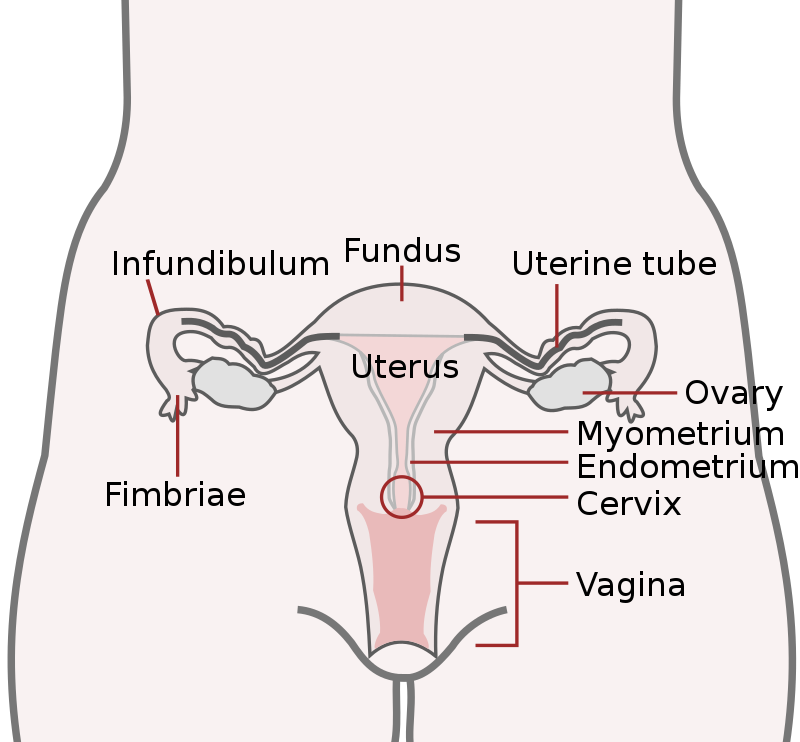
- Uterus and fallopian tubes (uterine tubes). (Endometrium labeled at center right.)
- Anatomy.Image2
- Proliferative phase endometrium -- high mag.jpg
- Anatomy.Caption2
- Endometrium in the proliferative phase
- Anatomy.Part_of
- Uterus
via Wikipedia infobox
Research
55,424 papers- Cellular Senescence in Endometrium: A Pivotal Regulator in Physiological Remodeling and Pathological Disorders.International journal of biological sciences · 2025
- Endometrium procurement and transplantation restores fertility in rats.Reproductive biomedicine online · 2024
- Pathogenesis of endometrium-related diseases based on genomic alterations in normal uterine endometrium.The journal of obstetrics and gynaecology research · 2023
- A review of in vivo and in vitro studies of the mare endometrium.Animal reproduction science · 2020
- In vitro models of the human endometrium: evolution and application for women's health.Biology of reproduction · 2021
via PubMed
Wikidata facts
- Part of
- uterus
- Image
- Illu cervix tr.svg
Show 1 more fact
- Commons category
- Endometrium
Sources (8)
via Wikidata · CC0
~14 min read
Encyclopedic overview
13 sectionsContents
- Structure
- Gene and protein expression
- Microbiome speculation
- Function
- Cycle
- Diseases related with endometrium
- Embryo transfer
- Endometrial protection
- Endometrial receptivity
- Additional images
- See also
- References
- External links
The endometrium is the inner epithelial layer, along with its mucous membrane, of the mammalian uterus. It has a basal layer and a functional layer: the basal layer contains stem cells which regenerate the functional layer. The functional layer thickens and then is shed during menstruation in humans and some other mammals, including other apes, Old World monkeys, some species of bat, the elephant shrew and the Cairo spiny mouse. In most other mammals, the endometrium is reabsorbed in the estrous cycle. During pregnancy, the glands and blood vessels in the endometrium further increase in size and number. Vascular spaces fuse and become interconnected, forming the placenta, which supplies oxygen and nutrition to the embryo and fetus. The speculated presence of an endometrial microbiota has been argued against.
==Structure== thumb|Histology of the most superficial layer of the endometrium, consisting of a simple columnar epithelium. H&E stain thumb|right|High magnification micrograph of decidualized endometrium due to exogenous [[progesterone (oral contraceptive pill). H&E stain]] thumb|right|Low magnification micrograph of decidualized endometrium. H&E stain
Excerpted from Wikipedia’s “endometrium” article, available under the CC BY-SA 4.0 licence.