
Estonia
Sign in to saveAlso known as Republic of Estonia, Estland, Eesti, ee, Eesti Vabariik
Estonia, officially the Republic of Estonia, is a country in the Baltic region of Northern Europe. It is bordered to the north by the Gulf of Finland across from Finland, to the west by the Baltic Sea across from Sweden, to the south by Latvia, and to the east by Russia. The territory of Estonia consists of the mainland, the larger islands of Saaremaa and Hiiumaa, and over 2,300 other islands and islets on the east coast of the Baltic Sea. Its capital city of Tallinn, along with the city of Tartu, are the country's two largest urban areas. The Estonian language, of the Finnic family, is the of
OverviewAI-generated
Estonia, officially the Republic of Estonia, is a country located in Northern Europe. Its capital is Tallinn. The nation is situated near the Baltic Sea and Lake Peipus. It has a population of 1,369,995 according to REST Countries data, while other sources list figures such as 1,572,916 and 1,372,341. The country covers an area of 45,227 square kilometers. Its official language is Estonian, and it uses the euro as currency.
The government is a parliamentary republic. The legislative body is the Riigikogu, and the head of government holds the office of Prime Minister of Estonia. Estonia shares diplomatic relations with Italy, Belarusian People's Republic, Australia, and Ukraine. It replaced the Livonia Governorate, Estonia Governorate, Pskov Governorate, and Soviet Union. The country is characterized as a free country. Its emergency phone number is 112.
Synthesized by Vinony from 67 facts across 9 sources: Wikidata, REST Countries, Open Meteo, Openweathermap, World Bank, OpenStreetMap, PubMed, Vinony graph, Geo. Generated from structured data (not the Wikipedia text) and checked against those facts — may still contain errors.
Weather now
cached 183h ago7-day forecast
via Open-Meteo
Country

- Capital
- Tallinn
- Population
- 1,369,995
- Region
- Europe · Northern Europe
- Demonym
- Estonian
- Currencies
- EUR (€)
- Languages
- Estonian
- Calling code
- +372
- Drives on
- Right
- Gini
- 30.3 (2018)
- FIFA code
- EST
- TLD
- .ee
- Timezones
- UTC+02:00
- Borders
- LVA, RUS
via REST Countries
Indicators · World Bank
- GDP
- $43.1B(2024)
- Population
- 1,372,341(2024)
- Life expectancy
- 79.3 yrs(2024)
- Unemployment
- 8.3 %(2025)
- Urban population
- 70.7 %(2024)
- Internet users
- 92.2 %(2024)
- Forest area
- 57.1 %(2023)
- Renewable energy
- 38 %(2021)
via World Bank Open Data · CC BY 4.0
Wikipedia views (30d)
135,631 totalvia Wikimedia Pageviews API
Key facts
- Country.HDI_rank
- 36th
- Country.HDI_year
- 2023
- Country.conventional_long_name
- Republic of Estonia
- Country.common_name
- Estonia
- Country.image_flag
- Flag of Estonia.svg
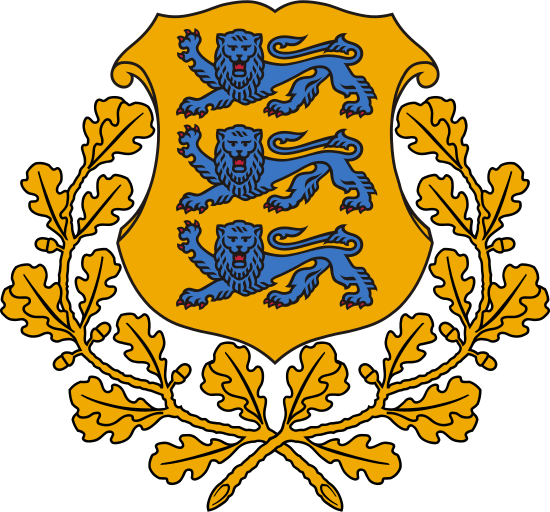
- Country.image_coat
- Coat of arms of Estonia.svg
- Country.symbol_width
- 88px
- Country.national_anthem
- ()
- Country.image_map
- EU-Estonia.svg
- Country.capital
- Tallinn
- Country.largest_city
- capital
- Country.languages_type
- Official language
- Country.languages
- Estonian
- Country.demonym
- Estonian
- Country.ethnic_groups_year
- 2025
- Country.religion
- 58.4% no religion 26.7% Christianity 16.3% Eastern Orthodoxy 7.7% Lutheranism 2.7% other Christian 12.7% undeclared 2.1% other
- Country.religion_year
- 2021
- Country.government_type
- Unitary parliamentary republic
via Wikipedia infobox
Research
21,894 papers- Lung Cancer in Estonia.Journal of thoracic oncology : official publication of the International Association for the Study of Lung Cancer · 2024Laisaar T, Innos K, Jaal J et al.DOI: 10.1016/j.jtho.2024.04.017
- Estonia: Health System Review.Health systems in transition · 2023Kasekamp K, Habicht T, Võrk A et al.
- Estonia.Practical neurology · 2015Rannikmäe KDOI: 10.1136/practneurol-2014-001058
- Pharmacology in Estonia, Latvia and Lithuania: From historical roots to nowadays achievements.ReviewPharmacological research · 2016Jansone B, Kuum M, Maciulaitis RDOI: 10.1016/j.phrs.2016.04.024
- Biobanking in Estonia.The Journal of law, medicine & ethics : a journal of the American Society of Law, Medicine & Ethics · 2016Keis ADOI: 10.1177/1073110516644186
- Alcohol consumption and alcohol policy in Estonia 2000-2017 in the context of Baltic and Nordic countries.ReviewDrug and alcohol review · 2020Pärna KDOI: 10.1111/dar.13008
- HIV epidemic in Estonia in the third decade of the AIDS era.ReviewScandinavian journal of infectious diseases · 2006Rüütel K, Uusküla ADOI: 10.1080/00365540500388743
- Rediscovering the mosquito fauna (Diptera: Culicidae) of Estonia: an annotated checklist with distribution maps and DNA evidence.ReviewZootaxa · 2022Kirik H, Tummeleht L, Kurina ODOI: 10.11646/zootaxa.5094.2.3
via PubMed
Travel guide
Understand
thumb|220px|right|Medieval city wall in [[Tallinn]]
Some visitors tend to see the Baltic states as being similar countries with regional differences. They share a common recent history: the three countries declared independence in 1918 at the collapse of the Russian Empire, were occupied by the Soviet Union in 1940, by Nazi Germany in 1941, and again by the Soviet Union from 1944 until independence was restored in 1991. However, there are differences between the countries' languages (Estonians speak a Finnic language unlike Latvia or Lithuania) and religion (Estonians are irreligious, Latvians are mostly Lutherans, and Lithuanians are Catholics). Also, Estonia is more oriented towards Northern Europe, while Lithuania is oriented towards Central Europe.
Tourism to Estonia has been growing, with statistics showing a jump from 1.8 million to 6 million foreign visitors between 2005 and 2015.
Get around
In Estonia, the public transport system is well-developed.
As of July 1, 2018, Estonia will have created the largest 24/7 free public transit zone in the world for local residents.
See
thumb|300px|Raekoja plats, the town square beside Tartu Town Hall in the Tartu Old Town at Christmas
Do
Frisbee — Frisbee seems to be the secret sport of Estonians. You will find many places, especially in rural areas, where the disc golf baskets can be found. So, bring a Frisbee. Hiking — There are at least three national parks in Estonia worth a day or two of hiking. Check them out. Otherwise, there are many areas where hiking and putting up a tent near the sea can be worthwhile. The forest administration has marked several hiking trails spanning north to south and east to west. Much like in the Nordic countries, in Estonia you can freely roam in the nature, but the rules are slightly stricter here. For instance, camping outside designated camping areas always requires permission from the landowner (private land) or local forest surveillance officer (public land). See Hiking in Estonia for more info. Birdwatching — Especially in West Estonia and Islands, there are numerous viewing platform to enjoy bird watching in spring or fall when birds move from one continent to the other. Self-guided tours — A good way to discover Estonia by yourself. For more information visit the interactive maps sections on the official tourism website. Swim in the bogs — Nature parks like the Lahemaa National Park are full of black and beautiful bogs that are also possible to swim in. Take a dip if you dare and it is warm enough, but always know how to get out again. Football — Ten clubs play soccer in Meistriliiga, the country's top tier; five of them are based in Tallinn. The national team play ho…
Eat
thumbnail|300px|right|Typical Baltic dark bread at a farmer's market Estonian food draws heavily from German, Russian and Nordic cuisine: traditional dishes are heavy meat-cabbage-and-potatoes fare, with lashings of dairy and fish.
The closest thing to a national dish is verivorst pig's blood sausage, similar to English black pudding and Finnish mustamakkara, a common winter dish particularly popular around Christmas. It's always accompanied by lingonberry jam and often served with mulgikapsad, which is basically sauerkraut stew.
Many types of food are similar to Russian dishes and have their equivalents almost exclusively in the former USSR, such as hapukoor, (lit. "sour cream", smetana in Russian), a sour 20%-fat milk dressing for salads, especially kartulisalat potato salad.
As Estonia used to be a food mass-production powerhouse in the times of the USSR, some of its foods, unknown to Westerners, are still well-recognized in the former Soviet Union. This is also true the other way around; in Estonian grocery stores products from countries of the former Soviet Union like Georgian mineral water are widely available.
Among other everyday food, some game products are offered in food stores in Estonia, mostly wild boar, elk sausages and deer. Some restaurants also offer bear meat.
For those with a sweet tooth, the national chocolate manufacturer is Kalev, with many specialist stores around the country as well as supermarkets retailing the product. The more adventurous may…
Drink
thumbnail|300px|right|Windmills are a symbol of Saaremaa, and they're also depicted on Saaremaa Vodka bottles Tap water is drinkable everywhere except where it says it isn’t.
Estonians know their alcohol. Favorite tipples include the local beer Saku, or A. Le Coq, the local vodka brands Viru Valge (Vironian White) and Saaremaa Vodka and the surprisingly smooth and tasty rum-like herbal liquor Vana Tallinn (Old Tallinn), famous in the countries of former USSR. Public drinking is illegal.
Kali is the Estonian equivalent of the Russian kvass, a very mildly alcoholic (~1%) drink made from fermented brown bread. Many locals also swear by keefir, a yogurt-like fermented milk drink similar to buttermilk.
Sleep
The number of hotels has exploded from a few to tens and hundreds after the reestablishment of Estonian independence. In 2004, Tallinn achieved first place among the Baltic Sea cities in the number of overnight stays in hotels, though still behind Stockholm and Helsinki in the number of total overnight stays.
As Soviet collective farms were disbanded, many farmers switched to running "turismitalud" or tourism farms, which are inexpensive and indispensable places for spending holidays in the nature, usually in a former farm house. Estonian Rural Tourism provides information on the tourism farms in Estonia. Hostels are another popular option for budget-sensitive travellers; see the website of the Estonian Youth Hostel Association.
Often accommodations give a discount if you book with them directly (e.g. phone) instead of using one of the monopolistic online middle men. This is due to the reason that most accommodations in Estonia can be booked without credit card anyhow. So, there is no real guarantee that someone does turn up. Just that via phone owners are at least not stuck with an online fee without receiving the room rent.
Camping is allowed virtually anywhere, except on private property. Some tourists have even camped in the city parks of Tartu because locals told them so. Otherwise, if you do not have a tent, some national parks (like Lahemaa) have observation towers with roof and space for up to 10 people at night.
Stay safe
Estonia has managed to avoid much of the crime and insecurity that has plagued many former Soviet Republics following the collapse of the USSR, and today it is among the safest European countries. Criminal activities are distributed unevenly across the territory with almost no crime in the island areas, modest petty crime in urban areas, and a considerable rate of drug dealing in the predominantly Russian-speaking industrial area of North-East.
In Tallinn, petty crime is a problem and there are some incidents involving tourists, mainly pickpocketing (especially in the markets). However, nowadays Tallinn's Old City and other main tourist attractions are closely watched by local police and private security companies.
Many Estonians are careless, reckless drivers. The number of deaths in traffic related accidents per 100,000 people are similar to South-European countries like Portugal or Italy. Estonia has strict drink-driving laws with a policy of zero tolerance, but accidents involving intoxicated drivers are nevertheless a major problem. Estonian traffic laws requires headlights to be used at all times while driving and use of seat belts by all passengers is mandatory.
Estonian law requires pedestrians to wear small reflectors, which people generally pin to their coats or handbags. Although this law is rarely enforced in cities, reflectors are very important in rural areas where it may be difficult for motorists to see pedestrians, especially in winter months. Violators of…
Stay healthy
thumb|250px|Sosnowsky's Hogweed For an Estonian, it is considered mauvais ton not to criticize the Estonian healthcare system. EU studies have shown, however, that Estonia occupies a healthy 4th place in the block by the basic public health service indicators, on the same level as Sweden. Around 1998-2000, the Estonian healthcare system was remodelled from the obsolete USSR model, directed to coping with disastrous consequences of large-scale war and made more up-to-date by the experts from Sweden. Estonia has harmonized its rules on travellers' health insurance with EU requirements. Information about health care in Estonia is provided by the government agency Eesti Haigekassa.
For fast aid or rescue, dial 112.
Estonia had Europe's second highest rate of adult HIV/AIDS infections, over 1.3% or 1 in 77 adults (2013), 28 adults per year 2019 . Generally, the rate is much higher in Russian-speaking regions like Narva or Sillamäe. Don't make the situation worse by not protecting yourself and others.
Ticks spread diseases like viral encephalitis and Lyme disease, which can be transmitted to humans, their season usually starts in April and lasts till October.
Beware of poisonous plants like Sosnowsky's Hogweed and Giant Hogweed. Wear protective clothes and goggles. If burned, clean your skin with water and soap and protect it from the sun for at least 48 hours.
Tap water is usually drinkable, though some people prefer bottled water.
Respect
Estonians can be mistaken as somewhat unwelcoming at first. This is just a matter of culture; Estonians generally do not open up to people they don't know that well. As in most places around the former USSR, smiling is traditionally reserved for friends; smile at a stranger and they will either think you're making fun of them and/or there's something wrong with their clothes or hairdo. Furthermore, an automatic Western smile is often regarded as insincere.
Estonians tend to keep their physical distance. If there is a "long time - no see" situation, then a hug may be suitable. Standing too close to someone can make someone feel uncomfortable.
A decent, quiet conversation is the Estonian way of doing business; a loud conversation is not. Don't be surprised if an Estonian takes time to formulate a response to whatever you've said; Estonians prefer to think before they act and they expect you to do the same.
Be genuine and authentic; accountability and responsibility are pillars of Estonian culture. Don't say "next time" if you know there isn't going to be a "next time".
Estonians tend to value their privacy and personal space, and they may not be as forthcoming or interested in discussing personal matters with strangers or acquaintances. This can sometimes be perceived as cold or distant, but it is simply a reflection of the cultural emphasis on privacy and personal boundaries.
Like Lithuania and Latvia, Estonians are usually very proud of their nation and their countr…
Travel guide from Wikivoyage (CC BY-SA 4.0)
~40 min read
Encyclopedic overview
48 sectionsContents
- Name
- History
- Prehistory
- The Viking Age
- Christianisation and the Middle Ages
- Swedish and Russian rule
- National awakening and independence
- Occupations
- Independence restored
- Geography
- Climate
- Biodiversity
- Government and politics
- Administrative divisions
- Law
- Foreign relations
- Military
- Economy
- Public policy
- Transport
- Natural resources and mining
- Energy
- Wind power
- Nuclear power
- Power market
- Agriculture, fishery and forestry
- Industry and services
- Science and technology
- Demographics
- Urbanization
- Religion
- Languages
- Education
- Culture
- Music and dance
- Mythology and folklore
- Literature
- Art
- Architecture
- Theatre, cinema and animation
- Media
- Cuisine
- Sports
- See also
- Notes
- References
- External links
- Government
Estonia, officially the Republic of Estonia, is a country in the Baltic region of Northern Europe. It is bordered to the north by the Gulf of Finland across from Finland, to the west by the Baltic Sea across from Sweden, to the south by Latvia, and to the east by Russia. The territory of Estonia consists of the mainland, the larger islands of Saaremaa and Hiiumaa, and over 2,300 other islands and islets on the east coast of the Baltic Sea. Its capital city of Tallinn, along with the city of Tartu, are the country's two largest urban areas. The Estonian language, of the Finnic family, is the official language and the first language of the majority of nearly 1.4 million people. Estonia is one of the least populous member states of the European Union.
Present-day Estonia has been inhabited since at least 9,000 BC. The medieval indigenous population of Estonia was one of the last pagan civilisations in Europe to adopt Christianity following the Northern Crusades in the 13th century. After centuries of foreign rule by the Teutonic Order, Denmark, Poland, Sweden, and the Russian Empire, a distinct Estonian national identity gained new momentum with the Age of Awakening in the mid-19th century. This culminated in the 1918 Estonian Declaration of Independence. Democratic throughout most of the interwar period, Estonia declared neutrality at the outbreak of World War II, but the country was repeatedly invaded and occupied, and ultimately annexed into the USSR. Throughout the de facto Soviet occupation, from World War II until 1991, Estonia's de jure state continuity was preserved by diplomatic representatives and the government-in-exile. Following the 1988–1990 "Singing Revolution" against Soviet rule, full independence was restored on 20 August 1991, and the country joined NATO and the European Union in 2004.
Excerpted from Wikipedia’s “Estonia” article, available under the CC BY-SA 4.0 licence.
Gallery (39)
On the map
4 mapped locations
Available in 292 languages
- Español
- Français
- Deutsch
- 中文
- 日本語
- Русский
- Português
- Italiano
- العربية
- हिन्दी
- Abkhazian
- abstract
- Acehnese
- Adyghe
- Afrikaans
- Akan
- Albanian
- Albanian
Show 273 more
- Amharic
- ami
- Angika
- Aragonese
- Aramaic
- Armenian
- Arpitan
- Asturian
- Avaric
- Awadhi
- Aymara
- azb
- Azerbaijani
- Bahasa Indonesia
- Balinese
- Bambara
- Bangla
- Bashkir
- Basque
- bat_smg
- Batak Toba
- Bavarian
- be_x_old
- Belarusian
- Betawi
- Bhojpuri
- Bikol
- Bishnupriya
- Bislama
- Bosnian
- Breton
- Bulgarian
- Buriat
- Burmese
- Catalan
- cbk_zam
- cdo
- Cebuano
- Central Kurdish
- Chamorro
- Chechen
- Cherokee
- Church Slavic
- Chuvash
- Colognian
- Cornish
- Corsican
- Crimean Tatar
- Croatian
- Czech
- dag
- Danish
- Dinka
- dty
- Dzongkha
- Egyptian Arabic
- eml
- Erzya
- Esperanto
- Estonian
- Ewe
- Extremaduran
- Faroese
- Fiji Hindi
- Filipino
- Finnish
- fiu_vro
- Friulian
- Fula
- Gagauz
- Galician
- Ganda
- gcr
- Georgian
- Gilaki
- Gothic
- Greek
- Guarani
- Gujarati
- Haitian Creole
- Hakka Chinese
- Hausa
- Hawaiian
- Hebrew
- Hungarian
- hyw
- Iban
- Icelandic
- Ido
- Igbo
- Iloko
- Inari Sami
- Ingush
- Interlingua
- Interlingue
- Irish
- Jamaican Creole English
- Javanese
- Kabardian
- Kabyle
- Kannada
- Kara-Kalpak
- Karachay-Balkar
- Kashmiri
- Kashubian
- Kazakh
- kbp
- kge
- Khmer
- Kinyarwanda
- Komi
- Komi-Permyak
- Kongo
- Konkani
- Kotava
- Kurdish
- Kyrgyz
- Ladino
- Lao
- Latgalian
- Latin
- Latvian
- Lezghian
- Ligurian
- Limburgish
- Lingala
- Lingua Franca Nova
- Lithuanian
- lld
- Lojban
- Lombard
- Low German
- Lower Sorbian
- Luxembourgish
- Macedonian
- Madurese
- Maithili
- Malagasy
- Malay
- Malayalam
- Maltese
- Manipuri
- Manx
- Māori
- map_bms
- Marathi
- Mari
- Mazanderani
- Minangkabau
- Mingrelian
- Mirandese
- Moksha
- Mongolian
- Moroccan Arabic
- Navajo
- nds_nl
- Neapolitan
- Nederlands
- Nepali
- Newari
- Northern Frisian
- Northern Sami
- Northern Sotho
- Norwegian
- Norwegian Nynorsk
- Novial
- nrm
- Nyanja
- Obolo
- Occitan
- Odia
- Old English
- olo
- Oromo
- Ossetic
- Pampanga
- Pangasinan
- Papiamento
- Pashto
- Pennsylvania German
- Picard
- Piedmontese
- Polski
- Pontic
- Punjabi
- Quechua
- roa_rup
- roa_tara
- Romanian
- Romansh
- Romany
- Rusyn
- Samoan
- Sango
- Sanskrit
- Santali
- Sardinian
- Saterland Frisian
- Scots
- Scottish Gaelic
- Serbian
- Serbian (Latin)
- Shan
- Shona
- Sicilian
- Silesian
- simple
- Sindhi
- Sinhala
- Slovak
- Slovenian
- Somali
- Southern Altai
- Southern Sotho
- Sranan Tongo
- Standard Moroccan Tamazight
- Sundanese
- Svenska
- Swahili
- Swati
- szy
- Tachelhit
- Tahitian
- Tajik
- Talysh
- Tamil
- Taroko
- Tatar
- tay
- Telugu
- Tetum
- Tibetan
- Tiếng Việt
- Tok Pisin
- Toki Pona
- Tongan
- Tsonga
- Tumbuka
- Türkçe
- Turkmen
- Udmurt
- Ukrainian
- Upper Sorbian
- Urdu
- Uyghur
- Uzbek
- Venda
- Venetian
- Veps
- Volapük
- Walloon
- Waray
- Welsh
- West Flemish
- Western Frisian
- Western Mari
- Western Panjabi
- Wolof
- Wu Chinese
- Xhosa
- Yakut
- Yiddish
- Yoruba
- Zaza
- Zeelandic
- zh_classical
- zh_min_nan
- zh_yue
- Zhuang
- Zulu
- فارسی
- ไทย
- 한국어
via Wikidata sitelinks · CC0