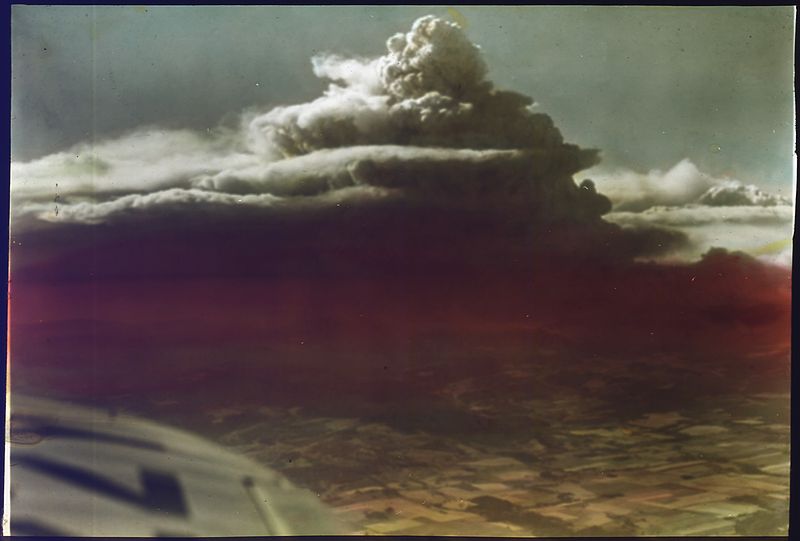
File:View_of_Tillamook_Fire,_Oregon_from_airplane_-_NARA_-_299308.jpg · Wikimedia Commons · See Wikimedia Commons
firestorm
Sign in to saveupright=1.1|right|thumb|A view of one of the Tillamook Burn fires in August 1933
Wikidata facts
- Subclass of
- fire
- Image
- Braunschweig15101944.jpg
Show 2 more facts
- has cause
- conflagration
- Commons category
- Firestorms
Sources (1)
via Wikidata · CC0
~23 min read
Encyclopedic overview
16 sectionsContents
- Mechanism
- Characterization of a firestorm
- Weather and climate effects
- Pyro-cumulonimbus and atmospheric effects (in wildfires)
- Black Saturday firestorm (Wildfire case study)
- Background
- Role that pyroCbs have on fire in case study
- Importance for continued study of these firestorms
- City firestorms
- Firebombing
- 21st-century cities in comparison to World War II cities
- Nuclear weapons in comparison to conventional weapons
- See also
- Potential firestorms
- References
- Further reading
upright=1.1|right|thumb|A view of one of the Tillamook Burn fires in August 1933
A firestorm is a conflagration which attains such intensity that it creates and sustains its own wind system. It is most commonly a natural phenomenon, created during some of the largest bushfires and wildfires. Although the term has been used to describe certain large fires, the phenomenon's determining characteristic is a fire with its own storm-force winds from every point of the compass towards the storm's center, where the air is heated and then ascends.
Excerpted from Wikipedia’s “firestorm” article, available under the CC BY-SA 4.0 licence.