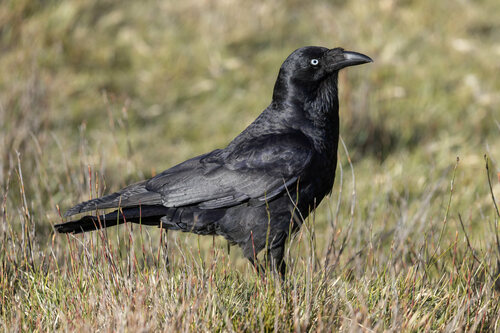
(c) Chris Burney, all rights reserved, uploaded by Chris Burney
Species
Least ConcernForest Raven
species
via IUCN
Wikidata facts
Show 9 more facts
- taxon rank
- species
- IUCN conservation status
- Least Concern
- taxon name
- Corvus tasmanicus
- Commons category
- Corvus tasmanicus
- Commons gallery
- Corvus tasmanicus
- taxon common name
- corvo-da-tasmânia
- endemic to
- Australia
- litter size
- 4.2
- short name
- C. tasmanicus
via Wikidata · CC0
~20 min read
Encyclopedic overview
The forest raven (Corvus tasmanicus), also commonly known as the Tasmanian raven, is a passerine bird in the family Corvidae native to Tasmania and parts of southern Victoria, such as Wilsons Promontory and Portland. Populations are also found in parts of New South Wales, including Dorrigo and Armidale. Measuring 50–53 cm (20–21 in) in length, it has all-black plumage, beak and legs. As with the other two species of raven in Australia, its black feathers have grey bases. Adults have white irises; younger birds have dark brown and then hazel irises with an inner blue rim. New South Wales populations are recognised as a separate subspecies C. tasmanicus boreus, but appear to be nested within the Tasmanian subspecies genetically.
The forest raven lives in a wide variety of habitats in Tasmania but is restricted to more closed forest on mainland Australia. Breeding takes place in spring and summer, occurring later in Tasmania than in New South Wales. The nest is a bowl-shaped structure of sticks sited high in a tree. An omnivorous and opportunistic feeder, the forest raven eats a wide variety of plant and animal material, as well as food waste from urban areas and roadkill. It has been blamed for killing lambs and poultry and raiding orchards in Tasmania, and is unprotected under Tasmanian legislation. The forest raven is sedentary, with pairs generally bonding for life and establishing permanent territories.
Excerpted from Wikipedia’s “Forest Raven” article, available under the CC BY-SA 4.0 licence.