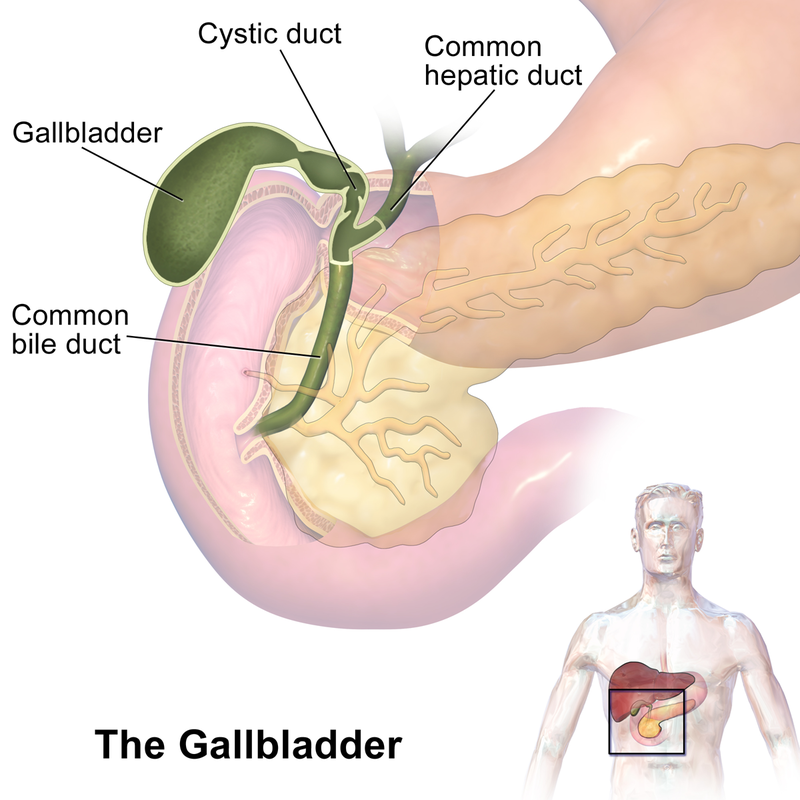
File:Gallbladder_(organ).png · Wikimedia Commons · See Wikimedia Commons
gallbladder
Sign in to saveAlso known as gall bladder, biliary vesicle, cholecyst, Gall bladder
In vertebrates, the gallbladder, also known as the cholecyst, is a small hollow organ where bile is stored and concentrated before it is released into the small intestine. In humans, the pear-shaped gallbladder lies beneath the liver, although the structure and position of the gallbladder can vary significantly among animal species. It receives bile, produced by the liver, via the common hepatic duct, and stores it. The bile is then released via the common bile duct into the duodenum, where the bile helps in the digestion of fats.
Your gallbladder is a small, pear-shaped organ tucked beneath your liver that stores and concentrates bile, a digestive fluid made by your liver. When you eat, your gallbladder releases this bile into your small intestine to help break down fats.
AI-generated from the Wikipedia summary — may contain errors.
Key facts
- Anatomy.Name
- Gallbladder
- Anatomy.Latin
- vesica biliaris, vesica fellea
- Anatomy.Image
- Gallbladder (organ).png
- Anatomy.Caption
- Diagram of human gallbladder
- Anatomy.Image2
- 2425 Gallbladder.jpg
- Anatomy.Caption2
- The gallbladder sits beneath the liver
- Anatomy.Precursor
- Foregut
- Anatomy.System
- Digestive system
- Anatomy.Artery
- Cystic artery
- Anatomy.Vein
- Cystic vein
- Anatomy.Nerve
- Celiac ganglia, vagus nerve
via Wikipedia infobox
Research
54,517 papers- Triple gallbladder: radiological review.Clinical journal of gastroenterology · 2023Picchi E, Leomanni P, Dell'Olio VB et al.DOI: 10.1007/s12328-023-01829-3
- Suprahepatic Gallbladder.ReviewJournal of gastrointestinal surgery : official journal of the Society for Surgery of the Alimentary Tract · 2015Hessey JA, Halpin L, Simo KADOI: 10.1007/s11605-015-2771-x
- Gallbladder duplication: evaluation, treatment, and classification.ReviewJournal of pediatric surgery · 2010Causey MW, Miller S, Fernelius CA et al.DOI: 10.1016/j.jpedsurg.2009.12.015
- Porcelain Gallbladder: A Case Report.Mymensingh medical journal : MMJ · 2019Chowdhury MM, Khan AS, Karim R et al.
- [Gallbladder anomalies--multiple gallbladders].ReviewRyoikibetsu shokogun shirizu · 1996Nakagawara G, Niimoto S
- Gallbladder histological alterations in patients undergoing cholecystectomy for cholelithiasis.Revista do Colegio Brasileiro de Cirurgioes · 2020Holanda AKG, Lima Júnior ZBDOI: 10.1590/0100-6991e-20192279
- Duplicated gallbladder.International surgery · 2014Shiba H, Misawa T, Ito R et al.DOI: 10.9738/INTSURG-D-13-00036.1
- Triple gallbladder with heterotopic gastric mucosa: a case report.BMC pediatrics · 2022Ott L, O'Neill J, Cameron D et al.DOI: 10.1186/s12887-022-03122-7
via PubMed
Wikidata facts
- Part of
- human digestive system
- Follows
- foregut
- Image
- 2425 Gallbladder.jpg
Show 8 more facts
- anatomical location
- abdominal cavity
- Commons category
- Gallbladder
- topic's main category
- Category:Gallbladder
- arterial supply
- cystic artery
- venous drainage
- cystic vein
- innervates
- vagus nerve
- NCI Thesaurus ID
- C12377
Sources (8)
via Wikidata · CC0
~19 min read
Encyclopedic overview
18 sectionsContents
- Structure
- Microanatomy
- Variation
- Development
- Function
- Clinical significance
- Gallstones
- Inflammation
- Gallbladder removal
- Complications
- Cancer
- Tests
- Other animals
- History
- Society and culture
- See also
- References
- External links
In vertebrates, the gallbladder, also known as the cholecyst, is a small hollow organ where bile is stored and concentrated before it is released into the small intestine. In humans, the pear-shaped gallbladder lies beneath the liver, although the structure and position of the gallbladder can vary significantly among animal species. It receives bile, produced by the liver, via the common hepatic duct, and stores it. The bile is then released via the common bile duct into the duodenum, where the bile helps in the digestion of fats.
The gallbladder can be affected by gallstones, formed by material that cannot be dissolved – usually cholesterol or bilirubin, a product of hemoglobin breakdown. These may cause significant pain, particularly in the upper-right corner of the abdomen, and are often treated with removal of the gallbladder (called a cholecystectomy). Inflammation of the gallbladder (called cholecystitis) has a wide range of causes, including the result of gallstone impaction, infection, and autoimmune disease.
Excerpted from Wikipedia’s “gallbladder” article, available under the CC BY-SA 4.0 licence.
Gallery (15)
Available in 101 languages
- Español
- Français
- Deutsch
- 中文
- 日本語
- Русский
- Português
- Italiano
- العربية
- हिन्दी
- Afrikaans
- Aramaic
- Armenian
- Assamese
- Atikamekw
- Azerbaijani
- Bahasa Indonesia
- Bangla
Show 82 more
- Basque
- Belarusian
- Betawi
- Bosnian
- Bulgarian
- Catalan
- cdo
- Chuvash
- Croatian
- Czech
- dag
- Danish
- Divehi
- Egyptian Arabic
- Esperanto
- Estonian
- Filipino
- Finnish
- Galician
- Georgian
- Greek
- Gujarati
- Hebrew
- Hungarian
- hyw
- Icelandic
- Ido
- Irish
- Javanese
- Kannada
- Kashmiri
- Kazakh
- Kurdish
- Kyrgyz
- Latin
- Latvian
- Limburgish
- Lithuanian
- Lombard
- Luxembourgish
- Macedonian
- Malay
- Malayalam
- Maltese
- Marathi
- Nederlands
- Nepali
- Norwegian
- Norwegian Nynorsk
- Odia
- Pashto
- Polski
- Romanian
- Sardinian
- Serbian
- Serbian (Latin)
- Shona
- simple
- Sindhi
- Slovak
- Slovenian
- Sundanese
- Svenska
- Swahili
- Tachelhit
- Tamil
- Tatar
- Telugu
- Tiếng Việt
- Türkçe
- Ukrainian
- Uyghur
- Uzbek
- Waray
- Welsh
- Wu Chinese
- Yiddish
- zh_yue
- Zhuang
- فارسی
- ไทย
- 한국어
via Wikidata sitelinks · CC0