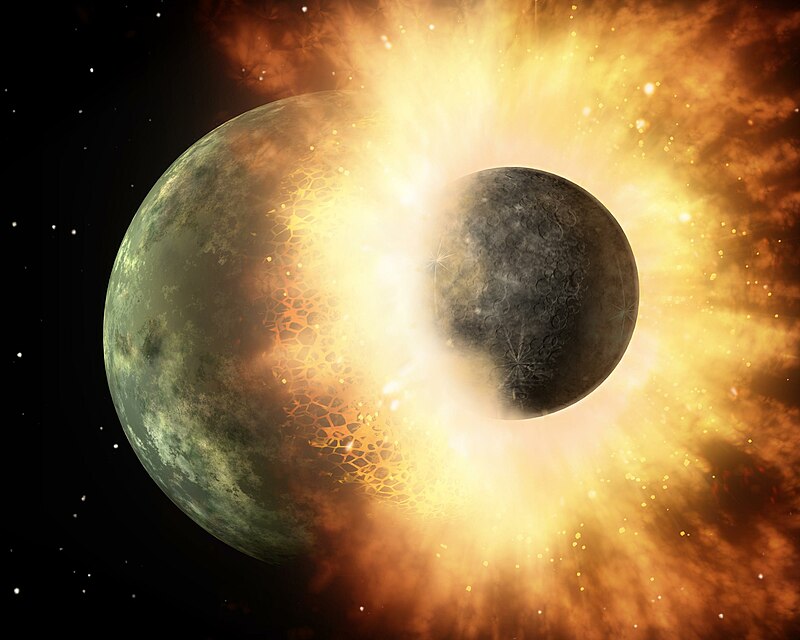
File:Artist's_concept_of_collision_at_HD_172555.jpg · Wikimedia Commons · See Wikimedia Commons
giant impact hypothesis
Sign in to saveAlso known as Theia Impact, Big Splash
theory that the Moon formed out of the debris left over from a collision between Earth and an astronomical body the size of Mars, approximately 4.5 billion years ago
In the Vinony graph
Vinony's link graph records 638 inbound references to giant impact hypothesis, and connects out to Moon, Lagrangian point and trojan.
It sits within the topics Earth sciences, Hypothetical Earth impact events and Lunar science.
Vinony links it to 39 Wikipedia language editions.
Wikidata facts
- Field of work
- origin of the Moon
- Image
- Artist's concept of collision at HD 172555.jpg
Show 3 more facts
- facet of
- Moon
- Commons category
- Big Splash
- Commons gallery
- Big Splash
Sources (1)
via Wikidata · CC0
~29 min read
Encyclopedic overview
Artist's depiction of a collision between two planetary bodies. Such an impact between Earth and a Mars-sized object likely formed the Moon. Animated seismic tomography showing the two large low-shear-velocity provinces (LLSVPs) at the Earth's core–mantle boundary, suspected to be sunken remnants of Theia's mantle
The giant-impact hypothesis, sometimes called the Theia Impact, is an astrogeology hypothesis for the formation of the Moon first proposed in 1946 by Canadian geologist Reginald Daly. The hypothesis suggests that the Proto-Earth collided with a Mars-sized co-orbital protoplanet likely from the L4 or L5 Lagrange points of the Earth's orbit approximately 4.5 billion years ago in the early Hadean eon (about 20 to 100 million years after the Solar System formed), and some of the ejected debris from the impact event later re-accreted to form the Moon. The impactor planet is sometimes called Theia, named after the mythical Greek Titan who was the mother of Selene, the goddess of the Moon.
Excerpted from Wikipedia’s “giant impact hypothesis” article, available under the CC BY-SA 4.0 licence.