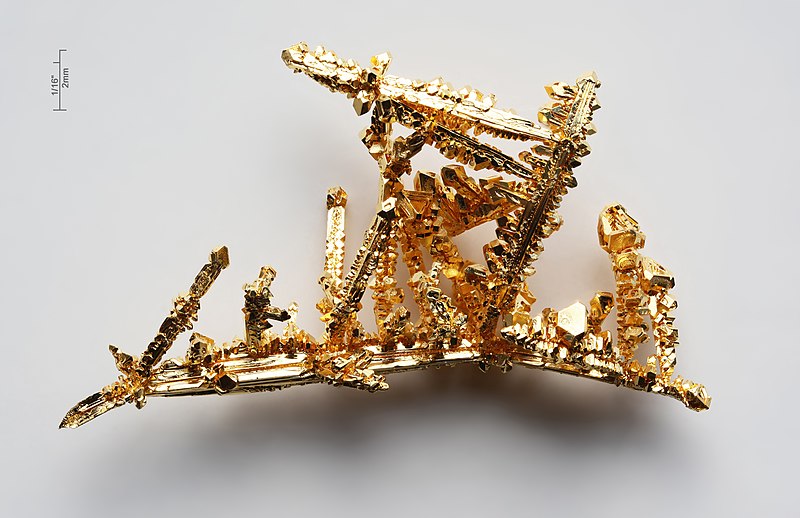
File:Gold-crystals.jpg · Wikimedia Commons · See Wikimedia Commons
Also known as element 79
elemento químico con número atómico 79
OverviewAI-generated
Gold is a chemical element with the symbol Au and atomic number 79. It has a gold color and crystallizes in a cubic crystal system. The element has a mass of 196.96657 and a specific heat capacity of 129.1. It exhibits a thermal conductivity of 295 and a speed of sound of 2030. Gold is distinct from the terms Gold, Or, Oro, and Oru.
The material has a Mohs' hardness of 2.5 and an ultimate tensile strength of 120. Its melting point is 1064.18, and its boiling point is 5378. Gold is used to treat rheumatoid arthritis. It was discovered around 6000 BCE. The element is referenced by 8,510 other encyclopedia articles.
Synthesized by Vinony from 34 facts across 4 sources: Wikidata, PubChem, PubMed, Vinony graph. Generated from structured data (not the Wikipedia text) and checked against those facts — may still contain errors.
Chemical data
- Formula
- Au
- Molecular weight
- 196.96657 g/mol
- IUPAC name
- gold
- SMILES
- [Au]
- InChIKey
- PCHJSUWPFVWCPO-UHFFFAOYSA-N
- Polar surface area
- 0 Ų
- H-bond donors
- 0
- H-bond acceptors
- 0
- Formal charge
- 0
via PubChem
Research
294,507 papers- Gold-based therapy: From past to present.ReviewProceedings of the National Academy of Sciences of the United States of America · 2020Balfourier A, Kolosnjaj-Tabi J, Luciani N et al.DOI: 10.1073/pnas.2007285117
- nanoGold and µGold inhibit autoimmune inflammation: a review.ReviewHistochemistry and cell biology · 2023Danscher G, Rasmussen SDOI: 10.1007/s00418-023-02182-9
- Gold nephropathy.ReviewNephron · 1988Hall CLDOI: 10.1159/000185185
- GOLD: human exposure and update on toxic risks.ReviewCritical reviews in toxicology · 2018Lansdown ABGDOI: 10.1080/10408444.2018.1513991
- The gold complexes.ReviewBailliere's clinical rheumatology · 1990Champion GD, Graham GG, Ziegler JBDOI: 10.1016/s0950-3579(05)80005-6
- Chiral Gold(III) Complexes: Synthesis, Structure, and Potential Applications.ReviewChemistry (Weinheim an der Bergstrasse, Germany) · 2021Jouhannet R, Dagorne S, Blanc A et al.DOI: 10.1002/chem.202100415
- Gold contact allergy: clues and controversies.ReviewDermatitis : contact, atopic, occupational, drug · 2015Chen JK, Lampel HPDOI: 10.1097/DER.0000000000000101
- Gold.Nature · 2013Brody HDOI: 10.1038/495S1a
via PubMed
Wikidata facts
- Instance of
- precious metal
- Subclass of
- noble metal
- Part of
- period 6
- Mass
- 196.96657
- Image
- Gold-crystals.jpg
Show 36 more facts
- atomic number
- 79
- color
- gold
- Commons category
- Gold
- element symbol
- Au
- topic's main category
- Category:Gold
- chemical formula
- Au
- canonical SMILES
- [Au]
- specific heat capacity
- 129.1
- thermal conductivity
- 295
- Commons gallery
- Gold
- described by source
- Pauly–Wissowa
- medical condition treated
- rheumatoid arthritis
- boiling point
- 5378
- time of discovery or invention
- 6000-00-00
- different from
- Mas
- on focus list of Wikimedia project
- Wikipedia:Vital articles/Level/4
- crystal system
- cubic crystal system
- Mohs' hardness
- 2.5
- melting point
- 1064.18
- price
- 5599.90
- speed of sound
- 2030
- ultimate tensile strength
- 120
- tensile modulus of elasticity
- 78
- Poisson's ratio
- 0.4
- thermal diffusivity
- 127
- Thomson Reuters Business Classification
- 51201060
- electrical conductivity
- 45200000
- OpenStreetMap tag
- resource=gold
- Unicode character
- 金
- electronegativity
- 2.54
- total produced
- 3300
- ionic radius
- 0.85
- density
- 19320
- maintained by WikiProject
- WikiProject Anthropology
- 2022 Harmonized System Code
- 710812
- subject has role
- allergen
Sources (14)
via Wikidata · CC0
Article · Español
El oro es un elemento químico cuyo número atómico es 79. Está ubicado en el grupo 11 de la tabla periódica. Es un metal precioso blando de color amarillo dorado. Su símbolo es Au (del latín aurum, ‘brillante amanecer’). Además, es uno de los metales más apreciados en joyería por sus propiedades físicas, al tener baja alterabilidad, ser muy maleable, dúctil y brillante, y valorado por su rareza, al ser un metal difícil de encontrar en la naturaleza. Es un metal de transición blando, brillante, amarillo, pesado, maleable y dúctil. El oro no reacciona con la mayoría de los productos químicos, pero es sensible y soluble al cianuro, al mercurio, al agua regia, al cloro y a la lejía. Este metal se encuentra normalmente en estado puro, en forma de pepitas y depósitos aluviales. Es un elemento que se crea gracias a las condiciones extremas en el núcleo colapsante de las supernovas. Cuando la reacción de una fusión nuclear cesa, las capas superiores de la estrella se desploman sobre el núcleo estelar, comprimiendo y calentando la materia hasta el punto de que los núcleos más ligeros, como por ejemplo el hierro, se fusionan para dar lugar a los metales más pesados (uranio, oro, etc.). Un estudio sugiere que el oro del planeta provino de la colisión de estrellas de neutrones. Los depósitos primarios de oro en la corteza se forman a partir de gases y líquidos muy calientes, metasomáticos, que se elevan desde el interior de la Tierra, los cuales se trasladan a la superficie a través de fallas de la corteza terrestre. En heráldica, representa todo poder económico y es símbolo de vanidad.
Abstract from DBpedia / Wikipedia · CC BY-SA
Gallery (53)
Available in 237 languages
- Español
- Français
- Deutsch
- 中文
- 日本語
- Русский
- Português
- Italiano
- العربية
- हिन्दी
- abstract
- Achinese
- Afrikaans
- Albanian
- Albanian
- Amharic
- Angika
- Aragonese
Show 218 more
- Aramaic
- Armenian
- Assamese
- Asturian
- Avaric
- Aymara
- azb
- Azerbaijani
- Bahasa Indonesia
- Balinese
- Bangla
- Banjar
- Bashkir
- Basque
- bat_smg
- Bavarian
- be_x_old
- Belarusian
- Bhojpuri
- Bikol
- Bosnian
- Breton
- Bulgarian
- Buriat
- Burmese
- Catalan
- cbk_zam
- cdo
- Cebuano
- Central Dusun
- Central Kurdish
- Chamorro
- Cherokee
- Cheyenne
- Church Slavic
- Chuvash
- Colognian
- Cornish
- Corsican
- Crimean Tatar
- Croatian
- Czech
- Danish
- dga
- Egyptian Arabic
- eml
- Erzya
- Esperanto
- Estonian
- Extremaduran
- Faroese
- Fiji Hindi
- Fijian
- Filipino
- Finnish
- fiu_vro
- Friulian
- Galician
- Gan Chinese
- Ganda
- gcr
- Georgian
- Greek
- Guarani
- Gujarati
- Haitian Creole
- Hakka Chinese
- Hausa
- Hebrew
- Hungarian
- hyw
- Iban
- Icelandic
- Ido
- Iloko
- Inari Sami
- Ingush
- Interlingua
- Irish
- Jamaican Creole English
- Javanese
- Kabyle
- Kalmyk
- Kannada
- Kara-Kalpak
- Kashmiri
- Kashubian
- Kazakh
- kbp
- Khmer
- Kikuyu
- Komi
- Komi-Permyak
- Kongo
- Kurdish
- Kyrgyz
- Lao
- Latin
- Latvian
- lbe
- Lezghian
- Ligurian
- Limburgish
- Lingala
- Lithuanian
- lld
- Lojban
- Lombard
- Low German
- Luxembourgish
- Macedonian
- Madurese
- Maithili
- Malagasy
- Malay
- Malayalam
- Manipuri
- Manx
- Marathi
- Mari
- Minangkabau
- Mingrelian
- Mirandese
- mnw
- Moksha
- Mongolian
- Moroccan Arabic
- nah
- Navajo
- nds_nl
- Nederlands
- Nepali
- Newari
- Northern Frisian
- Northern Sami
- Norwegian
- Norwegian Nynorsk
- Novial
- nrm
- Occitan
- Odia
- Old English
- olo
- Oromo
- Ossetic
- Pampanga
- Papiamento
- Pashto
- Piedmontese
- Polski
- Punjabi
- Quechua
- roa_rup
- Romanian
- Romansh
- Rusyn
- Sanskrit
- Santali
- Sardinian
- Saterland Frisian
- Scots
- Scottish Gaelic
- Serbian
- Serbian (Latin)
- Shona
- Sicilian
- simple
- Sindhi
- Sinhala
- Slovak
- Slovenian
- Somali
- Southern Altai
- Sranan Tongo
- Standard Moroccan Tamazight
- Sundanese
- Svenska
- Swahili
- syl
- Tamil
- Tatar
- Telugu
- Tibetan
- Tiếng Việt
- Toki Pona
- Tulu
- Tumbuka
- Türkçe
- Tuvinian
- Tyap
- Ukrainian
- Upper Sorbian
- Urdu
- Uyghur
- Uzbek
- Venetian
- Veps
- Volapük
- Walloon
- Waray
- Welsh
- Western Frisian
- Western Mari
- Western Panjabi
- Wu Chinese
- Xhosa
- Yakut
- Yiddish
- Yoruba
- Zaza
- zh_classical
- zh_min_nan
- zh_yue
- Zhuang
- Zulu
- فارسی
- ไทย
- 한국어
via Wikidata sitelinks · CC0